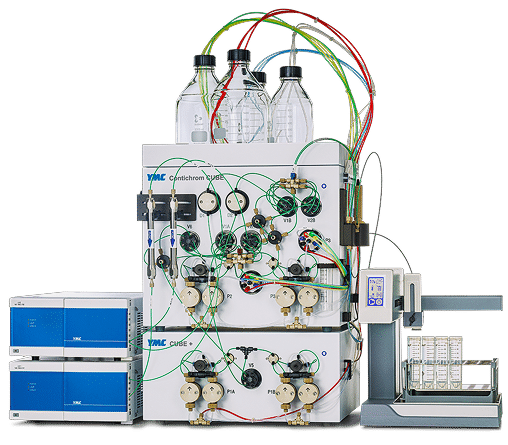
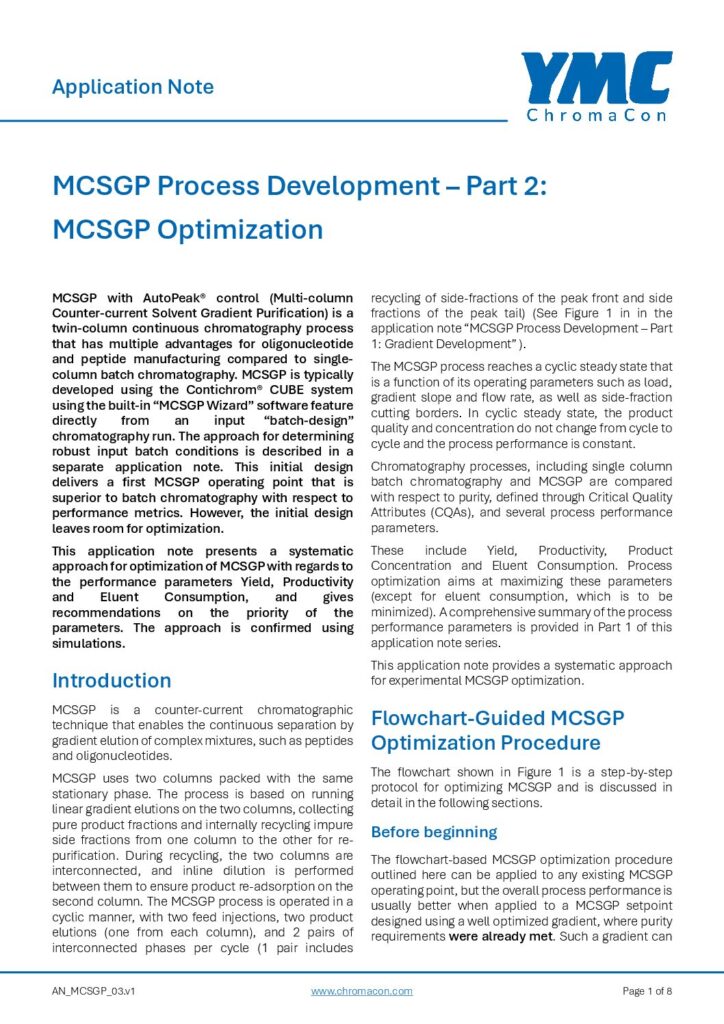
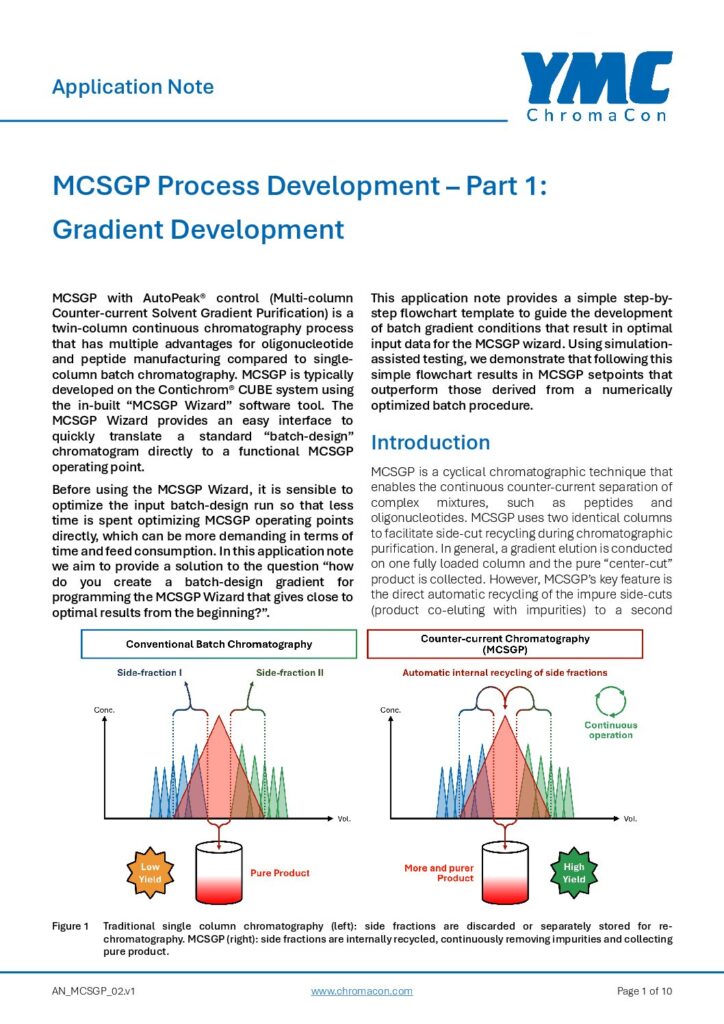
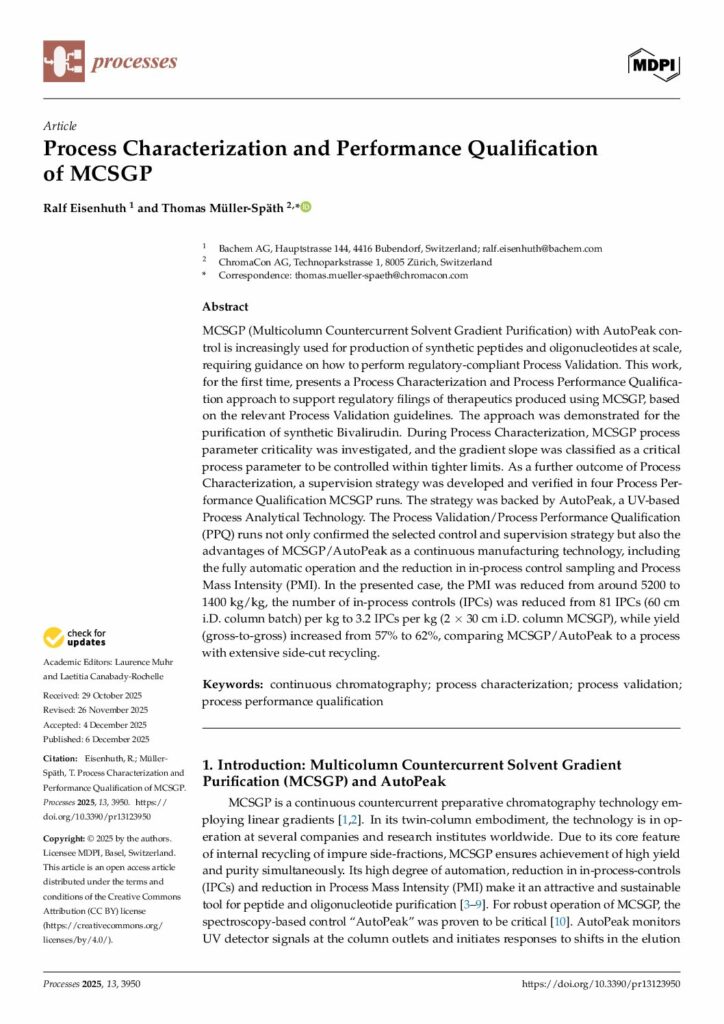
Molecule: Glucagon (29 amino acids, MW 3485 Da), crude synthetic mixture (55% chromatographic purity in feed) Equipment: Contichrom CUBE Combined (ChromaCon/YMC) Mode: RP-HPLC — 10 µm C8 resin; mobile phases: ammonium acetate/ACN gradient
| Parameter |
Batch (25 cm column) |
MCSGP (2 × 15 cm columns) |
| Purity |
89.3% |
89.2% — identical |
| Recovery (Yield) |
71.2% |
87.7% (+23% relative) |
| Productivity |
9.9 g/L/h |
6.1 g/L/h (−38%) |
Key finding: MCSGP increased glucagon recovery by +23% at identical purity (~89%) — from 71.2% to 87.7% — demonstrating that even a process designed from a single batch chromatogram, with no dedicated optimisation, meaningfully improves yield. The 38% productivity reduction is an inherent tradeoff of the interconnected phases; for expensive therapeutic peptides like glucagon, maximising recovery more than compensates for this. The MCSGP process ran fully automated for 5 cycles (steady state achieved after cycle 1), illustrating the method-transfer simplicity of the ChromIQ® MCSGP Wizard workflow.
De Luca, C., Felletti, S., Lievore, G. et al. J. Chromatogr. A, 1625, 461304 (2020). DOI: 10.1016/j.chroma.2020.461304