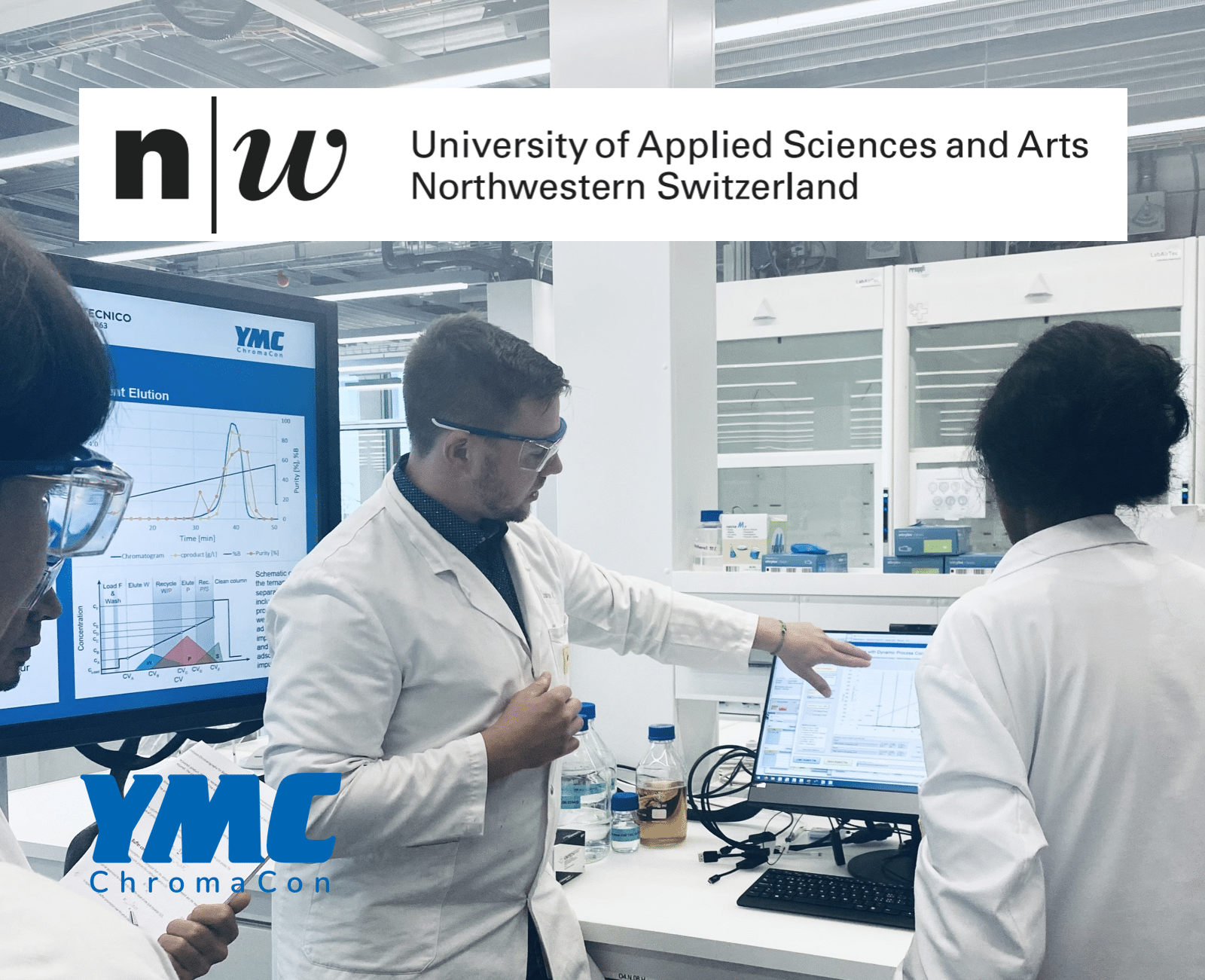
From 7 to 9 September 2027, the FHNW School of Life Sciences hosts a three-day, hands-on seminar on continuous chromatography at its Muttenz campus near Basel, Switzerland. You learn the principles from leading experts in the field and apply them straight away on Contichrom® CUBE twin-column systems, for capture and polishing of mAbs, peptides, oligonucleotides and viral vectors.
Key facts
| Dates | Tuesday 7 – Thursday 9 September 2027 (3 days) |
| Location | FHNW Campus Muttenz, Hofackerstrasse 30, 4132 Muttenz (near Basel), Switzerland |
| Organizer | FHNW School of Life Sciences |
| Format | On site: lectures, lab sessions and group work |
| Language | English |
| Course fee | CHF 3,000 |
| Application deadline | 31 July 2027 |
| Certificate | Confirmation of participation |
| Course director | Prof. Dr. Thomas Villiger, FHNW |
What you will learn
Continuous twin-column processes such as CaptureSMB® and MCSGP raise productivity and resin utilisation and cut buffer and solvent use compared with single-column batch chromatography. This seminar shows you how, and when, to use them. By the end of the three days you will be able to:
- explain the fundamentals of large-molecule chromatography
- design, run and optimise multi-column chromatography processes
- evaluate process performance and plan the scale-up
- apply what you learned straight away, through practical lab training
Hands-on training on Contichrom® CUBE
Every day pairs lectures with lab sessions. Working in small groups on Contichrom® CUBE twin-column systems, you will:
- run batch and CaptureSMB® affinity capture side by side
- develop a linear-gradient polishing method and run it as MCSGP with AutoPeak® dynamic process control
- compare batch and continuous runs on productivity, yield, resin use and buffer consumption
- present your group’s capture and polishing results and discuss them with the lecturers
Programme
Each day combines theory, lab work and expert-guided analysis. The topics below follow the 2026 programme; the detailed 2027 timetable will be published on the FHNW course page.
| Day | Theme | Topics |
|---|---|---|
| Tue 7 Sep | Production of Biotherapeutics | Production of biotherapeutics; fundamentals of large-molecule chromatography; continuous countercurrent chromatography for affinity capture; performance evaluation. Lab: batch capture and CaptureSMB®. Evening: welcome reception. |
| Wed 8 Sep | Hands-on Chromatography | Bind-and-elute (polishing) chromatography. Lab: linear gradient chromatography and MCSGP with AutoPeak®. Evaluation of batch vs CaptureSMB®; group presentations. Evening: social programme and dinner. |
| Thu 9 Sep | Workshop and Wrap-up | Modelling and simulation; MCSGP evaluation and group presentations; scale-up of continuous chromatography; N-Rich® for isolation of impurities; course review. Optional guided lab tour. |
Course leaders
Learn from experts with academic and industrial backgrounds, supported in the lab by experienced supervisors and tutors.
- Massimo Morbidelli, Ph.D. – Professor of Chemical Reaction and Separation Technologies, Department of Chemistry, Politecnico di Milano
- Thomas Müller-Späth, Ph.D. – CEO, YMC ChromaCon, Zurich
What past participants say
“The continuous chromatography seminar had an excellent balance of theoretical content and laboratory based exercises. It was great to explore the significant gains observed in productivity, buffer consumption and resin utilization over batch chromatography.” – Theresa Ahern, PhD, Eli Lilly (Ireland)
“Great to learn all the potential and applications of the different ways of using continuous chromatography and learn that this is not just a smart way of working in research, but that it can be implemented in large scale production.” – Mercedes Ferreras, PhD, Novo Nordisk (Denmark)
Who should attend
The seminar is designed for separation scientists and process development engineers from industry and academia who already have some experience with single-column chromatography. It suits you if you work in:
- downstream process development for biologics, peptides or oligonucleotides
- chromatography method development and purification
- scale-up and manufacturing
- academic research moving from batch to continuous processing
How to register
Apply by 31 July 2027 on the FHNW website. Places are limited to keep the lab groups small.
Questions about the course or registration: Prof. Dr. Thomas Villiger, FHNW – , +41 61 228 52 46
Questions about the technology or Contichrom® systems: YMC ChromaCon –
Read up before the course
- CaptureSMB® – continuous capture
- MCSGP – continuous polishing
- AutoPeak® dynamic process control
- Contichrom® CUBE lab system
- Applications: mAbs · peptides · oligonucleotides · viral vectors
- White papers and application notes
Questions about the course?

Frequently Asked Questions About the Continuous Chromatography Course