




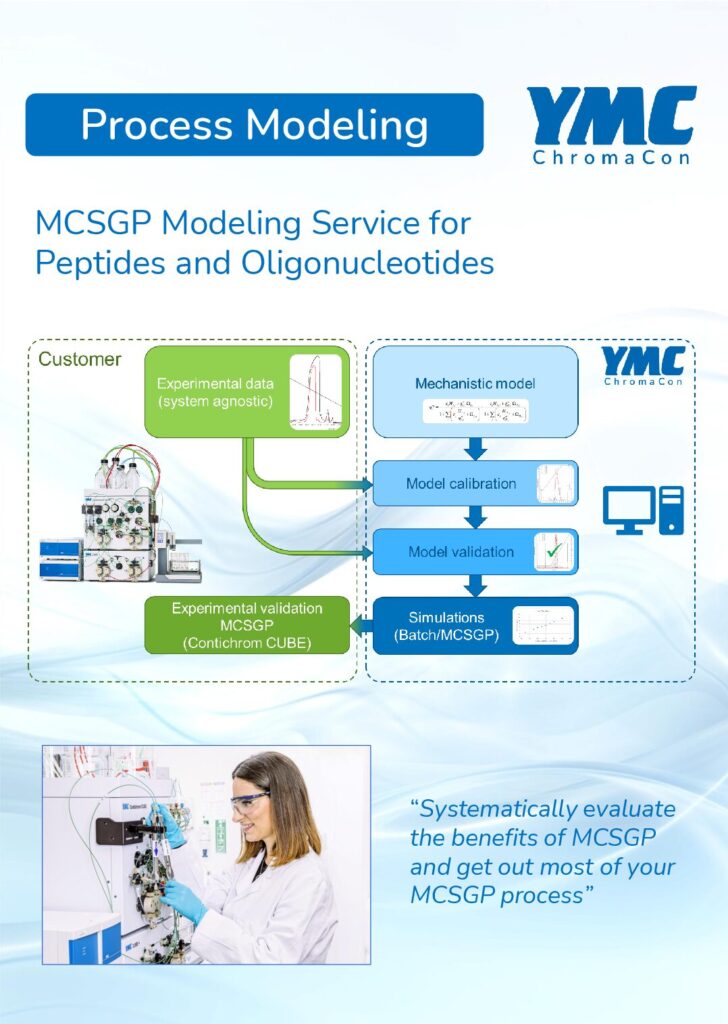
MCSGP Modeling Service for Peptides and Oligonucleotides
ChromaCon’s modeling services support and accelerate MCSGP process design and scale-up of oligo and peptide purifications
Dynamic Process Control
Real-time UV control that compensates for feed variation, column aging, and gradient drift — keeping every cycle on target without operator intervention. │ 24/7 Unattended GMP operation │ Validated as Process Analytical Technology │ Built into ChromIQ®
Continuous chromatography is cyclic — the same columns are loaded, washed, and eluted dozens, hundreds, or thousands of times over a campaign. In a purely timed process, every phase switch happens at a fixed time point set during method development. That works only when nothing changes.
But things change. Feed titers fluctuate batch-to-batch. Columns age. Buffer batches vary. Temperature shifts affecting retention time. Any of these moves either the breakthrough curve (capture steps) or the elution peak (polishing steps) relative to your fixed timing. In a timed process, that translates directly to yield loss, purity excursions, or both.
Managing this manually — an operator adjusting windows by hand each cycle — is not 24/7 manufacturing. It is supervised batch operation running faster.
Fixed-time operation is the right starting point when converting a batch method to continuous mode. Conditions are well-defined, run numbers are low, and the process is closely supervised. AutoPeak® and AutomAb® are not required at this stage — and deliberately so: running without dynamic control first gives you a clean baseline and confirms the underlying process is sound.
For scale-up and sustained manufacturing operation, UV-based dynamic control becomes essential. Retention time drift, column aging, and feed titer variability accumulate over time and across scales in ways that fixed timing cannot accommodate. AutoPeak® and AutomAb® are the step that takes a process from development-ready to production-ready — closed-loop UV control systems embedded in ChromIQ®, activated in dedicated tabs within the standard process wizard, responding to what is actually happening at the column outlet in real time, every cycle, without further operator input.
Both controllers share the same principle: a real-time UV signal at the column outlet triggers the process decision, not the clock.
| AutoPeak® | AutomAb® | |
|---|---|---|
| Applied to | MCSGP, N-Rich® | CaptureSMB® |
| Phase controlled | Elution — fraction collection | Loading — interconnected phase switch |
| Signal monitored | UV elution profile at column outlet | UV breakthrough signal at inter-column sensor |
| What it adjusts | Collection window boundaries for product cut and side-cut zones | Loading duration and phase switch timing between columns |
| Compensates for | Retention time drift, column aging, bed-height variation, feed variability | Feed titer variability, column aging, bed-height variation |
| Configured in | MCSGP Wizard — “AutoPeak® Process Control” tab / N-Rich® Wizard — “AutoPeak®” tab | CaptureSMB® Wizard — “Method Settings & Performance” tab |
| Scales to | CUBE → PILOT 300X → TWIN HPLC | CUBE → TWIN LPLC – Capture |
AutomAb® solves the titer variability problem for CaptureSMB® not by watching for a UV level to be crossed, but by integrating the UV signal over the entire interconnected loading phase. The detector between the two columns monitors the UV continuously as product begins to break through the upstream column. AutomAb® subtracts the impurity baseline — measured automatically in the previous switch — and integrates the remaining signal over time. This running integral is the “preload area”, which is proportional to the mass of target compound entering the downstream column.
Interconnected loading continues until the accumulated preload area reaches the target preload area setpoint. If the titer is higher in this cycle, breakthrough emerges faster, the target preload area is reached sooner, the loading is stopped earlier. If the titer is lower, loading is stopped later. The result is always the same amount of product loaded onto the downstream column — consistent cycle after cycle, independent of feed variability or resin age.
This requires only the single UV sensor positioned between the two columns.
The Evaluation Center makes dynamic control performance visible and documentable.
The ChromIQ® logbook records every AutoPeak® UV trigger event and every AutomAb® phase switch with timestamp and the triggering value — for AutoPeak® this is the UV level (absolute or relative) that started a new phase; for AutomAb® it is the accumulated preload area value at the point the switch was triggered. An unalterable record of every autonomous decision the system made.
AutoPeak® and AutomAb® are relevant wherever process drift, titer variability, or column aging would otherwise require manual intervention or conservative operating margins.
| Molecule class | Controller | Example Application |
|---|---|---|
| Monoclonal antibodies (mAbs) | AutomAb® | Protein A capture — CaptureSMB® loading control for batch-to-batch titer variation |
| Monoclonal antibodies (mAbs) | AutoPeak® | Charge variant separation via CIEX MCSGP — collection window tracking over extended campaigns |
| Bispecifics / antibody variants | AutoPeak® | Complex charge variant profiles — tight windows requiring precise UV-triggered boundaries |
| Peptides | AutoPeak® | RP MCSGP polishing — compensation for gradient retention time drift across long synthesis batches |
| Oligonucleotides | AutoPeak® | AEX MCSGP polishing — close-eluting species where collection window precision is critical |
| Recombinant proteins | AutomAb® + AutoPeak® | Affinity capture (AutomAb®) followed by IEX MCSGP polishing (AutoPeak®) |
| Impurity isolation (N-Rich) | AutoPeak® | Final elution fractionation of accumulated target — boundaries track actual elution signals |
| AAV / gene therapy | AutoPeak® | IEX polishing with high-value capsid fractions — automated boundaries minimise losses |
One Setting. Continuous Adaptation. Consistent Results.