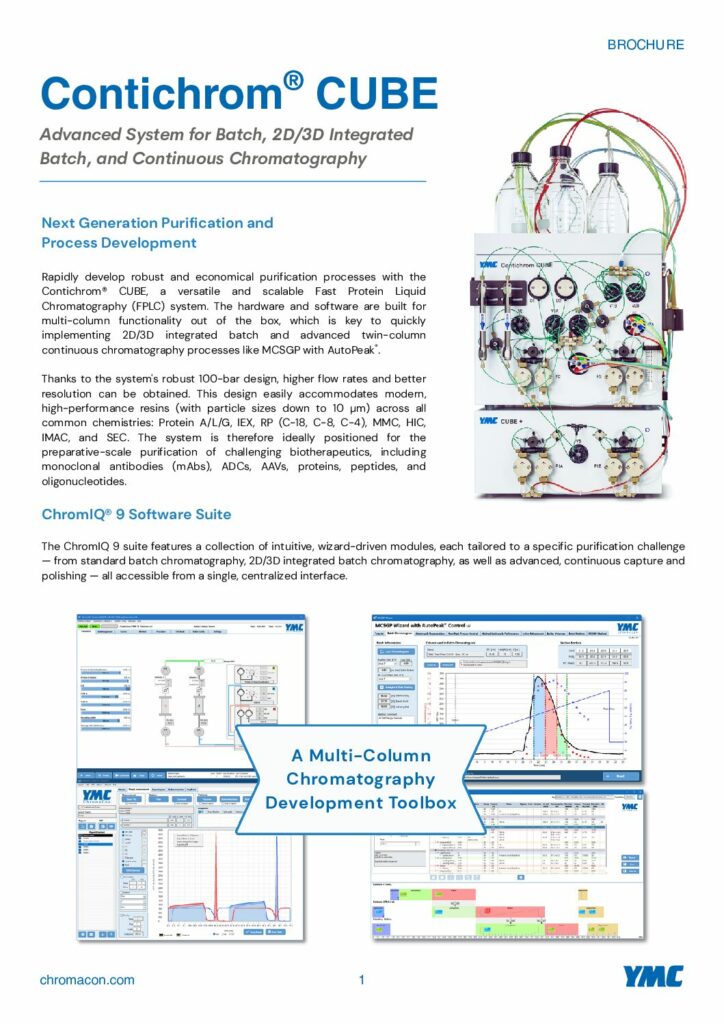
Brochures & Datasheets
04 Dec 2025
RESOURCE LIBRARY
The evidence behind every Contichrom® process. Download the open-access PPQ paper, browse application notes by molecule, watch on-demand webinars, and access the peer-reviewed publications underpinning MCSGP, CaptureSMB®, and N-Rich® at GMP commercial scale.

The first peer-reviewed PC/PPQ framework for MCSGP. 95% IPC reduction, 73% PMI reduction, 96% gross-to-gross yield — validated at GMP commercial scale on Bachem Bivalirudin.
Eisenhuth, R. & Müller-Späth, T. — Processes, 2025 (Open-Access)

First peer-reviewed AIEX MCSGP for therapeutic siRNA. Yield improved from 80% to 93% on a sugar-conjugated siRNA sense strand — software-aided method development enabled fast batch-to-MCSGP transfer. Throughput increased 87%.
Weldon et al. Org. Process Res. Dev. 2025, (Open-Access)

Proof-of-concept MCSGP for AAV2 polishing. Full capsid content increased from 30% to 68% (ddPCR) after six cycles — with +20.6% yield, +23% productivity, and 27% reduced buffer consumption vs batch AEX. AutoPeak® PAT validated against cryo-TEM and ddPCR.
Müller et al.
Biotechnol. Bioeng. (Open-Access)
Application notes, peer-reviewed papers, process guides, datasheets, and recorded webinars — searchable by application, technology, product, or service.
A twin-column continuous chromatography method enables simultaneous separation and collection of both acidic and basic mAb charge variants in a single continuous operation.
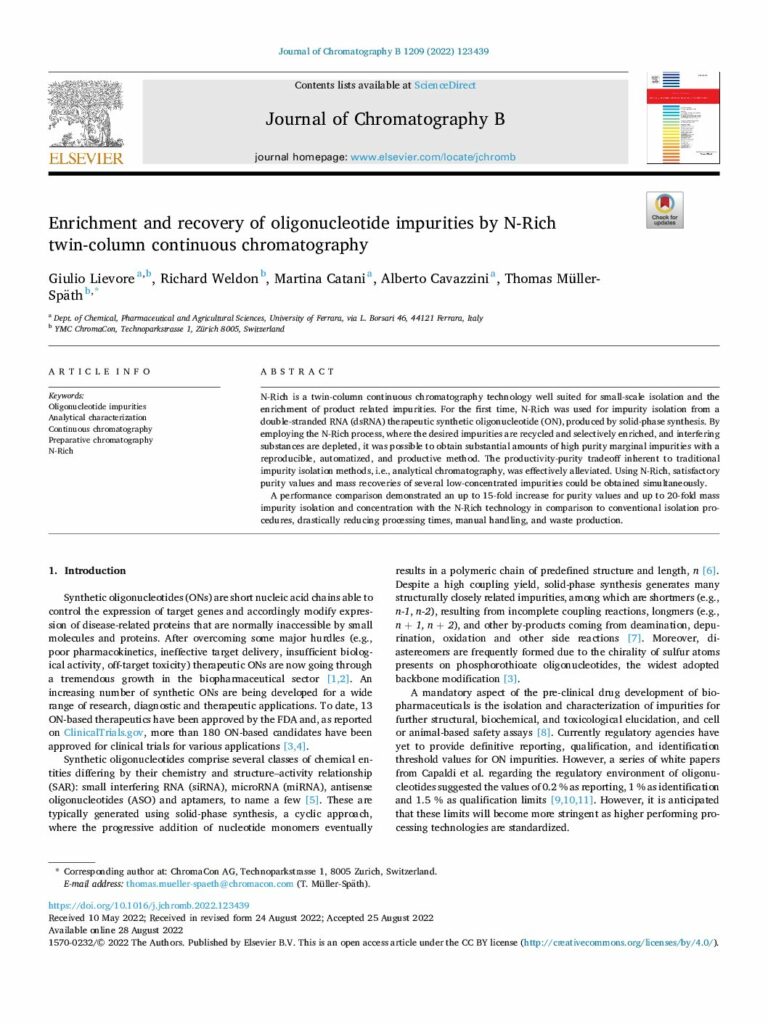
N-Rich applied for simultaneous isolation of multiple low-concentration dsRNA impurities enables efficient characterization of oligonucleotide process-related substances.
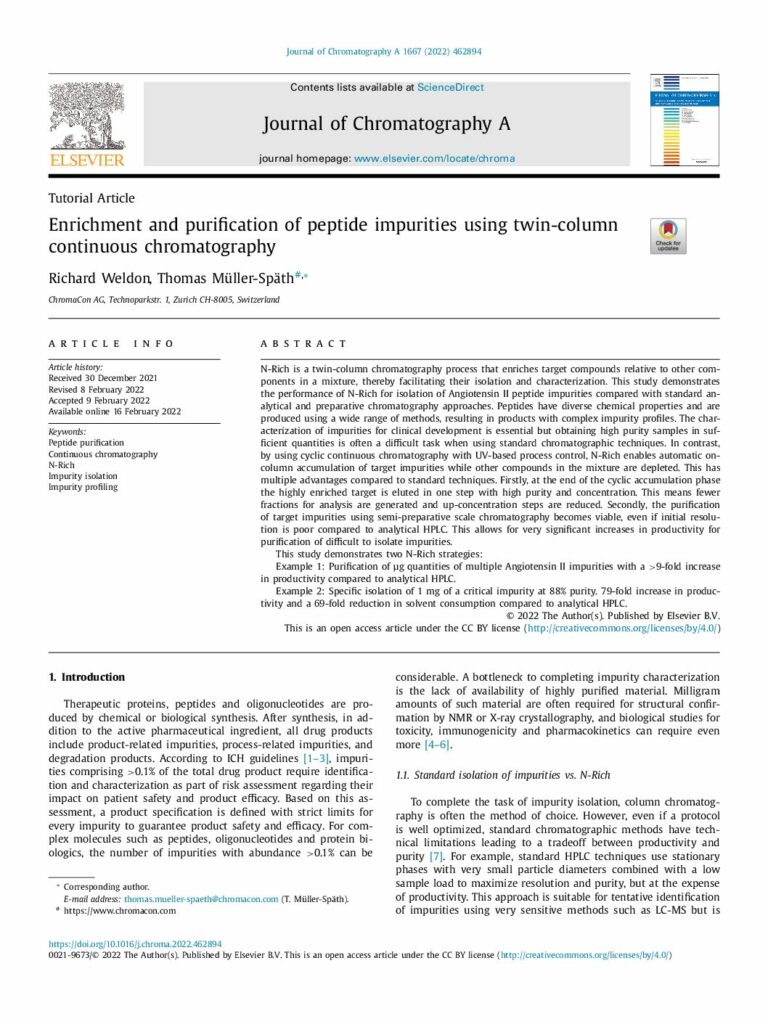
N-Rich demonstrated for peptide impurity isolation with up to 15-fold purity improvements and 20-fold mass enrichment compared to conventional methods.
N-Rich continuous chromatography for mAb charge variant enrichment achieves 95% purity in 10 hours versus 78-87% purity in 48-300 hours with conventional methods.
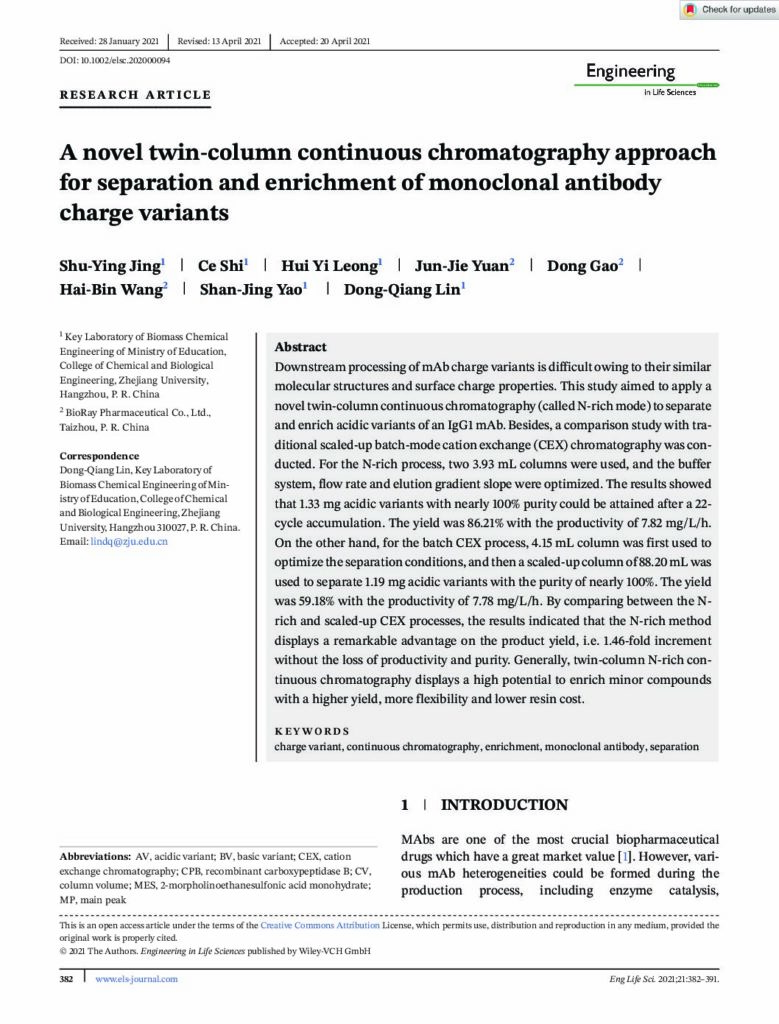
N-Rich applied for mAb acidic variant enrichment achieves 86% yield at nearly 100% purity compared to 59% yield with scaled-up batch chromatography.
A practical primer on chromatography: what it is, how it works, and why it matters. Learn about key separation mechanisms including reversed-phase, ion exchange, size exclusion and affinity chromatography, plus how to read chromatograms and the difference between analytical and preparative methods.

Analytical chromatography produces data; preparative chromatography produces purified material. This guide explains the key differences in goals, scale, column design and optimization strategies, and why every preparative step is a balance of competing goals—purity, yield and throughput.
YMC ChromaCon Chromatography Newsletter.
Subscribe for New Resources Unsubscribe anytime.