

MCSGP Modeling Service for Peptides and Oligonucleotides
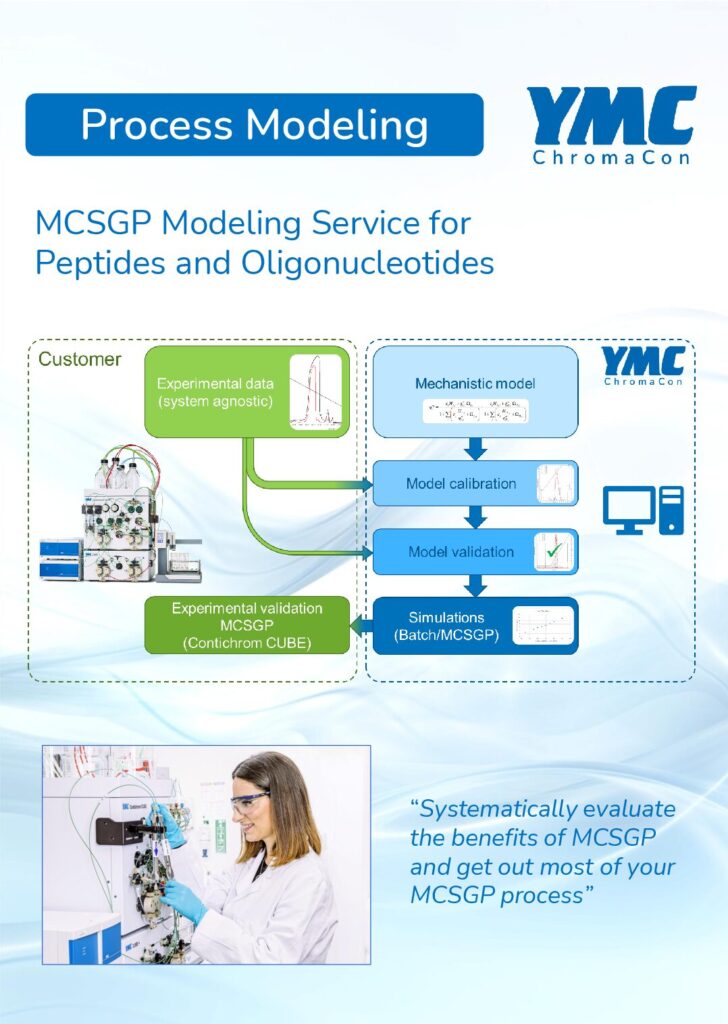
ChromaCon’s modeling services support and accelerate MCSGP process design and scale-up of oligo and peptide purifications
Oligonucleotides
In AIEX or IP-RP modes. Recover full-length product that batch chromatography discards in side-fractions, without changing your resin, gradient, or buffers.
Published case results: +50% yield (60→90%+) on 20-mer | +38.8 pp yield (52.7→91.5%) on GalNAc conjugate | +13 pp yield (80→93%) on conjugated siRNA AIEX
Sources: YMC ChromaCon Oligo Application Note; Weldon et al., J. Chromatogr. A 2022; Weldon et al., Org. Process Res. Dev. 2025
Oligonucleotide therapeutics are surging — with 24 FDA-approved drugs, 200+ candidates in clinical trials, and blockbuster siRNAs driving demand to multi-kilogram scales. Purification by anion exchange (AIEX) or ion-pair reversed-phase (IP-RP) chromatography is the critical downstream bottleneck.
Batch chromatography forces a painful trade-off: high purity or high yield — not both. Oligonucleotide crude feeds contain hundreds of closely related impurities — N-1 shortmers, N+1 longmers, phosphodiester (PO) failures, depurination products, and phosphorothioate diastereomers — many differing by as little as 1 Da in a 7,000+ Da molecule. Achieving target purity requires a narrow center-cut, discarding valuable full-length product in side-fractions. Recovering that product means costly re-chromatography — with all the associated solvent, buffer, and QC burden.
For high-volume APIs demanded by cholesterol-lowering siRNAs, hepatitis B ASOs, and GalNAc-conjugated therapies, this inefficiency is unsustainable.
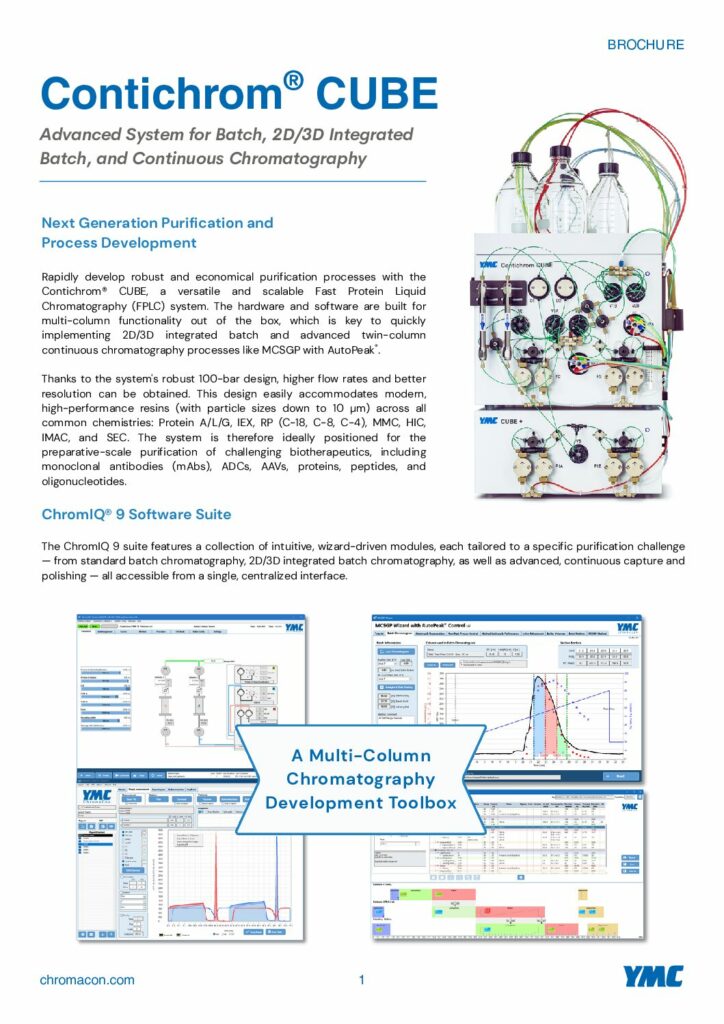
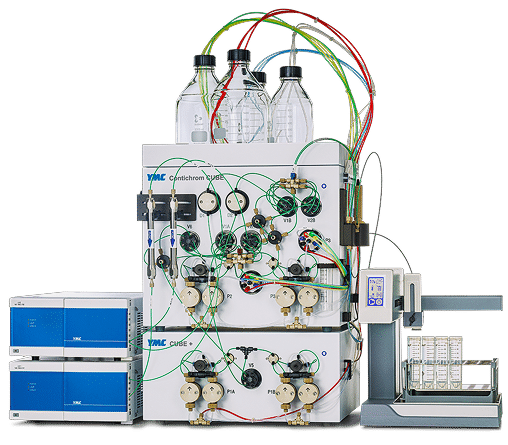
MCSGP (Multi-column Countercurrent Solvent Gradient Purification) eliminates the purity-yield trade-off in oligonucleotide chromatography. Two identical columns continuously recycle impure side-fractions — recovering full-length oligonucleotide product that batch processes discard. It uses the same AIEX, IP-RP, and RP resins, buffers, and solvents as your existing batch oligonucleotide method.
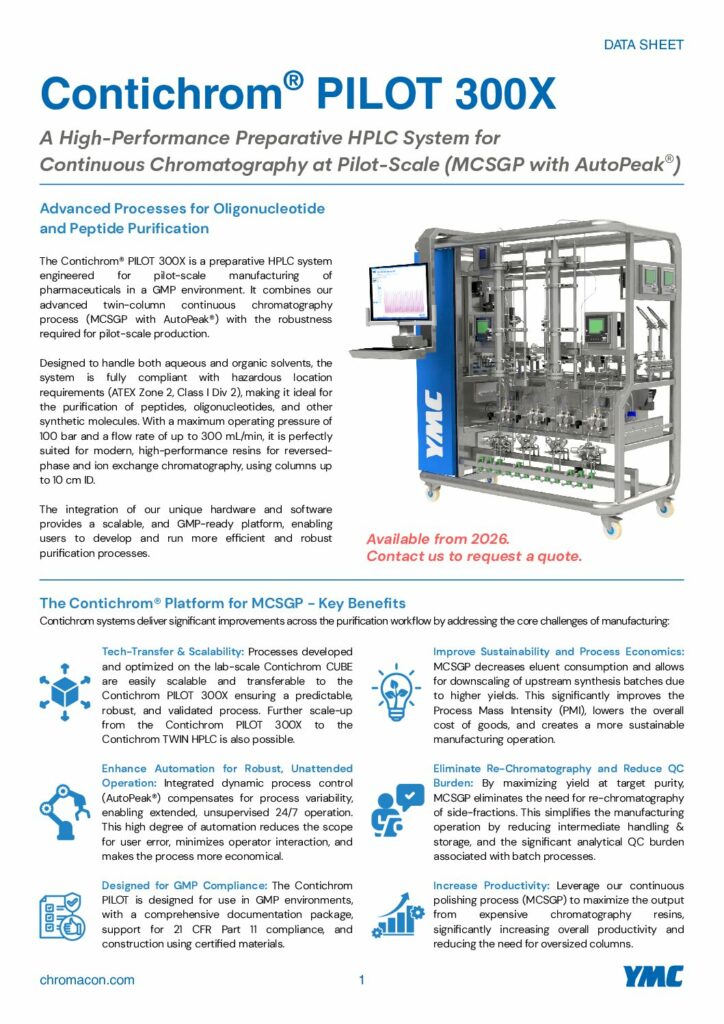
AutoPeak® dynamic process control monitors oligonucleotide elution profiles in real-time via UV and conductivity, automatically adjusting collection windows to maintain consistent output quality — enabling robust, unattended 24/7 oligonucleotide purification. Without AutoPeak® control, studies have shown yields can drop to as low as 20% under process variability — AutoPeak® eliminates this risk.
Same chemistry. Better results. MCSGP works with the AIEX, IP-RP, and RP stationary phases and mobile phases already used in your oligonucleotide batch process — your existing resin and eluent conditions are the starting point for MCSGP development. No change to your chromatographic chemistry is needed.
Yield Increase
Typical MCSGP Yield
Throughput Increase
Re-chromatography Runs
Synthesis Scale Reduction
Productivity Gain
| Parameter | Batch Oligonucleotide Chromatography | MCSGP with AutoPeak® |
|---|---|---|
| Purity-Yield Trade-off | Inherent — narrow cuts sacrifice yield | Eliminated — high purity AND yield simultaneously |
| Product Yield | 50–80% | 90–95% (+13–74% absolute) |
| Re-chromatography | Required for side-fractions | Eliminated — internal recycling |
| Buffer/Solvent Consumption | High | Comparable or reduced per gram product |
| IPC/QC Burden | Testing every side-fraction, every batch | Massively reduced — one sample per MCSGP cycle |
| Throughput | Limited by re-chromatography cycles | Up to 87% higher (continuous 24/7) |
| Process Control | Manual monitoring | Automated (AutoPeak® UV-based PAT) |
| Robustness | Sensitive to drift and crude feed variability | AutoPeak® dynamically compensates |
| Operator Requirement | Requires supervision | Designed for unsupervised operation |
| Upstream Synthesis Impact | Fixed synthesis scale | Higher yield enables up to 42.5% synthesis downscaling |
| Stationary Phase / Eluents | Standard AIEX / IP-RP / RP | Same — no change required |
ASOs with phosphorothioate (PS) backbones generate complex diastereomer mixtures and broad chromatographic peaks that make batch purification especially challenging. MCSGP continuously recovers full-length product from overlapping PS impurity shoulders — delivering yields of 90%+ at target purity with AIEX or IP-RP chromatography.
siRNA sense and antisense strands require high-purity individual strand purification before duplex annealing. Published MCSGP data on a conjugated siRNA sense strand showed yield improvement from 80% to 93% with AIEX, with 87% higher throughput — critical for the multi-kilogram scales demanded by cholesterol-lowering and hepatitis therapies.
GalNAc conjugation enables liver-targeted delivery and is used in the latest FDA-approved oligonucleotide therapies. The bulky GalNAc cluster adds purification complexity. MCSGP with RP-HPLC demonstrated +73.6% relative yield improvement for a GalNAc-DNA-LNA gapmer, enabling 42.5% synthesis downscaling.
Combine orthogonal oligonucleotide purification steps — AIEX for charge-based separation and IP-RP for hydrophobicity-based separation — in a single automated 2D integrated batch workflow. RP-AEX sequence eliminates the need for in-line dilution and produces the sodium counterion form required for formulation.
ICH-required oligonucleotide impurity characterization (N-1, N+1, PO failures, depurination products) typically takes weeks of repetitive analytical runs. N-Rich automated on-column enrichment isolates milligram quantities of target oligonucleotide impurities up to 80× faster.
Ready to Transform Your Oligonucleotide Purification?