Brochures & Datasheets
04 Dec 2025
TRACE IMPURITIES
Overnight enrichment of trace impurities for ICH Q3A/Q6B reference standards, charge variants, glycoforms, and more.
Across published cases: 100–1,000× Enrichment factor | 80–95% Purity (from <20% by batch) | 10 h vs. 300 h analytical HPLC | 69× Less solvent
Sources: Bigelow et al. (BMS), J. Chromatogr. A 2021; Weldon & Müller-Späth, J. Chromatogr. A 2022
Regulatory agencies require isolated, pure impurity reference standards — not just detected peaks. ICH Q3A(R2) mandates structural identification above 0.10% and toxicological qualification above 0.15% for certain classes of molecules. ICH Q6B demands comprehensive characterization of all product-related variants for biologics. A common FDA citation deficiency: “failure to provide a sample of a critical impurity.”
The problem: trace impurities co-elute with a dominant main peak. Conventional batch preparative HPLC requires hundreds of injections, produces dilute, low-purity fractions, and may take 30+ days per isoform. Custom synthesis costs $5,000–$50,000+ per compound — and is simply impossible for biologic impurities like charge variants, glycoforms, or aggregates that only exist as product-related species.
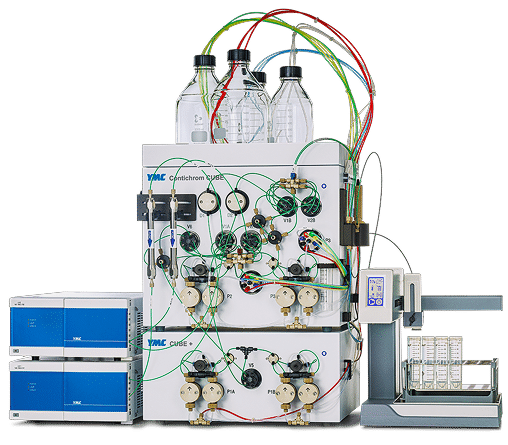
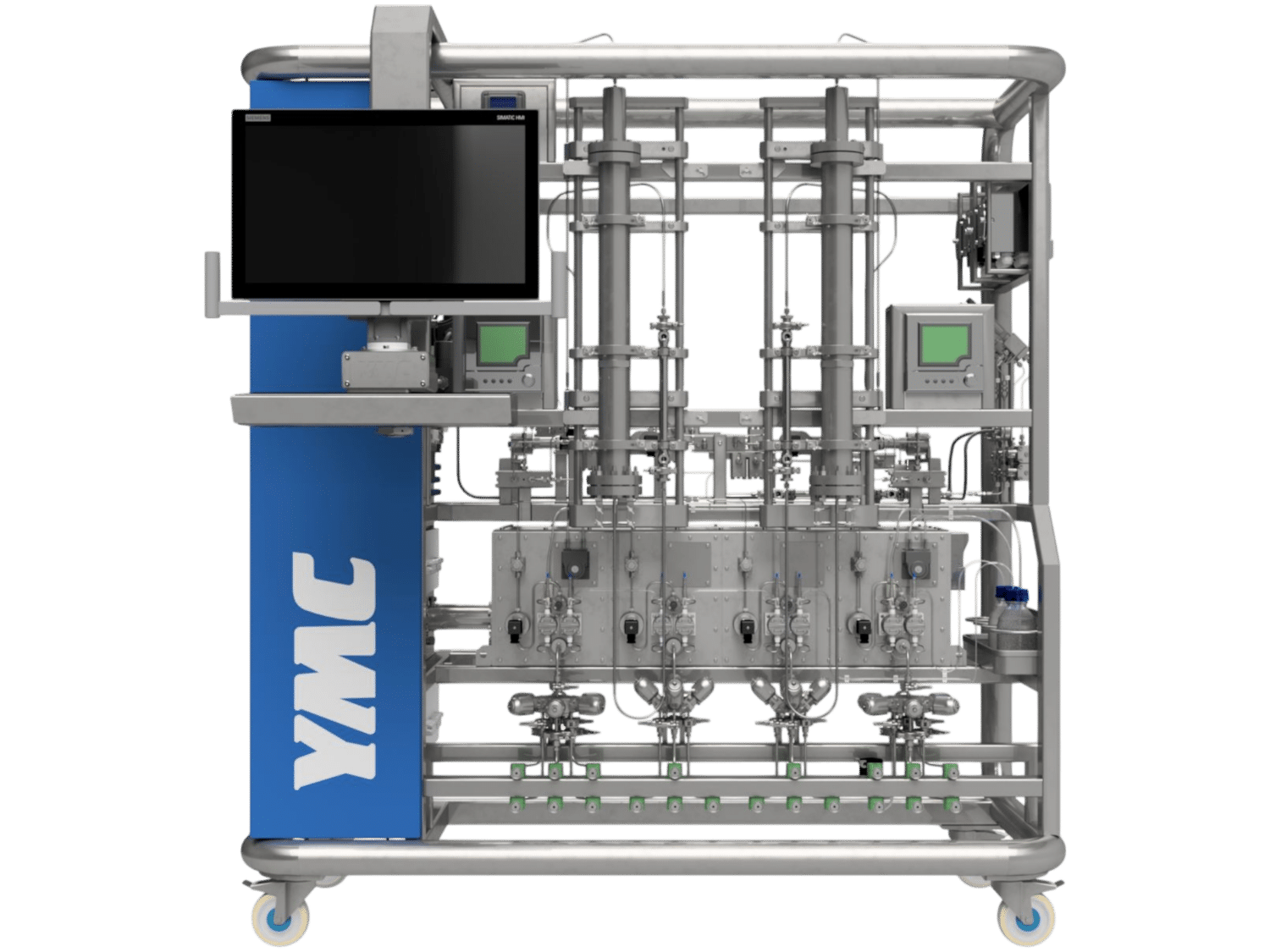
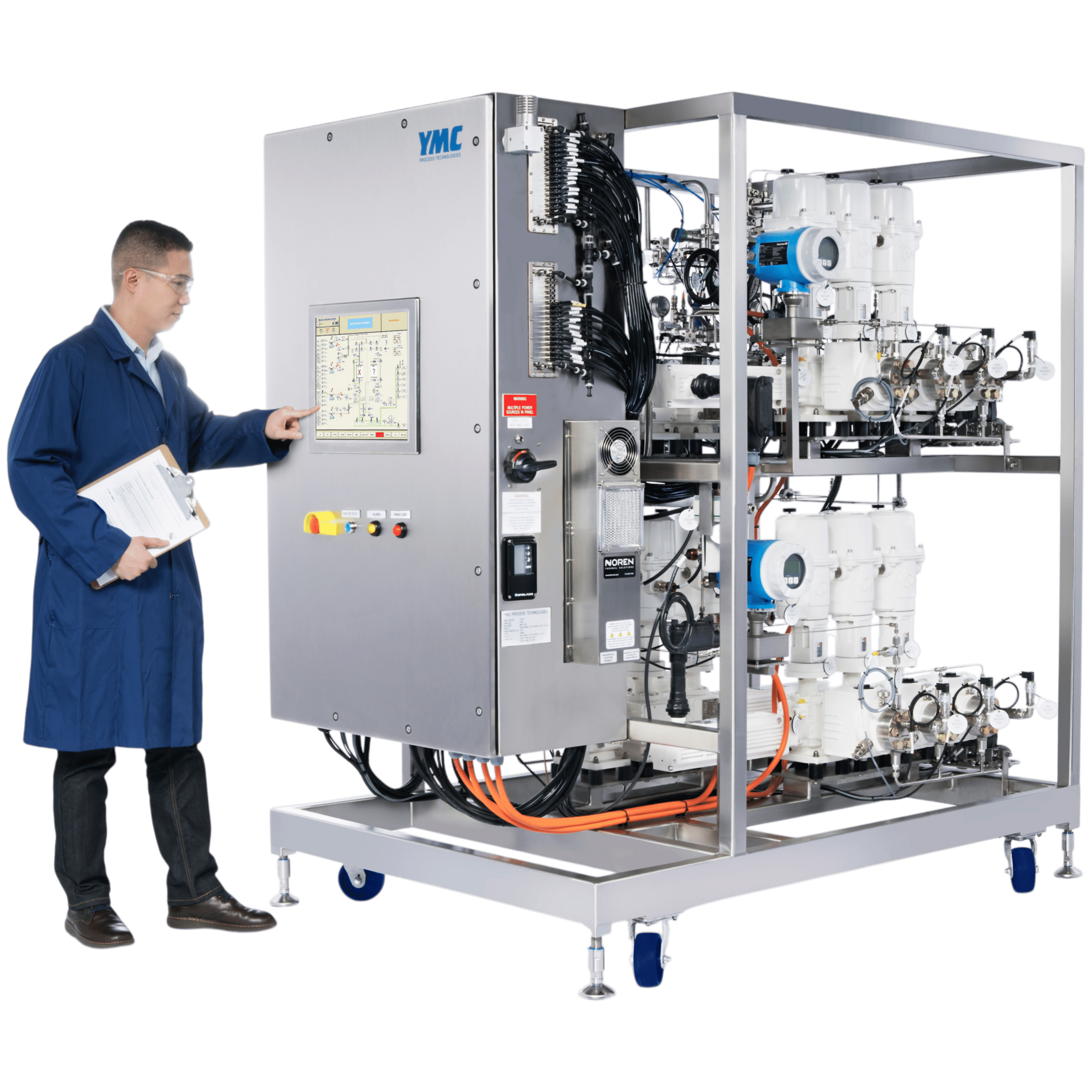
N-Rich® is YMC ChromaCon’s automated enrichment process for isolating trace impurities from complex mixtures. Two identical columns cyclically accumulate the target impurity on-column across repeated load–recycle–wash cycles — progressively depleting the dominant main peak. The result: 100- to 1000-fold enrichment in an overnight run using conventional resin (IEX, HIC, RP-C8).
ChromIQ® software’s N-Rich® Process Wizard configures the entire run from a single batch chromatogram: Once configured, N-Rich® runs fully unattended.
Same resin. Your existing batch conditions are the starting point. N-Rich works with the IEX, RP, HIC, and other standard stationary phases and mobile phases already used in your existing analytical or batch preparative method. The ChromIQ® N-Rich® Process Wizard builds the initial enrichment method parameters from a single batch chromatogram — minimal chromatographic expertise required.

Fully Automated Runs
Purity Achieved
Enrichment Factor
vs. 30+ Days (Biosimilar mAb)
Productivity Gain (Peptide)
Faster than Batch (mAb BMS)
| Parameter | Conventional Batch HPLC | N-Rich® Twin-Column Process |
|---|---|---|
| Impurity starting abundance | 0.1–5% of feed | 0.1–5% of feed |
| Achievable purity | <20% for co-eluting trace species | 80–95%+ |
| Enrichment factor | ~1–2× | 100–1000× |
| Time to isolate | 30+ days (hundreds of injections) | Overnight (1 automated run) |
| Automation | Semi-automated fraction collection | Fully automated via ChromIQ® |
| Yield | ~5% for trace species | 15–86% |
| Solvent consumption | Very high (hundreds of injections) | Up to 69× reduction |
| Resin required | 1 Large column (low load) | 2 Smaller columns |
| Custom synthesis alternative | $5K–$50K+, weeks–months | N/A — isolates directly from mixture |
| Applicable to biologics | Limited — extremely low productivity | Yes — charge variants, glycoforms, capsids |
N-1 deletions, deamidation products, and oxidation variants co-elute with the parent peptide and resist single-pass batch isolation. N-Rich® enriches them for NMR characterization, toxicological qualification, and ICH Q3A(R2) reference standard submission in a single overnight run. 88% purity, 79× productivity gain vs. analytical HPLC (Weldon & Müller-Späth 2022)
Shortmers, failure sequences, PS→PO variants, and deamination products co-elute with full-length oligonucleotide and resist conventional LC. N-Rich® accumulates several impurity species simultaneously in a single automated overnight run. 15× purity increase, 20× mass enrichment vs. conventional isolation (Lievore et al. 2022)
Acidic and basic charge variants require high-purity isolation for forced degradation studies, potency assays, and biosimilar comparability. N-Rich® completes the task in hours rather than weeks of repetitive batch preparative IEC. 95% purity in 10 hours vs. 300 hours by analytical HPLC (Bigelow et al./BMS 2021); ~100% purity at 86% yield (Jing et al. 2021)
Minor bioactives from plant or fermentation extracts — crocin variants, flavonoid aglycones, alkaloid side-products — co-elute with dominant matrix compounds and resist batch isolation. N-Rich® concentrates them for, identification, characterization and natural product reference standard preparation. Applicable – <5% minor co-eluting species in complex natural matrices; saffron crocin fractionation demonstrated (Hooshyari Ardakani et al. 2024)

Odd-DAR variants (DAR 1, 3, 5, 7) appear as minor HIC shoulders on dominant even-DAR peaks and are inaccessible for individual PK/PD or toxicology studies. N-Rich® enriches these rare species from your existing HIC method.
Empty and partial capsid species co-elute with the full capsid peak on AEX. N-Rich® isolates each population — empty, partial, and full — for independent characterisation and reference standard preparation.
Dimers, trimers, and higher-order aggregates at 0.5–5% abundance co-elute as leading SEC shoulders with the target monomer. N-Rich® isolates them for immunogenicity testing and in vivo safety studies at significantly higher productivity than preparative SEC.




Ready to Isolate Your Critical Impurities?
Clear answers to your most common questions about oligonucleotide purification and continuous chromatography.