


Brochures & Datasheets
04 Dec 2025
INTEGRATED CHROMATOGRAPHY
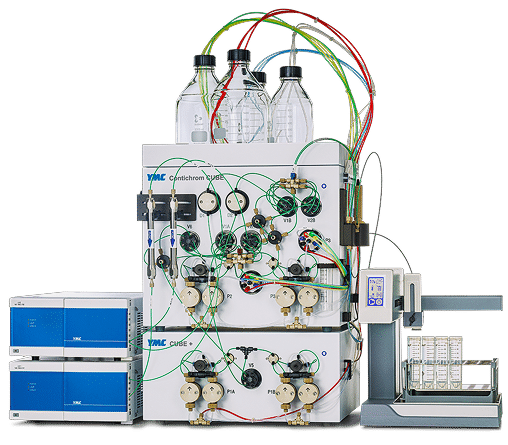
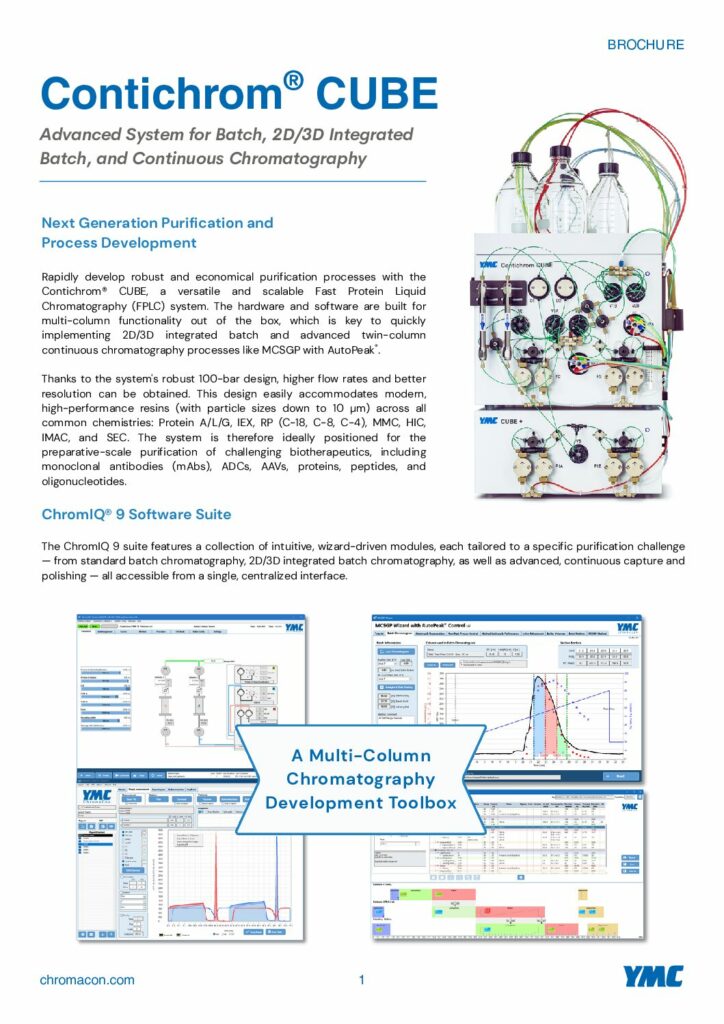
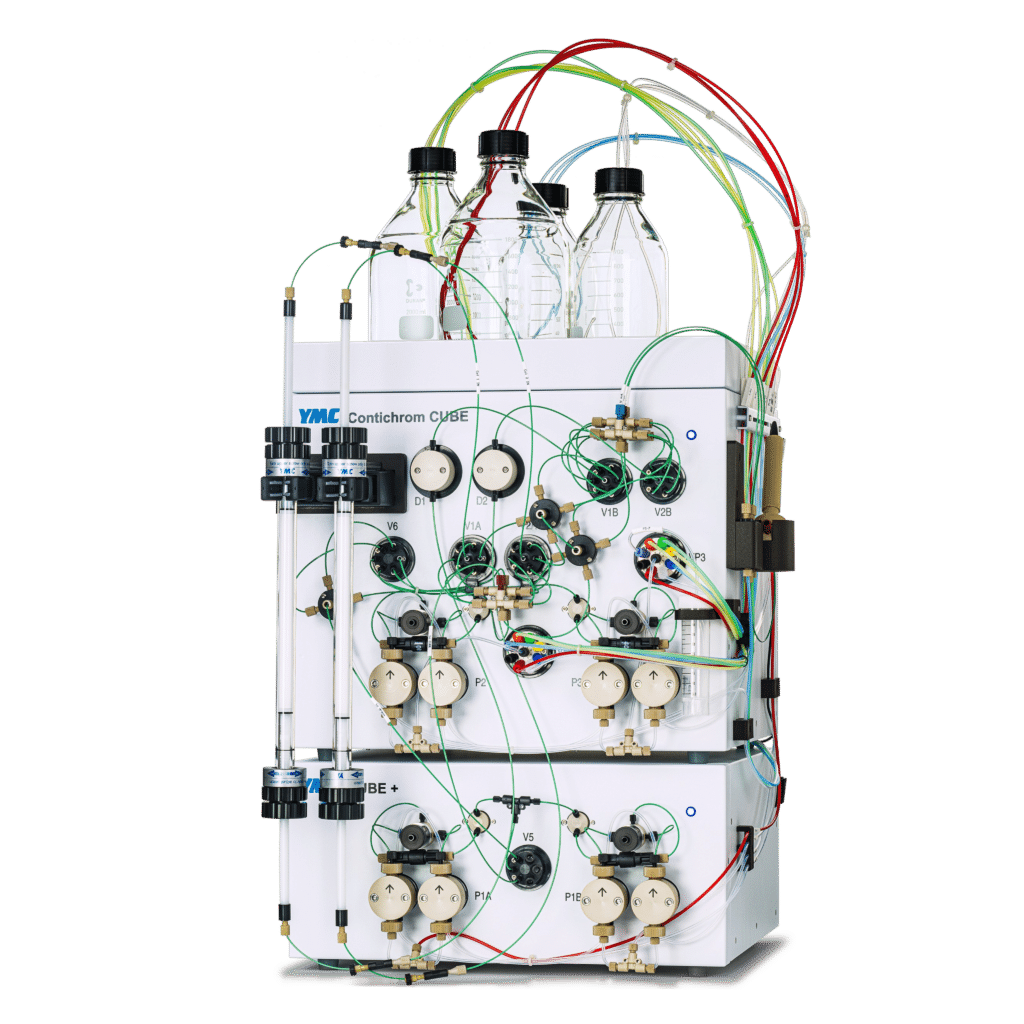
Your batch method is already step one. ChromaCraft™ adds the next — orchestrating multi-column purification (2D/3D) on the Contichrom® CUBE in a single integrated run, with automated transfer, in-line dilution, and full method control across every dimension.

The moment you run your first batch method on the Contichrom® CUBE, you have the foundation for a 2D purification process. The same hardware, columns, and ChromIQ® software that ran your Protein A capture can route the eluate directly onto a second column — IEX polishing, HIC, desalting — without breaking the run.
The CUBE handles the handoff automatically:
That’s 2D integrated batch chromatography. Add a third column step and it becomes 3D. The CUBE’s twin-column valve architecture supports both natively, and ChromaCraft™ designs the complete method in the same visual Gantt chart editor you already use for single-column batch.
The result is an automated, end-to-end purification train — capture through polishing to desalting — completed in a single unattended run. Collect one product pool or fractionate as desired. Time from load to final purified fraction drops from days to hours.

2D chromatography combines two chromatographic purification steps in sequence. A selected product-containing portion of the eluate from the first column is transferred directly to a second column, typically using a different and complementary separation mode.
On the Contichrom® CUBE, this is implemented as an integrated batch process. Each dimension follows its own batch chromatography method, while ChromaCraft™ and ChromIQ® control the Product Transfer Window, column-to-column routing, and any required in-line dilution. This makes it possible to connect workflows such as Protein A capture followed by ion exchange polishing or anion exchange followed by reversed-phase purification without an intermediate hold step or manual reloading.
| Process format | Number of purification steps | Transfer between columns | Example workflow | Method control |
|---|---|---|---|---|
| Single-column batch | 1 | No inter-column transfer | Protein A capture | One single-column batch method |
| 2D integrated batch | 2 | Selected product window transferred automatically from Dimension 1 to Dimension 2 | Protein A → IEX or AEX → RP | One integrated ChromIQ® method |
| 3D integrated batch | 3 | Automated sequential transfer across three column steps | Capture → polishing → desalting | One multi-step ChromIQ® method |
The 2D and 3D configurations use the same ChromaCraft™ Batch Editor as single-column batch methods. A third dimension requires the additional column position enabled by the Column Selection Valve Kit.
| Process factor | Separate batch purification steps | Integrated 2D chromatography on the CUBE |
|---|---|---|
| Product transfer | The first product pool is collected and subsequently loaded onto another column | The selected product window is transferred automatically |
| Intermediate handling | Operator intervention and an intermediate container are normally needed | No manual transfer or intermediate hold tank |
| Stream conditioning | Salt concentration, pH, or solvent composition may require offline adjustment | The pump network applies the defined in-line dilution |
| Method execution | Each column is commonly run as a separate method | Both dimensions run within one ChromIQ® method |
| Data review | Each purification step produces a separate run record | Both dimensions appear in one continuous Evaluation Center record |
| Fraction collection | Intermediate and final pools may need to be collected separately | Product collection can take place after the final dimension |
Unlike separate batch steps, integrated 2D chromatography connects both purification dimensions within one automated workflow. On the Contichrom® CUBE, the selected product window from Dimension 1 can be transferred, conditioned through in-line dilution, and processed in Dimension 2 without manual reloading or an intermediate hold step. This reduces handling between stages while keeping method execution and data evaluation within one continuous process record.
The CUBE’s valve network connects the outlet of the first column directly to the inlet of the second. When the Dimension 1 UV trace meets the Product Transfer Window you set in ChromaCraft™, ChromIQ® diverts the eluate to Dimension 2 and applies in-line dilution at the ratio you specify.
The transfer window can be triggered two ways:
The pumps adjust automatically. No manual action between steps.
Dimension 2 then runs its own equilibration, bind, wash, and elution sequence, governed by the method parameters defined for that column. Both steps run within the same ChromIQ® method.
For 3D methods, add a third column position using the Column Selection Valve Kit — a full capture → polishing → desalting train in one automated run.

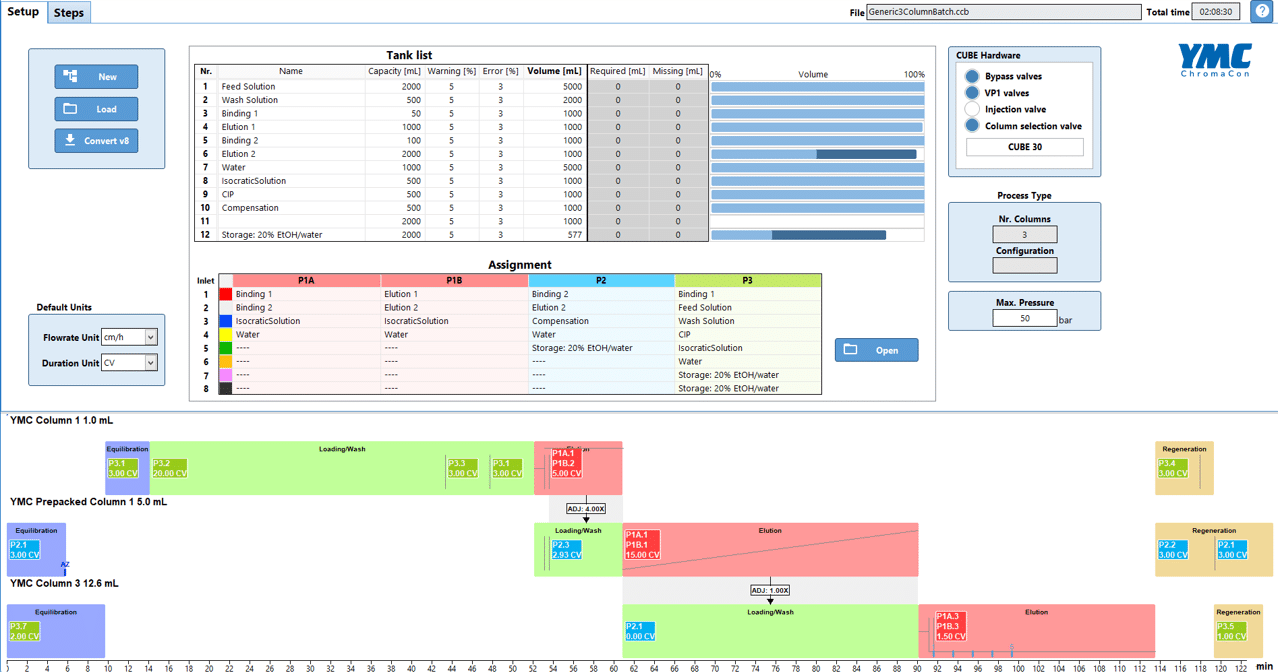


Both dimensions of a 2D or 3D run are captured in a single, continuous run record in the Evaluation Center. The UV trace spans the complete method — you see the Dimension 1 elution, the transfer point, and the Dimension 2 (and Dimension 3) chromatogram as a single timeline.
The ChromIQ® logbook records every system event — including the Product Transfer Window trigger — in an unalterable audit trail with data integrity checksums and multi-level user rights management.

| Molecule class | Typical 2D/3D configuration |
|---|---|
| Monoclonal antibodies (mAbs) | 2D: Protein A capture → CIEX polishing; 3D: Protein A → CIEX → desalting — full downstream train, single run |
| ADCs | 2D: Protein A capture → HIC (DAR fractionation); or HIC → IEX polishing |
| Recombinant proteins / hormones | 2D: His-Tag IMAC → IEX polishing; 3D: Protein L → IEX → SEC |
| Peptides | 2D: RP polishing (Dim 1) → AIEX polishing (Dim 2) — orthogonal gradient-gradient; or RP → desalting |
| Oligonucleotides | 2D: AEX gradient → RP polishing; orthogonal selectivity, single automated run |
| AAV / gene therapy | 2D: Affinity capture → IEX polishing |
| mRNA / LNP | 2D: Affinity → IEX at appropriate scale |
| Nutraceuticals / small molecules | 2D: RP → mixed-mode or normal-phase polishing |
| Format | Step 1 | Step 2 | Step 3 | Required accessories |
|---|---|---|---|---|
| 2D | Isocratic (e.g. Protein A, IMAC) | Isocratic (e.g. SEC, desalting) | — | Column Bypass Valve Kit |
| 2D | Isocratic (e.g. Protein A) | Gradient (e.g. CIEX, AEX, HIC) | — | Column Bypass Valve Kit |
| 2D | Gradient (e.g. RP) | Gradient (e.g. AIEX) | — | Column Bypass Valve Kit + Buffer Selection Valve Kit |
| 3D | Isocratic | Gradient | Isocratic (e.g. desalting) | Column Bypass + Column Selection Valve Kits |
| 3D | Isocratic | Gradient | Gradient | Column Bypass + Buffer Selection + Column Selection Valve Kits |
| Advantage | What it means in practice |
|---|---|
| No hold tanks between steps | Eluate transfers column-to-column automatically — no intermediate container, no manual handling, no wait |
| In-line dilution built in | Ionic strength or pH adjustment between dimensions is handled by the pump network — no separate dilution step |
| Single product pool | Fraction collection happens once, at the end of the final dimension — not after every step |
| Reduced QC burden | One run record, one chromatogram, one report — instead of three per downstream step |
| Same hardware as batch | No additional system purchase — 2D/3D runs on the CUBE you already have, with accessory valve kits |
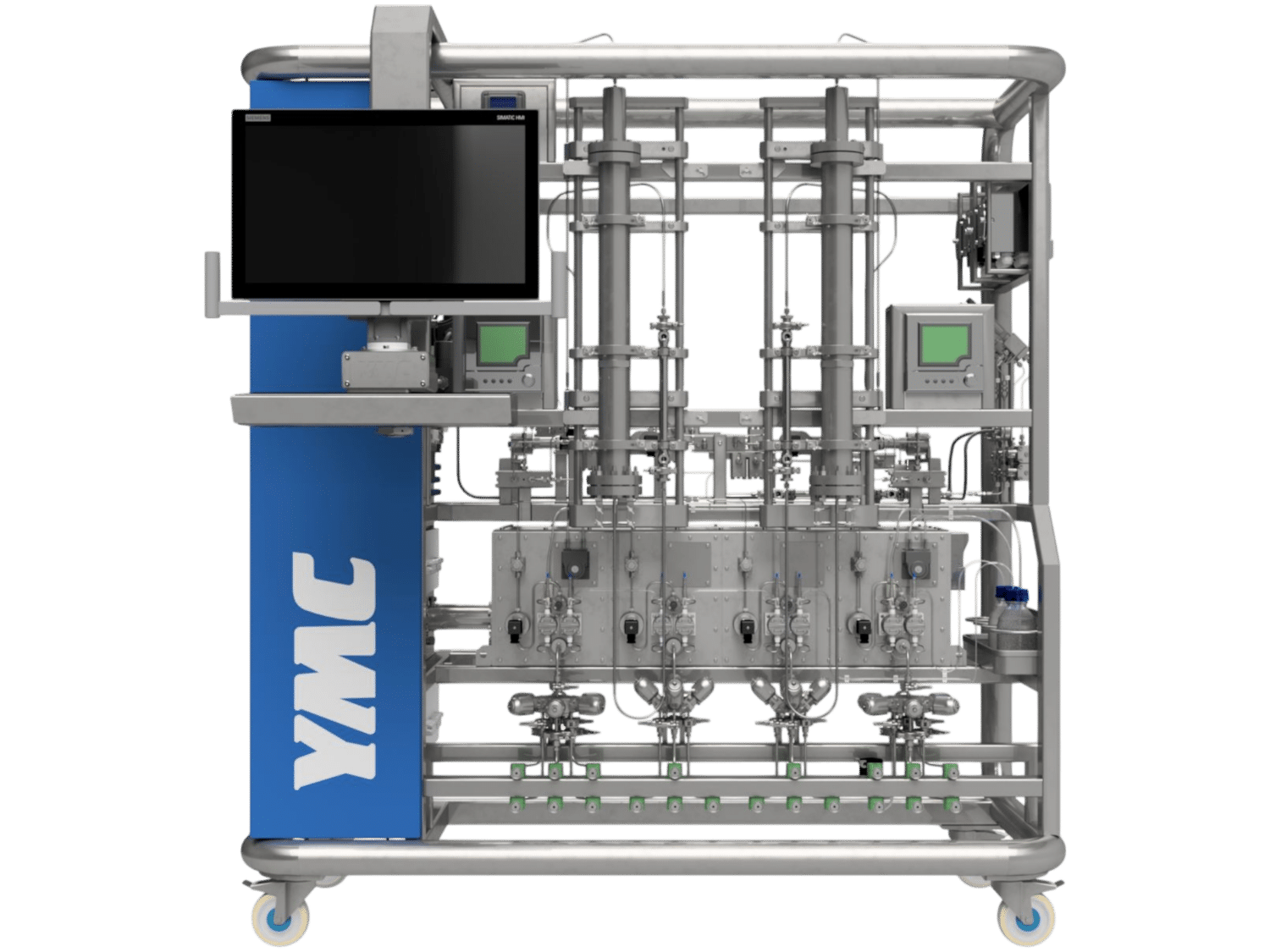
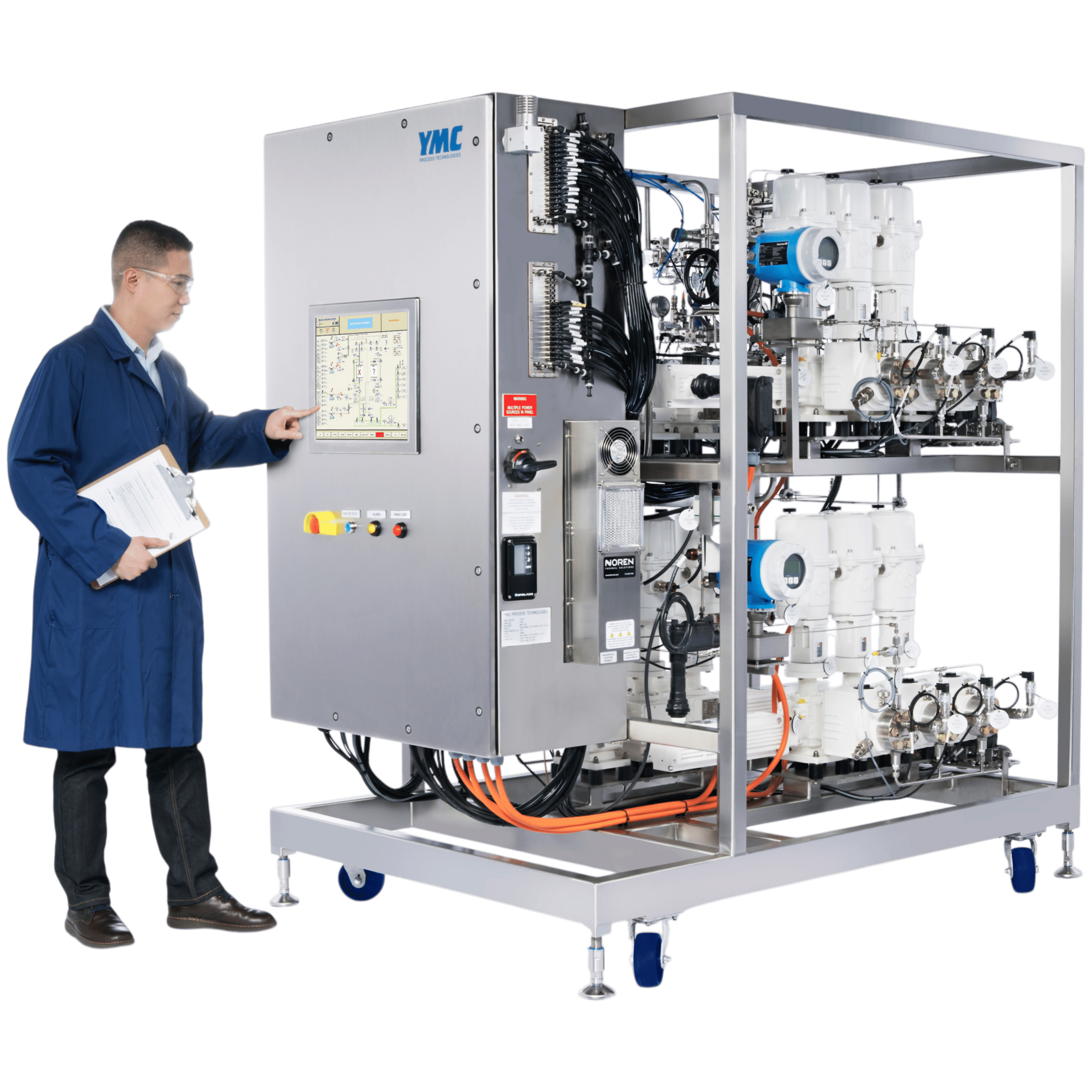
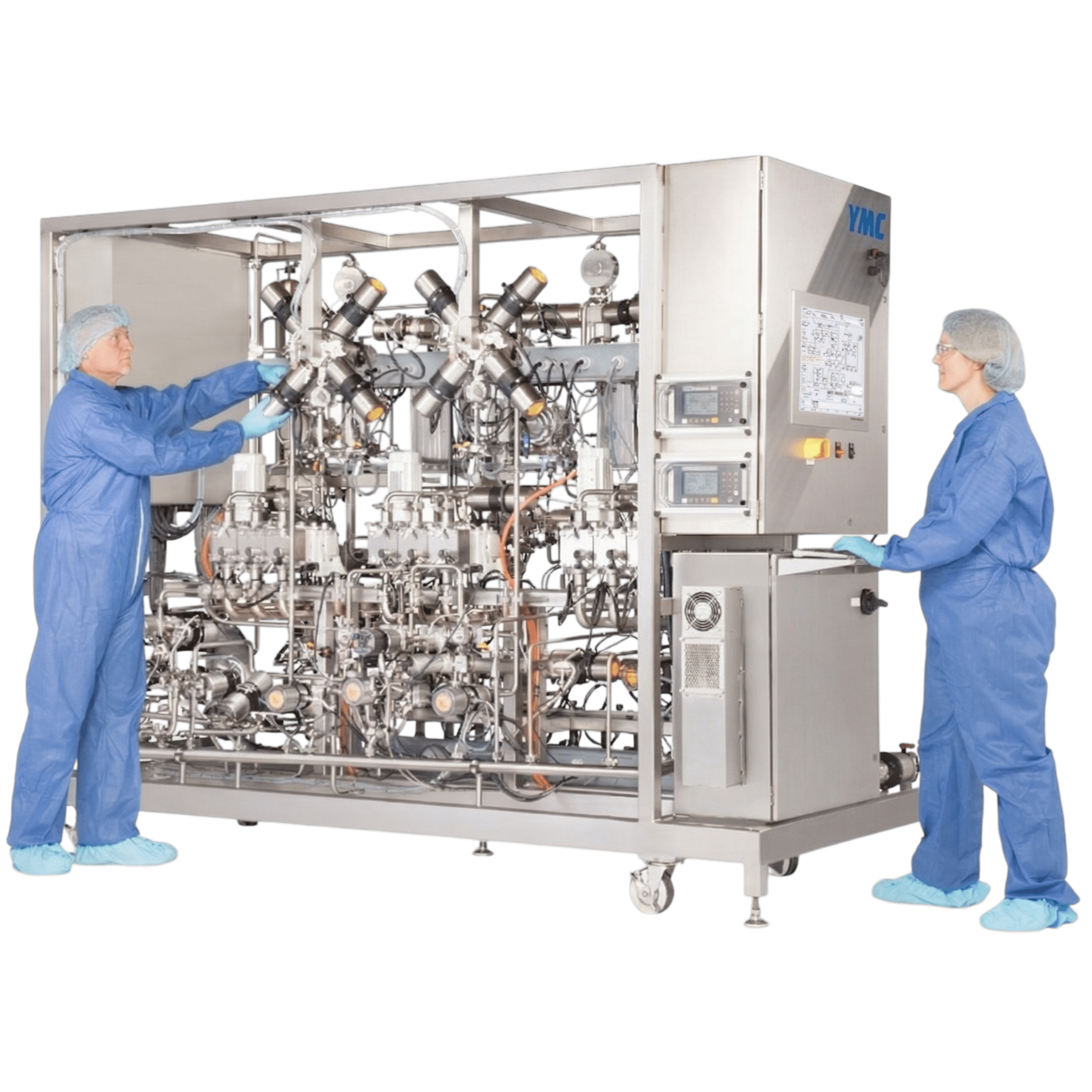
| Direct scale-up path | 2D methods transfer directly to the Contichrom® PILOT 300X and TWIN systems |
One System. Two or Three Purification Steps.
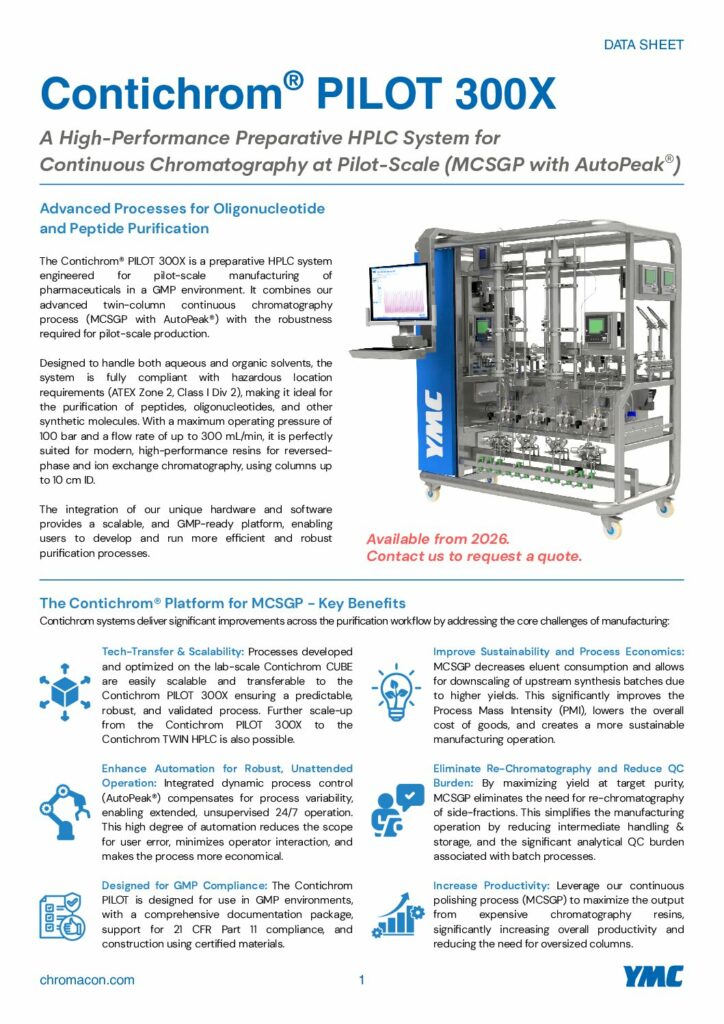
Overview of the technical specifications and functionalities offered by the Contichrom PILOT 300X