Brochures & Datasheets
04 Dec 2025
ADC DOWNSTREAM
Less cytotoxin wasted.
Isolate target DAR species without discarding on-target product to side-fractions — demonstrated on a Kadcyla®-type lysine-conjugated ADC model: 100% yield at 57% purity vs. 22% yield at 31% purity for batch (DAR 3.0) | up to 50% fewer synthesis operations (DAR 2.0)
Source: YMC ChromaCon ADC Application Note (CEX, Kadcyla®-type model)
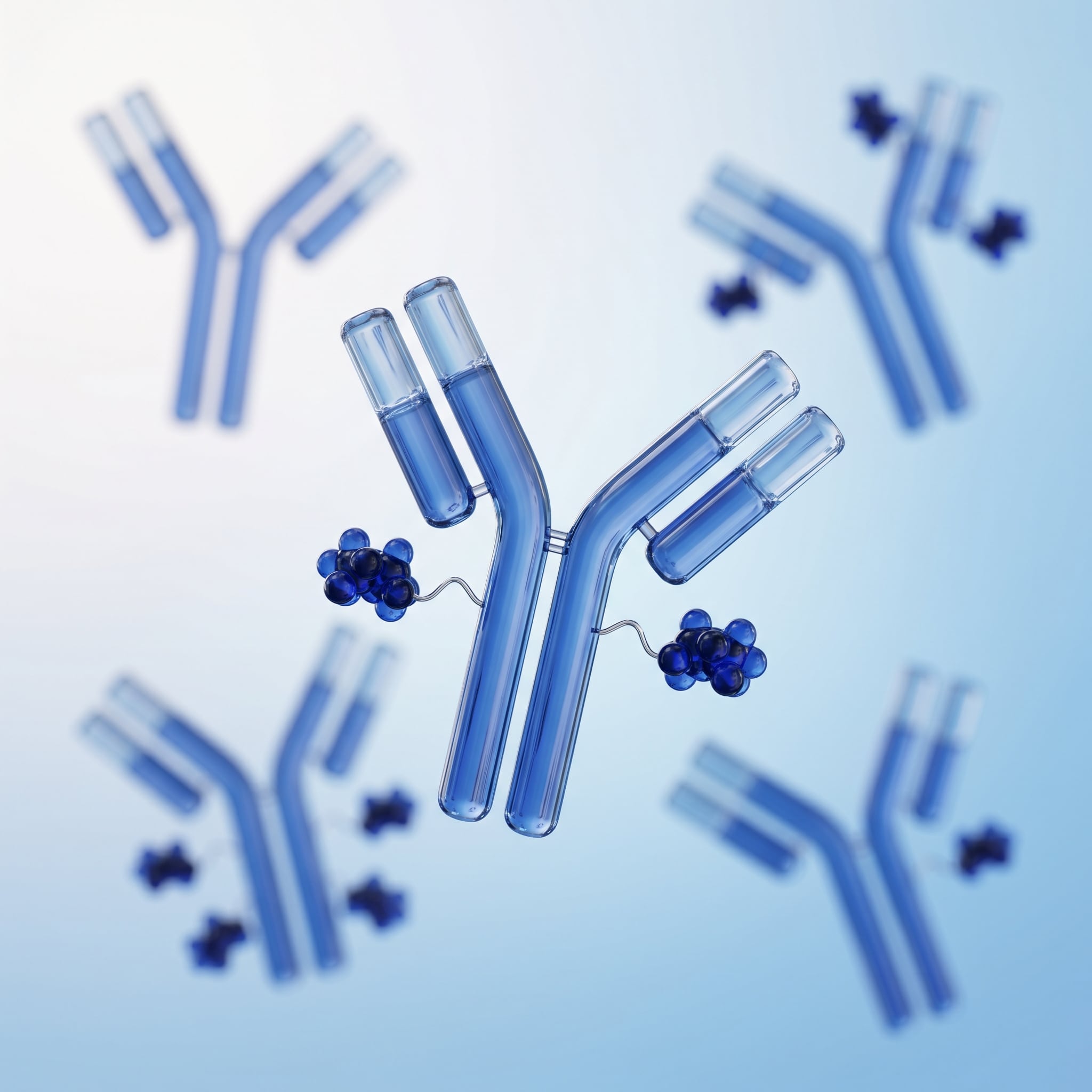
ADC demand is surging — with over a dozen FDA-approved products, hundreds of clinical candidates, and rapid market growth. But conjugation of cytotoxic payloads to antibody lysine residues or reduced cysteines produces a statistical mixture of DAR species. A narrow DAR distribution is a critical quality attribute — higher DAR species clear faster and cause more toxicity, while unconjugated antibody (DAR 0) is therapeutically inactive.
Hydrophobic interaction chromatography (HIC) is the primary preparative tool for DAR control, but the different DAR species have very similar adsorptive properties. Batch HIC forces a tight center-cut, discarding valuable on-target product in the side-fractions. For lysine-conjugated ADCs — where positional isomers further complicate resolution — batch yields for a specific DAR can be as low as 22–34%.

MCSGP (Multi-column Countercurrent Solvent Gradient Purification) eliminates the purity-yield trade-off in ADC DAR purification. Two identical chromatographic columns continuously recycle impure DAR side-fractions — recovering on-target DAR product that batch chromatography would discard. The process uses the same resins, buffers, and gradient conditions as your existing batch ADC method — whether HIC, CEX, or mixed-mode.
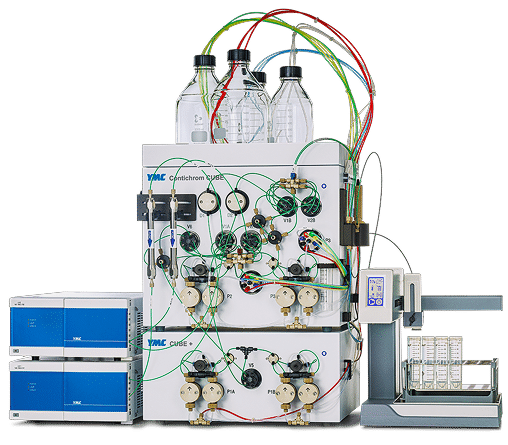
AutoPeak® dynamic process control monitors the ADC elution profile in real-time via UV, automatically adjusting collection windows to maintain the target DAR distribution — enabling robust, unattended DAR polishing runs.
Same resins. Same buffers. Superior DAR control. MCSGP works with all major HIC, CEX, and mixed-mode resins — your existing batch ADC conditions are the starting point. Continuous side-fraction recycling recovers on-target DAR product from overlapping peaks, delivering up to 4× yield vs. batch. AutoPeak® compensates in real-time for conjugation variability and column aging, enabling unattended DAR polishing runs.

MSCGP
Yield Improvement
Productivity Gain
Buffer Reduction
More than DAR polishing. The Contichrom® platform addresses multiple steps in the ADC downstream workflow:
| ADC Purification Step | Contichrom Capability | Scale |
|---|---|---|
| DAR polishing (post-conjugation) | MCSGP — continuous DAR homogenization with higher yield | CUBE (CEX, HIC) → TWIN LPLC (HIC) |
| Aggregate removal | MCSGP or batch HIC — co-separated with off-target DAR species | CUBE → TWIN LPLC |
| Free payload/linker clearance | 2D integrated batch: CEX → desalting in one automated process | CUBE → TWIN LPLC |
| Antibody capture (pre-conjugation) | CaptureSMB® — 2.5× higher Protein A productivity, 30-40% less resin (BMS-validated for mAb capture) | CUBE → TWIN LPLC |
| Payload purification (small molecule) | MCSGP with RP — cytotoxin/linker-payload purification | CUBE → TWIN HPLC |
| Impurity enrichment | N-Rich — automated isolation of ADC-related impurities for characterization | CUBE |

CaptureSMB®
Lysine-Conjugated ADCs (Broad DAR Distribution) Non-specific lysine conjugation produces the broadest DAR distribution (DAR 0–7+) with extensive positional isomers. MCSGP with CEX demonstrated up to 4× higher yield on a Kadcyla®-type model, including DAR 3.0 at 100% yield. Same principle applies to HIC.
Cysteine-Conjugated ADCs (DAR 0/2/4/6/8) Partial reduction of interchain disulfides produces five DAR species. HIC resolves these by hydrophobicity — but batch yields are low. MCSGP continuous HIC polishing on the TWIN LPLC recovers on-target DAR 2–4 product at production scale.
Site-Specific ADCs (THIOMAB, Engineered Cysteine, Glycoconjugation, AJICAP™) Site-specific conjugation narrows the DAR distribution but only produces even DARs (2.0, 4.0, 6.0). MCSGP sharpens the target peak further and uniquely enables uneven DARs (3.0, 5.0) that site-specific chemistry cannot access.
ADC Aggregate Removal Aggregates from hydrophobic payload self-association co-elute with high-DAR species late in HIC. MCSGP simultaneously removes aggregates while polishing DAR — combining two steps into one.

Free Payload & Linker Clearance TFF handles most free drug removal, but some hydrophobic payloads (PBD dimers) resist TFF. CEX clears free payload effectively — mAb platform conditions often transfer directly. The CUBE runs batch CEX and 2D integrated batch workflows.
Cytotoxic Payload Purification (Pre-Conjugation) Auristatins, maytansinoids, PBD dimers, and camptothecin derivatives require high-purity RP purification before conjugation. MCSGP with RP-HPLC increases payload yield — reducing cost of these expensive, potent compounds.
Antibody Capture (Pre-Conjugation) The mAb intermediate requires Protein A capture before conjugation. CaptureSMB delivers 2.5× higher Protein A productivity and 30-40% less resin — validated by Bristol Myers Squibb for mAb capture from lab to GMP scale.



Ready to Improve Your ADC Purification Process?
Comprehensive methodology chapter explaining CaptureSMB and MCSGP concepts, process design, regulatory aspects, scale-up, and UV-based process control with practical application examples.
Methods for purification of human mAbs and fragments covering both batch and continuous chromatography approaches.
Comprehensive methodology for designing continuous expression and purification processes including perfusion bioreactors, CaptureSMB, and MCSGP.