


GENE THERAPY
Separate Empty and Full AAV Capsids with MCSGP — Gene Therapy Manufacturing.
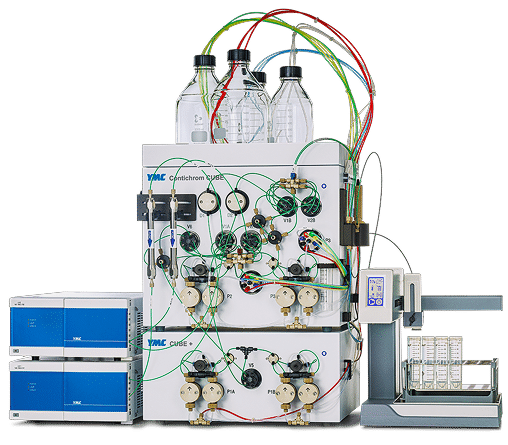
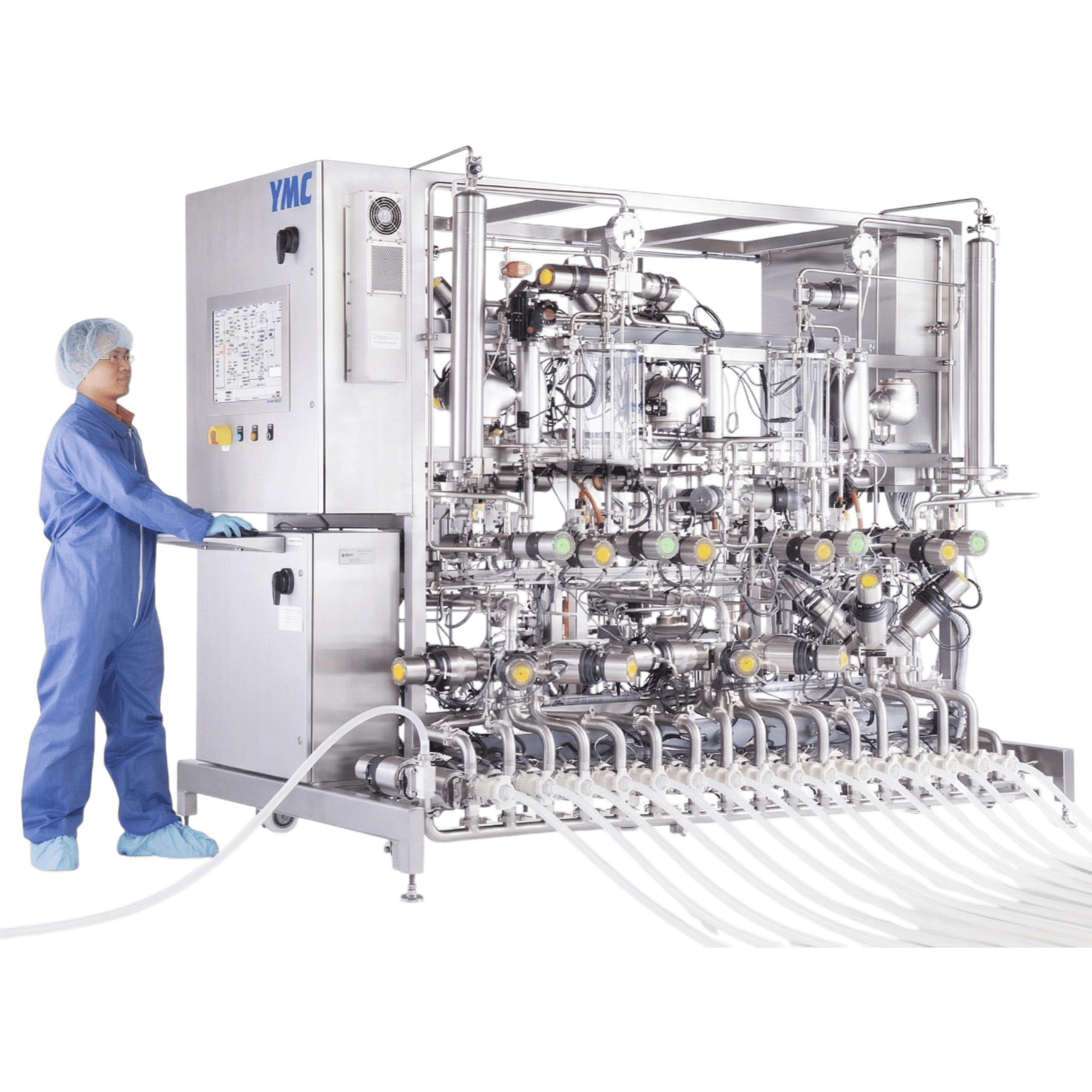
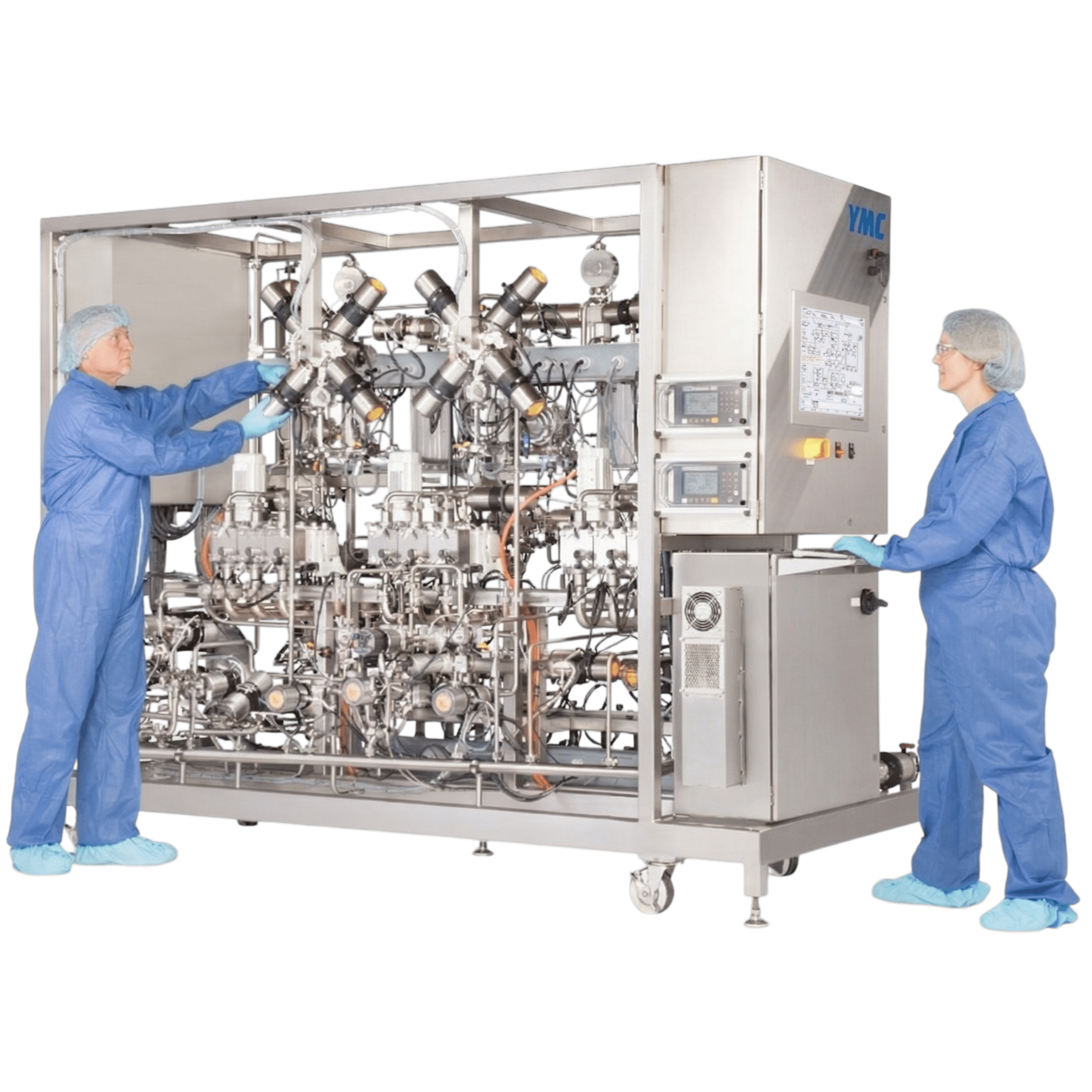
Continuous AIEX polishing for full capsids. Recover the full capsids that batch AIEX discards in the side-cut. Published on AAV2 by two independent research groups: 5× Higher full capsid yield | 2.5× Productivity | 3× Lower process mass intensity. Develop on the Contichrom® CUBE; manufacture on the TWIN LPLC.
Müller et al., Biotechnol. Bioeng., 2025; Grob et al., J. Chromatogr. A, 2025 (independent AAV2 AEX studies)
The AAV Downstream Bottleneck: Empty Capsids
Adeno-associated virus (AAV) is the leading vector platform in gene therapy — with multiple approved products (Luxturna®, Zolgensma®, Hemgenix®, Roctavian®, Elevidys®) and over 130 clinical trials underway. But manufacturing recombinant AAV at the yields and quality needed for clinical and commercial supply remains a defining challenge.
A critical problem is the high proportion of empty capsids in every AAV harvest. Empty capsids — identical in size and shape to full, genome-containing capsids but lacking therapeutic DNA — routinely comprise 50–95% of total viral particles in crude material. They are therapeutically inactive and at high levels may trigger immune responses and increase patient dosing burden.
Empty and full AAV capsids are near-identical in size and surface chemistry, differing only slightly in isoelectric point — meaning they co-elute across a narrow, overlapping zone in anion exchange chromatography. Full capsid yield using Batch AEX chromatography can be very low, leaving much room for optimization of the polishing step.
The Solution: MCSGP with AutoPeak® for AAV Full Capsid Enrichment
MCSGP (Multi-column Countercurrent Solvent Gradient Purification) resolves the yield-purity trade-off that makes batch AEX polishing of AAV so wasteful. Two identical columns operate in a continuous countercurrent mode — recycling the overlapping empty/full capsid fractions that batch chromatography discards. The process uses the same AEX resins, buffers, and gradient conditions as your existing batch AAV method — these conditions are the starting point for MCSGP process development.
AutoPeak® dynamic process control monitors the AAV elution profile in real-time via the UV260/280 absorbance ratio — a reliable online indicator of the empty/full capsid transition zone — automatically adjusting the recycling and collection windows to maintain robust, unattended full-capsid enrichment.
Same resin. Same buffers. Superior performance. MCSGP works with the AEX resins and gradient methods already validated for your AAV serotype — Capto Q, POROS HQ, Fractogel TMAE, or others. The online UV260/280 ratio provides a reagent-free PAT signal for the empty/full transition, enabling AutoPeak® to deliver consistent full-capsid enrichment run-to-run, even as upstream empty/full ratios fluctuate.
Proven Results: MCSGP vs. Batch for AAV Empty/Full Capsid Separation
5×
Higher Full Capsid Yield
2.5×
Higher Productivity
3×
Lower Process Mass Intensity (PMI)
30% → 68%
Full Capsid Enrichment
AAV Purification Comparison Table (Polishing):
| Parameter | Batch AEX | MCSGP (Contichrom) |
|---|---|---|
| Full capsid yield (at 70% purity spec) | ~10–11% | ~58% (+5×) |
| Productivity | 3.85×10¹³ VP/(L_resin·h) | 8.65×10¹³ VP/(L_resin·h) (+2.5×) |
| Process mass intensity (buffer) | Baseline | 3× lower |
| Full capsid enrichment | Limited by center-cut | 30% → 68% (ddPCR) |
| Yield-purity trade-off | Hard constraint — cannot improve both | Eliminated |
| Process continuity | Batch cycles, idle time | Continuous, 24/7 |
| Resin / method change | Current validated method | Same resin, same gradient |
| Online monitoring (PAT) | Offline analytics only | UV260/280 ratio — real time |
| Process variability compensation | Manual re-optimization | AutoPeak® automatic adjustment |
💡 Process insight:
In batch AEX, lengthening the gradient to recover more full capsids proportionally reduces productivity — the two objectives are fundamentally opposed. MCSGP resolves this by recycling the overlapping fractions, allowing both to be maximized independently. This is particularly critical for AAV, where upstream empty capsid content is inherently variable and often unpredictable — a challenge that AutoPeak® continuously adapts to in real time.
MCSGP Applications Across AAV Purification
Use Case 1 — AAV2 Polishing (AEX)
The most thoroughly published serotype for MCSGP-based empty/full separation. Two independent 2025 publications demonstrated 5× full-capsid yield improvement and 2.5× productivity gain vs. batch AEX. Directly applicable to any AAV2 program currently using AEX polishing.
Use Case 2 — Other Serotypes (AAV5, AAV8, AAV9, and variants)
MCSGP applies to any serotype for which an AEX gradient method achieves at least partial empty/full resolution. The CUBE development platform enables rapid method screening and adaptation for new serotypes without published separation data.
Use Case 3 — High-Variability Upstream Feeds
AAV empty/full ratios vary batch-to-batch based on cell system, transfection efficiency, and serotype. AutoPeak® compensates in real time using the UV260/280 ratio — maintaining consistent full-capsid output without manual re-optimisation between runs.
Use Case 4 — Integrated Affinity Capture + MCSGP Polishing
For programs using pan-AAV affinity resins (POROS CaptureSelect AAVX, Capto AVB, AVIPure®), MCSGP replaces or augments batch AEX polishing. A complete two-step continuous chromatography solution applicable to the broadest range of AAV programs.
Ready to Increase Full Capsid Yield in Your AAV Process?
FAQ
Clear answers to your most common questions about oligonucleotide purification and continuous chromatography.