RECOMBINANT PROTEINS

Two Steps. One Train. Continuous Recombinant Protein Purification.

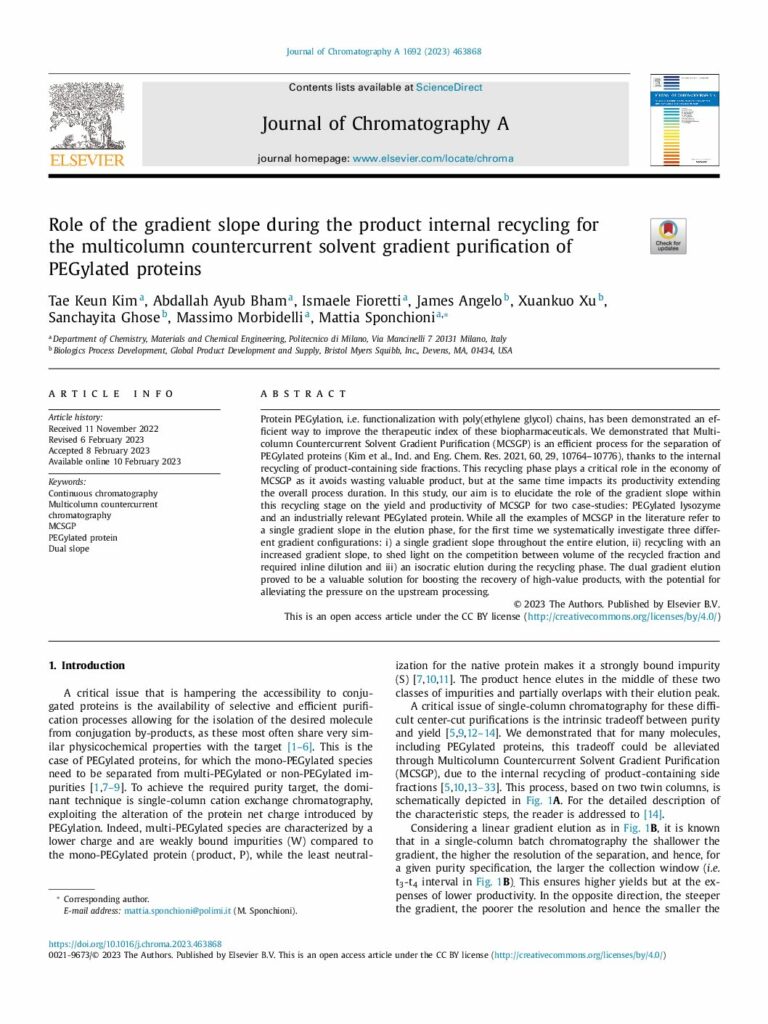
CaptureSMB® capture and MCSGP polishing on the Contichrom® platform — MCSGP demonstrated in collaboration with Bristol Myers Squibb on a PEGylated protein at 98% target purity: +8.2 pp Yield (73.1→79.1%) | +17.8% Productivity | −15% PMI | lowest COG of all five scenarios modelled. With dual-slope MCSGP: yield further increases to +20–23 pp vs. batch maximum. CaptureSMB® separately validated at 100× scale-up by BMS for Protein A capture.


Sources: Kim et al., J. Chromatogr. A (2022) — BMS industrial-scale COG study; Kim et al., J. Chromatogr. A(2023) — dual-slope MCSGP; CaptureSMB®, production-scale BMS validation: Angelo et al., BioProcess International 2018

The Affinity Capture Bottleneck

Batch bind-and-elute chromatography leaves resin capacity systematically underutilized. A column is loaded to 60-80% of dynamic binding capacity to avoid product breakthrough — meaning 20-40% of expensive affinity resin sits idle in every cycle.

For high-cost resins — Protein L for F(ab’)₂ fragments, Protein A for Fc-fusion proteins, or custom affinity supports for novel scaffolds — this underutilization directly inflates cost of goods. Add the large buffer volumes required for batch cycling and the long processing times for high-titer feeds, and affinity capture becomes a significant manufacturing bottleneck.

For manufacturers targeting continuous downstream processing or integration with perfusion bioreactors, batch capture also introduces the largest process time discontinuity in the train.

The Solution: CaptureSMB® Continuous Affinity Capture

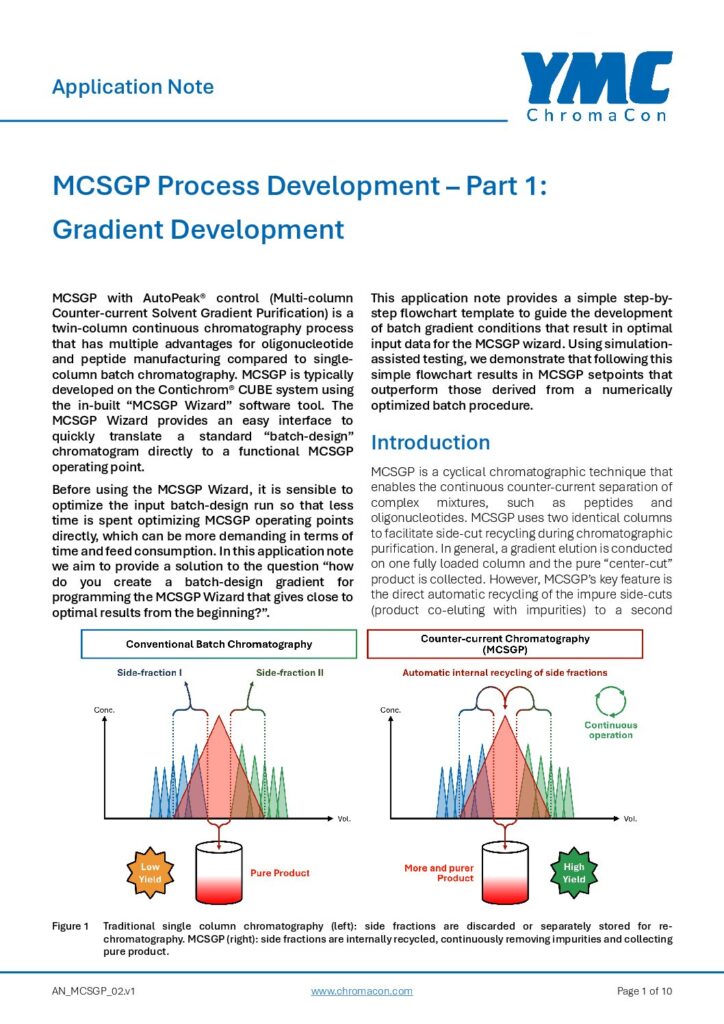
CaptureSMB® uses a twin-column countercurrent loading strategy to maximize affinity resin utilization. While the first column reaches full saturation, breakthrough is captured on the second column — ensuring near-complete loading of both columns before any elution occurs. Resin utilization consistently reaches ≥95% versus 60-80% for batch loading.

AutomAb® dynamic process control monitors UV breakthrough in real-time and triggers column switching automatically, maintaining optimal loading regardless of feed titer variation — enabling robust operation directly coupled to a perfusion bioreactor or continuous clarification train.

CaptureSMB® is compatible with any affinity, IEX, or mixed-mode capture resin — Protein A, Protein L, Protein G, and custom affinity ligands.

Works with any affinity resin. CaptureSMB® has been demonstrated for Protein A (mAb and Fc-fusion capture), Protein L / KappaSelect (F(ab’)₂ and κ-light chain fragment capture), and custom affinity resins. The twin-column principle applies to any bind-and-elute system where maximizing resin utilization and minimizing buffer consumption is valuable.

Learn About CaptureSMB® with AutomAb®

Proven Results: CaptureSMB® vs. Batch – Affinity Capture – F(ab’)₂

64% ↑

Load

>30%

Resin cost savings (F(ab’)₂ / Protein L)

1.9×

Productivity

54% ↓

Buffer Consumption

Protein Purification Comparison Table (Capture Step):

Parameter Batch Bind-and-Elute CaptureSMB® with AutomAb®
Resin Utilization 60% (breakthrough avoidance) ≥95% — countercurrent loading saturates both columns
Resin Cost Baseline >30% savings demonstrated for Protein L
Product Concentration Baseline 2.2× higher in eluate (F(ab’)₂)
Buffer Consumption High (Lower load = large wash/elution volumes per g) 54% Reduced (Higher load =  lower wash/elution volumes per g)
Feed Variability Handling Fixed breakthrough limit; manual adjustment required AutomAb® dynamically adjusts column switching to real-time UV signal
Perfusion Integration Batch holds required between harvest and capture Direct coupling
Process Control Manual or timer-based column switching Automated (AutomAb® UV-based PAT)
Resin / Buffer Compatibility Any affinity, IEX, or mixed-mode Same — no change required

The Polishing Bottleneck in Protein Biomanufacturing

Recombinant proteins rarely elute as a single, pure species. Charge variants, aggregates, PEGylation isoforms, and process-related impurities co-elute with the target — and conventional batch polishing cannot resolve them without a costly trade-off.

A tight center-cut achieves target purity but discards large fractions of expensive product. Widening the cut improves yield but fails purity specifications. Recovering side-fractions through re-chromatography adds time, buffer, and complexity.

For high-value proteins — including PEGylated bioconjugates, Fc-fusion proteins, cytokines, recombinant enzymes, and growth factors — this inefficiency directly inflates cost of goods and delays manufacturing throughput.

The Solution: MCSGP Continuous Polishing

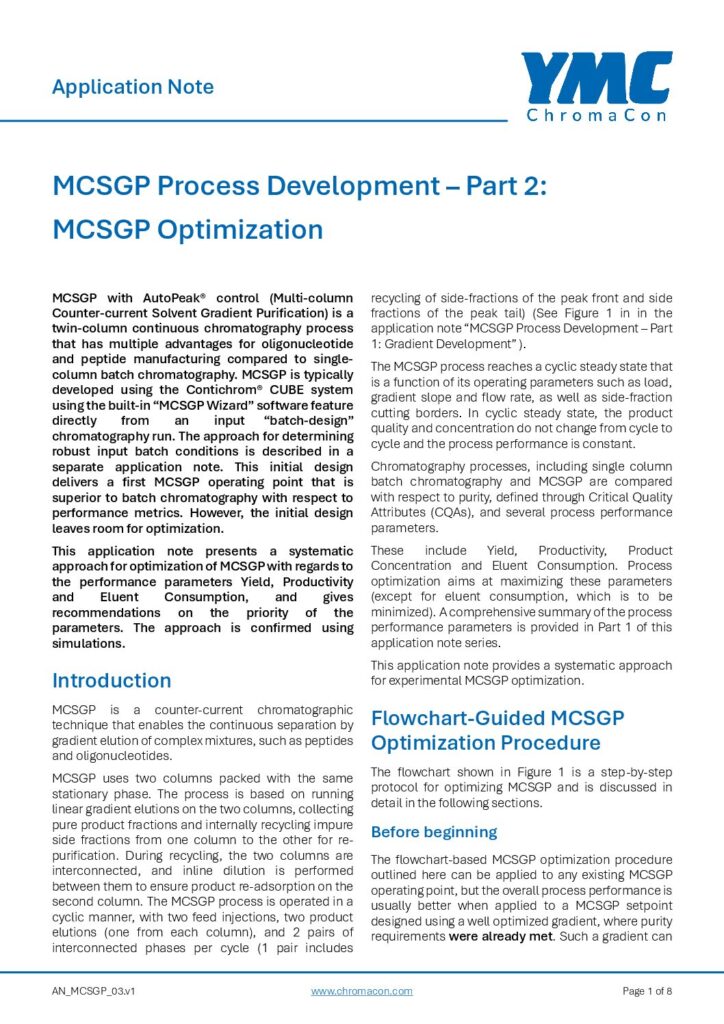
MCSGP (Multi-column Countercurrent Solvent Gradient Purification) eliminates the purity–yield trade-off. Two identical columns continuously recycle impure side-fractions back into the purification cycle — recovering product that batch processes discard as waste. It operates with the same IEX, HIC, mixed-mode, or affinity resins and buffers already used in your polishing step.

AutoPeak® dynamic process control monitors elution profiles in real-time via UV and conductivity, automatically adjusting collection windows to maintain consistent output quality — enabling robust, unattended 24/7 operation.

Same chemistry. Better outcomes. MCSGP is compatible with cation exchange (CEX), anion exchange (AEX), hydrophobic interaction (HIC), and mixed-mode resins at any column size. Your existing resin and buffer conditions are the starting point — no change to your chromatographic chemistry is required.

Learn About MCSGP + AutoPeak®

Proven Results: MCSGP vs. Batch Polishing – PEGylated Protein

+8–23%

Yield Increase

17% ↓

PMI / Buffer Reduction

18% ↑

Productivity Gain

Zero

Re-chromatography Runs

Protein Purification Comparison Table (Polishing):

Parameter Batch Polishing MCSGP with AutoPeak®
Purity–Yield Trade-off Inherent — narrow cuts sacrifice yield Eliminated — high purity AND yield simultaneously
Product Yield 60–80% (typical polishing step) +8–23% absolute improvement
Re-chromatography Required for off-spec side-fractions Eliminated — internal countercurrent recycling
Buffer Consumption (PMI) High −15% demonstrated at industrial scale
Productivity Limited by single-column throughput Up to +18% improvement
Cost of Goods Baseline Reduced across all manufacturing scenarios
Campaign Flexibility Fixed batch cadence Adjustable by tuning cycle number and column diameter
Process Control Manual fraction collection Automated (AutoPeak® UV-based PAT)

CaptureSMB Applications:

Fc-Fusion Proteins (Capture Step)

Fc-fusion proteins are captured via Protein A affinity — the same resin and method as for full-length mAbs. CaptureSMB® continuous loading applies directly, maximizing resin utilization and product concentration for this growing class of therapeutics.


Antibody Fragments — F(ab’)₂, Fab, scFv, Nanobodies

Antibody fragments lacking the Fc region require Protein L, Protein G, Protein A (for Fc-containing fragments), or custom affinity resins. CaptureSMB® has been demonstrated for F(ab’)₂ capture using Protein L (>30% resin savings, 2.2× product concentration vs. batch) and applies to any κ-light-chain-containing fragment.


Recombinant Proteins with Custom Affinity Resins

Many recombinant proteins are captured by custom affinity or mixed-mode resins. CaptureSMB® is compatible with any bind-and-elute system — the performance benefits (≥95% resin utilization, higher product concentration, reduced buffer use) scale to any affinity resin cost and titer.


Perfusion-Coupled Continuous Manufacturing

CaptureSMB’s continuous loading mode couples directly to perfusion bioreactor output — eliminating large intermediate hold tanks, reducing facility footprint, and enabling true end-to-end continuous biomanufacturing from expression to purified drug substance.

MCSGP Polishing Applications:

PEGylated Proteins

PEGylation creates multiple isoforms (mono-, di-, multi-PEGylated) that overlap in conventional IEX or AEX chromatography. MCSGP separates isoforms with simultaneous high purity and yield — demonstrated on both model and industrially relevant molecules with full COG analysis (BMS collaboration).


Recombinant Cytokines and Growth Factors

Cytokines (IL-2, IFN-α, G-CSF, EPO) and growth factors are produced as charge variant mixtures from microbial or mammalian expression. MCSGP IEX polishing recovers the target isoform at high yield while rejecting deamidated, oxidized, or truncated species — without the yield loss of batch center-cutting.


Recombinant Enzymes

Enzymes produced in microbial or yeast systems carry process-related impurities and isoforms requiring polishing. MCSGP is applicable wherever gradient IEX, HIC, or mixed-mode polishing is already in use — the continuous version operates on the same resin and buffer system with no chemistry change.


Fc-Fusion Proteins (Polishing Step)

Fc-fusion proteins (e.g., etanercept, romiplostim class) require charge variant polishing after Protein A capture. MCSGP continuous IEX or HIC polishing applies directly, removing acidic/basic variants at higher yield than batch center-cutting and enabling tighter CQA specifications if needed.


Aggregate and Impurity Removal

Protein aggregates and high-molecular-weight species co-eluting with the monomer peak cannot be removed at high yield by batch center-cutting. MCSGP recycles these side-fractions internally, recovering monomer product while meeting tight aggregate specification limits.
Getting Started with MCSGP and CaptureSMB® for Recombinant Proteins

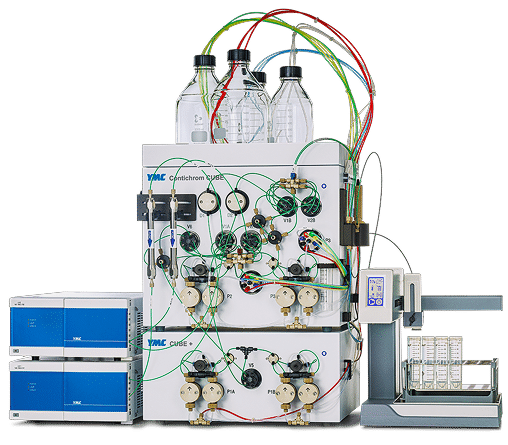
See the Contichrom® platform in action before you commit, then assess MCSGP polishing, CaptureSMB® capture, or both — computationally from your existing batch data, or experimentally at YMC ChromaCon’s Zurich facility. Develop your methods on a Contichrom CUBE and scale to the TWIN LPLC for GMP production.

See It First — Free Demo or Webinar

Not yet familiar with the Contichrom® platform? Start here. YMC ChromaCon offers no-charge demonstrations and introductory webinars tailored to your team.

  • On-site in Zurich (half day, 2–4 hours): see the CUBE in person, run ChromIQ® live, discuss your recombinant protein purification challenge with YMC ChromaCon application scientists
  • Remote webinar (1–3 hours): interactive live session covering MCSGP, CaptureSMB®, N-Rich®, ChromIQ® software, and the full Contichrom® ecosystem
  • Sessions can cover both polishing (MCSGP) and capture (CaptureSMB®) in the same engagement

→ Request a free demo or introductory webinar

Modeling Assessment for Proteins

Predict continuous chromatography performance on your protein process before running any new experiments. YMC ChromaCon builds calibrated mechanistic models from your existing batch data.

  • For MCSGP polishing (IEX, HIC): submit gradient batch runs with fraction analysis; YMC ChromaCon simulates MCSGP yield, purity, and productivity versus your batch polishing step
  • For CaptureSMB® capture (affinity, bind-elute): submit breakthrough curve data; YMC ChromaCon simulates CaptureSMB® productivity, resin utilization, and buffer savings versus your batch capture step
  • Both steps can be modeled together as separate work packages; no Contichrom® hardware required
  • Typical timeline: 3–5 weeks from receipt of data

→ Process Modeling Services

Experimental Feasibility Study — Your Protein, Your Resin

Your molecule is run on YMC ChromaCon’s Contichrom® platform at our facility in Zurich. We reproduce your batch method as a benchmark and run ≥ 3 continuous chromatography experiments — MCSGP, CaptureSMB®, or both.

  • Ship starting material to Zurich — typically ≥ 20× a single preparative batch run, scaled to 1 cm i.D. columns
  • We reproduce your analytical method and establish the batch benchmark using your resin and buffer system
  • Deliverable: side-by-side batch vs. continuous performance report with real data from your protein and resin, plus purified fractions for your independent verification
  • MCSGP and CaptureSMB® can be scoped as separate work packages; typical timeline: 4–6 weeks after receipt of material

→ YMC ChromaCon Feasibility Studies

Develop at Lab Scale — Rent or Purchase a CUBE

Method development for both MCSGP polishing and CaptureSMB® capture is performed on the Contichrom CUBE using your existing resin and buffers.

  • ChromIQ® MCSGP Wizard (polishing): builds the initial MCSGP operating point from your batch gradient conditions — typically 1–2 weeks of experimental work
  • ChromIQ® CaptureSMB Wizard (capture): converts your breakthrough curve data into an initial CaptureSMB operating point — first continuous run typically achievable within a day
  • AutoPeak® (polishing) or AutomAb® (capture) process control configured during CUBE development for robust, unattended operation
  • Both methods can be developed sequentially on a single CUBE

→ Contichrom CUBE Rental Program

→ Purchase a Contichrom CUBE

Scale to GMP Production — Contichrom TWIN LPLC

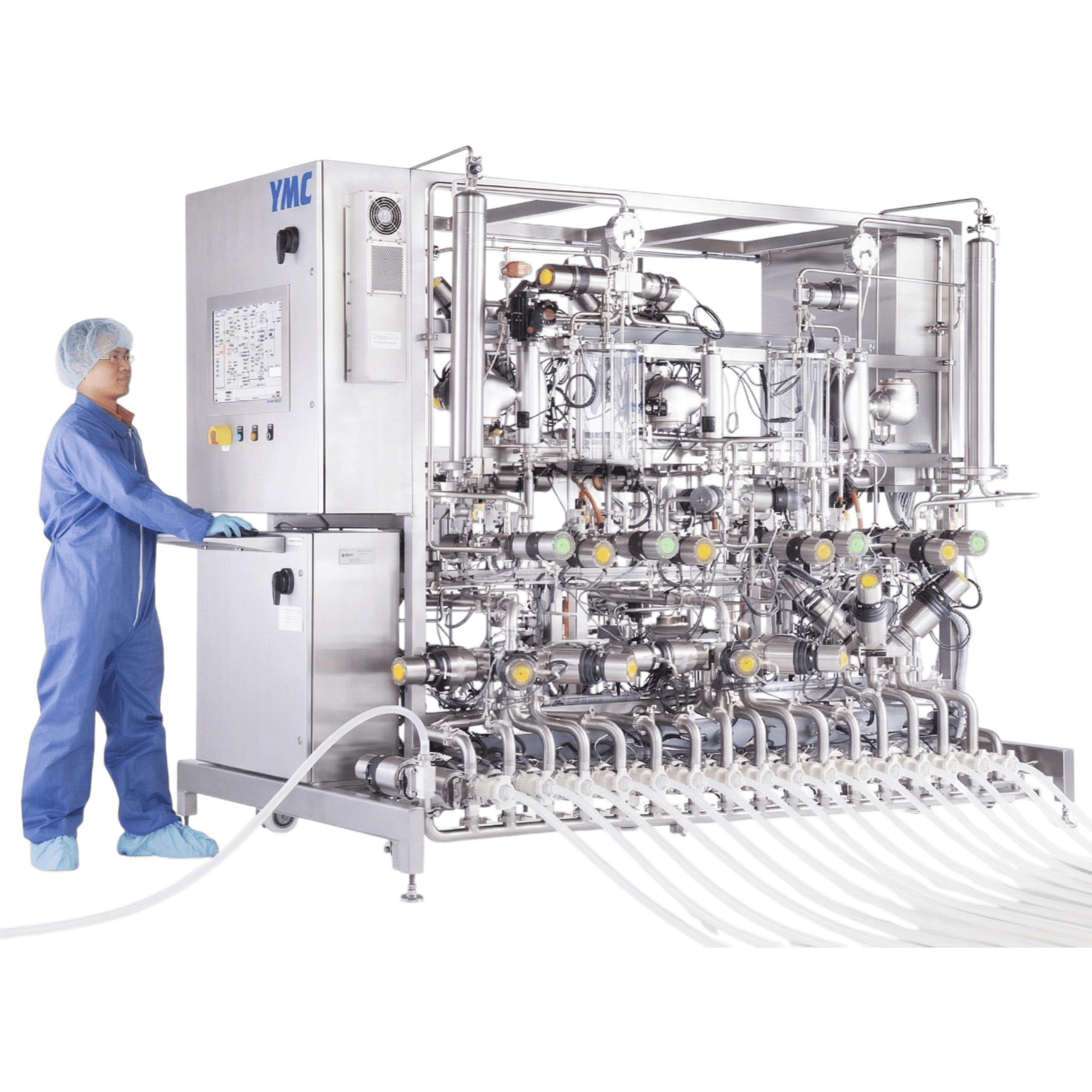
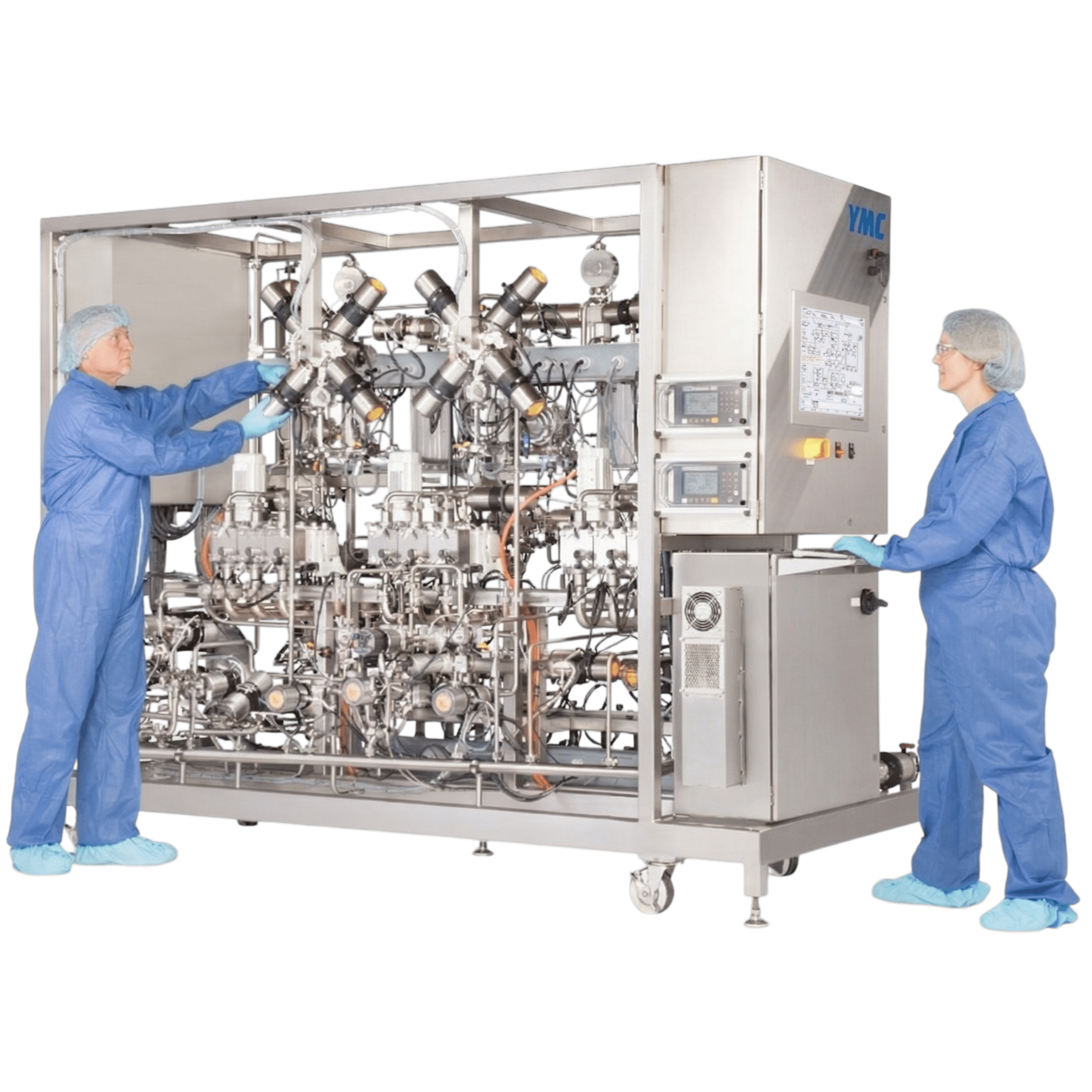
Methods developed on the CUBE transfer directly to the TWIN LPLC for manufacturing-scale production. ChromaCon provides scale-up consulting and GMP documentation support for both steps.

  • TWIN LPLC Polishing for MCSGP — continuous polishing with the same column chemistry and gradient conditions preserved at scale
  • TWIN LPLC Capture for CaptureSMB — continuous bind-elute affinity capture at pilot and production scale
  • Parameters scale predictably — bed height and linear flow rate maintained across scales
  • GMP documentation support (IQ/OQ/PQ) and scale-up consulting available for both steps

→ Scale-Up Consulting and Training

Ready to Intensify Your Recombinant Protein Downstream Process?

Unlock This Resource

Fill in your details to receive the full content straight to your inbox.

Frequently Asked Questions