





Twin-Column Cation-Exchange Chromatography for the Purification of Biomolecules, Biopharm International
Twin-column cation-exchange MCSGP for biomolecule purification showcases yield and productivity improvements over batch processing.
TWIN-COLUMN POLISHING
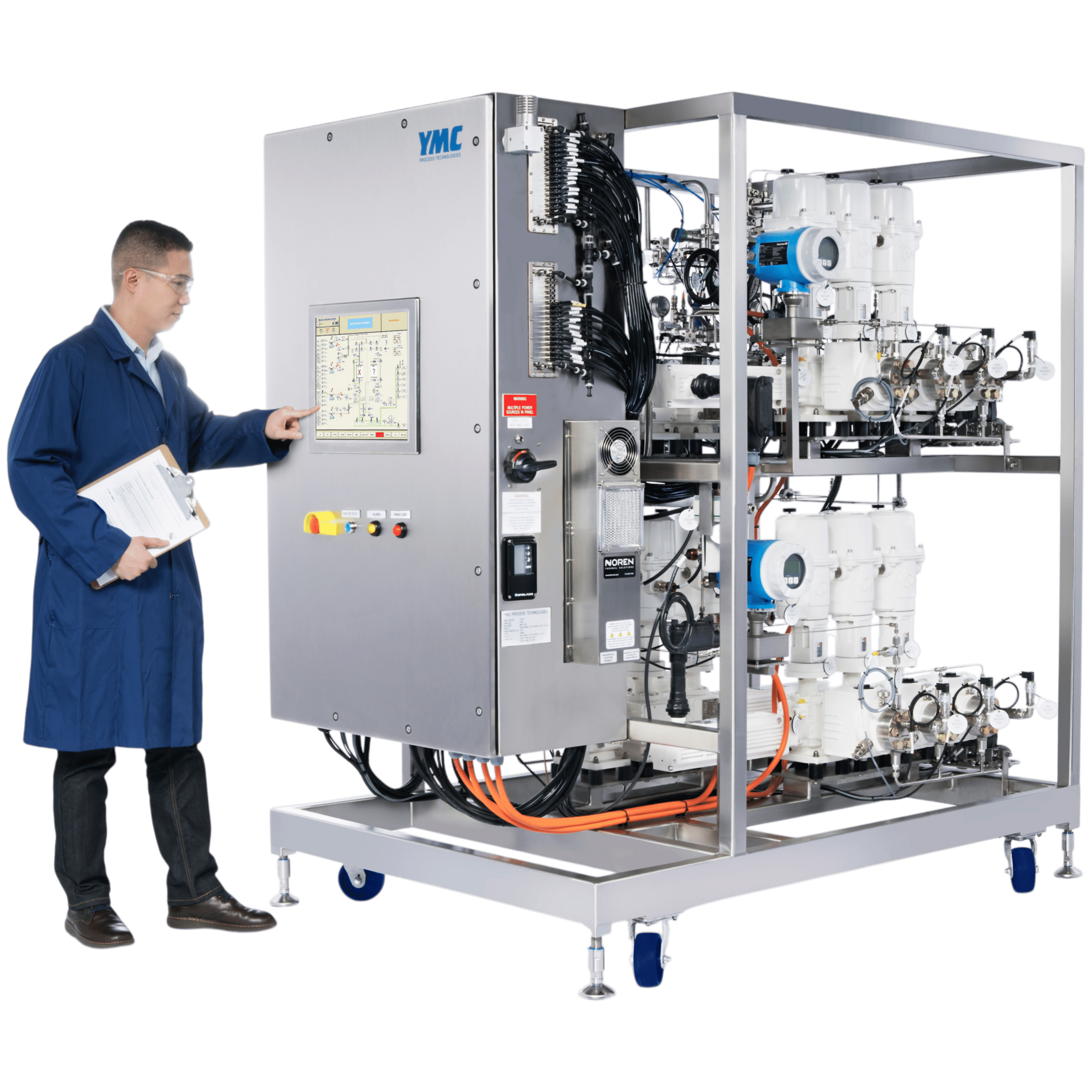
Recover what batch chromatography leaves behind. MCSGP is the twin-column preparative HPLC process that breaks the purity–yield trade-off in reversed-phase and ion-exchange polishing — same resin, same buffers, no chemistry change. With AutoPeak® dynamic process control, MCSGP delivers manufacturing-grade reproducibility on the Contichrom® platform, validated at GMP scale in peptide and oligonucleotide manufacturing.
Validated across 4 PPQ runs: 99.2% Purity | −96% In-process controls | 235 h unattended operation | +9% Yield gain
Source: Eisenhuth & Müller-Späth, Processes 2025 (Bachem Bivalirudin PPQ campaign, Open Access)
Every gradient polishing step faces the same constraint. A tight centre-cut achieves target purity — but discards product in the early and late fractions flanking the peak. Widening the cut recovers that product — but fails the purity specification. Storing side fractions and reprocessing them with additional batch runs only improves yield at a massive cost: it multiplies handling steps, analytical burden, buffer consumption, and campaign time.
This is not a method development failure. It is an inherent limitation of single-column batch chromatography. When your product and its impurities are closely-eluting, no fractionation strategy can simultaneously maximize both purity and yield on a single column.
MCSGP (Multi-column Counter-current Solvent Gradient Purification) does not optimise the cut — it eliminates the trade-off by continuously recycling the impure side-fractions rather than discarding them.
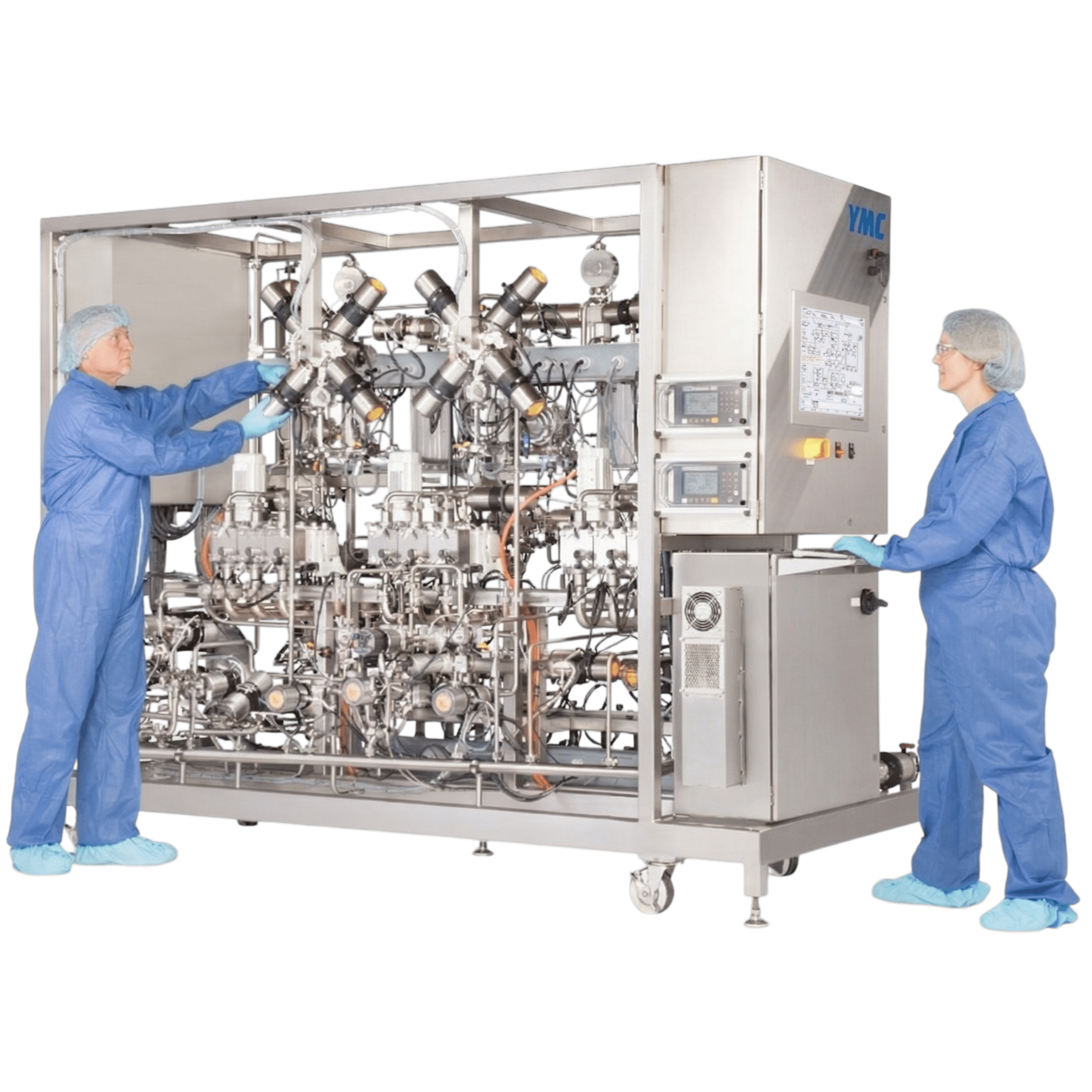
Two identical columns operate in a coordinated cyclic process. While one column elutes, the other regenerates and loads fresh feed in parallel. The early-eluting and late-eluting impure fractions — the side-cuts that batch processes collect, pool, store, and reprocess — are instead transferred directly from the first column to the second column with in-line dilution, ready to re-adsorb and be re-separated in the next switch. Product never leaves the system unless it is pure. The result is that high yield and high purity are achieved simultaneously, in a continuous automated process.
Because MCSGP operates with the same gradient as your existing batch polishing step, there is no change to resin, buffers, or eluent composition. Your batch method is the starting point.
The performance gains are quantified across multiple validated industrial applications. Bachem AG and Bristol Myers Squibb have both published results across peptide and protein applications.
Absolute yield increase at target purity
Solvent reduction vs. batch process
Re-chromatography runs, internal recycling replaces pooling
Campaign time (peptide API), Bachem, GMP production scale
Each MCSGP cycle consists of two switches, with one elution from each column per cycle. Within a switch, four phases run in sequence:
| Phase | Upstream column | Downstream column |
|---|---|---|
| P1 – Elution start | Gradient started; weakly adsorbing impurity (W) removed | Regeneration completed; preparation for loading |
| P2 – Weak recycling | Columns interconnected; early low-purity fractions (W/P) transferred to downstream column with in-line dilution for re-adsorption | Receives recycled W/P fraction + binds product |
| P3 – Product collection | Pure product (P) center-cut collected | Fresh feed loaded |
| P4 – Strong recycling | Late low-purity fractions (P/S) transferred to downstream column with in-line dilution for re-adsorption | Receives recycled P/S fraction + binds product |
At the end of the switch, the two columns exchange positions by valve switching — no physical movement — and the cycle repeats. The process reaches a cyclic steady state within 1–2 cycles, at which point product quality and yield are consistent from cycle to cycle.
In-line dilution during the recycling phases (P2 and P4) lowers the eluotropic strength of the transferred fraction, ensuring the recycled product re-adsorbs onto the downstream column rather than passing through. The dilution factor is calculated automatically by the MCSGP Wizard from the batch chromatogram.
Want to learn MCSGP?
Join our Continuous Chromatography Workshop.
Fixed-time phase boundaries work during early MCSGP development when conditions are well-defined and the process is closely supervised. For manufacturing campaigns — where column aging shifts retention times, buffer batches vary, and the process must run automatically for hundreds of cycles — AutoPeak® is essential.
AutoPeak® replaces fixed-time phase transitions with real-time UV-triggered boundaries. The UV signal at the outlet of the eluting upstream column is monitored continuously. When the signal crosses the defined threshold — an absolute mAU value on the ascending peak front, or a percentage of that switch’s actual peak maximum on the descending tail — a new process phases is started. Four transitions can be controlled independently: Weak Recycling Start (t2), Product Collection Start (t3), Product Collection End (t4), and Strong Recycle End (t5).
The critical detail is that the relative triggers (% of peak maximum) are recalculated fresh every switch from that switch’s actual UV maximum — not from a fixed reference. This means AutoPeak® adapts to changes in peak height as well as peak position. If feed concentration drops and the elution peak shrinks, the tail triggers still work at the correct relative point. Collection windows follow the peak wherever it moves, across the full column lifetime, without any operator input after initial configuration.
The trigger values are pre-populated from the section boundaries set on the batch chromatogram — no manual entry required.
See Dynamic Process Control → for the full mechanism and trigger type guidance
Every MCSGP run is captured in the Evaluation Center — ChromIQ®’s integrated data analysis module.
The ChromIQ® logbook records every system event and AutoPeak® trigger with timestamp and triggering value — an unalterable audit trail of every decision the system made.
| Advantage | What it means in practice |
|---|---|
| 10–50% absolute yield increase | Product recovered from side fractions that batch processes discard — directly reduces the crude material required per lot |
| Re-chromatography eliminated | No pooling, storage, or reprocessing of side fractions — QC burden and campaign time reduced proportionally |
| Up to 5× throughput gain | Parallel column operation and smaller columns eliminate batch idle time — more product from the same equipment footprint |
| Same resin and buffers | No change to chromatographic chemistry — your existing batch conditions are the starting point for MCSGP development |
| 24/7 unattended operation | AutoPeak® maintains consistent output quality without operator supervision across extended campaigns |
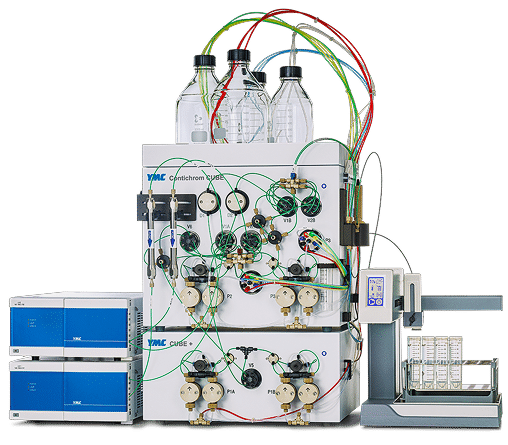
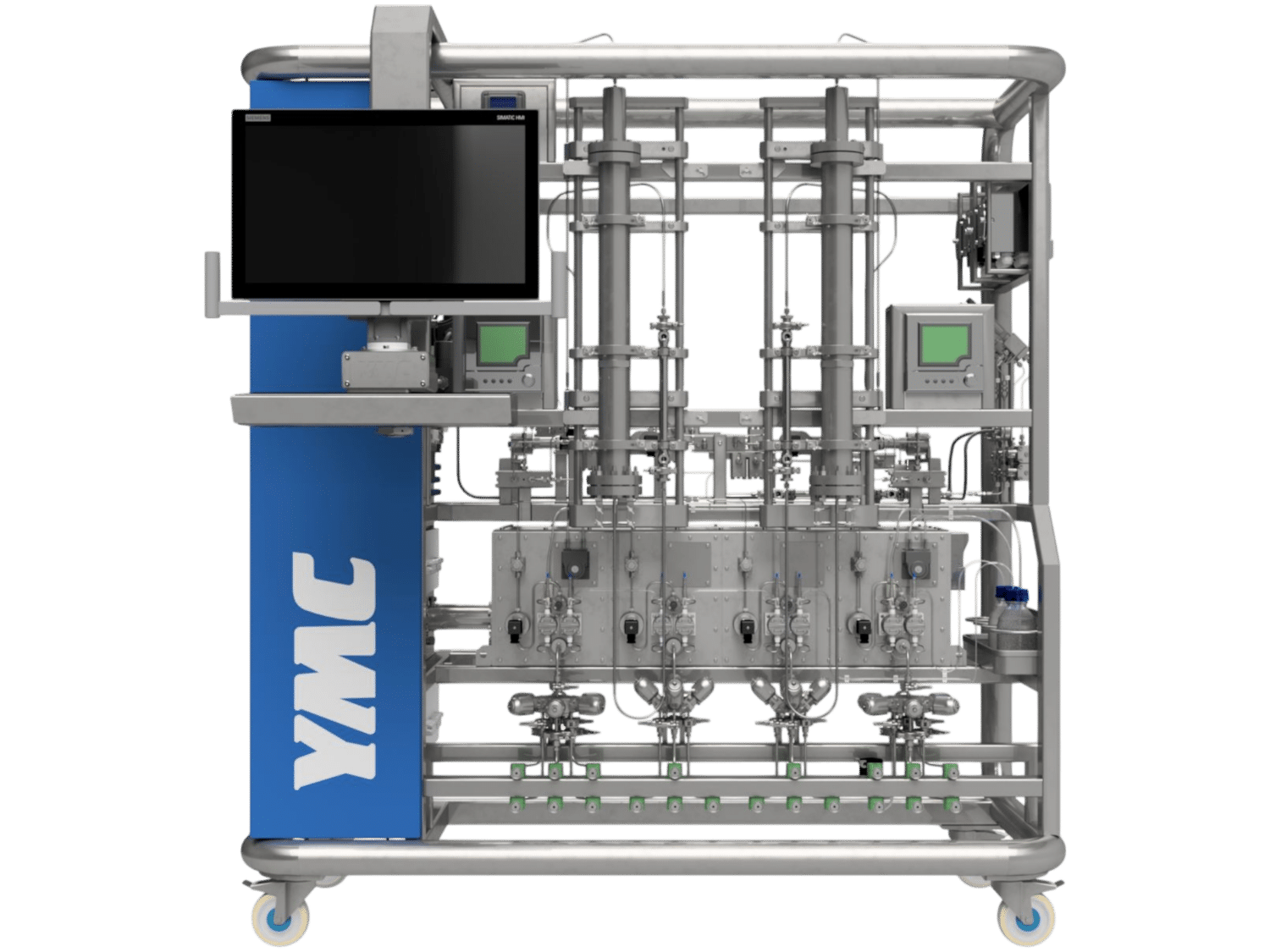
| Direct scale-up path | Methods developed on the Contichrom® CUBE transfer directly to the Contichrom® PILOT 300X and TWIN HPLC |
MCSGP is applicable to any gradient polishing step where the product peak co-elutes with structurally similar impurities — the most common and most difficult scenario in downstream processing.
| Molecule class | Stationary phase | Typical separation |
|---|---|---|
| Monoclonal antibodies | Cation exchange (CEX) | Charge variant separation — acidic/basic isoforms from main species, aggregate (HMW) and fragment (LMW) separation |
| Bispecifics / antibody variants | CEX, mixed-mode | Complex charge variant profiles; half-antibody, parental antibody, and mis-paired species removal |
| Antibody-drug conjugates (ADCs) | Hydrophobic interaction (HIC), RP | DAR species separation; unconjugated antibody removal |
| Peptides | Reversed phase (RP) | Deletion sequences, oxidized variants, closely eluting impurity removal |
| Oligonucleotides | Anion exchange (AEX) | n−1 / n+1 shortmers, backbone variants, closely resolved sequence impurities |
| Recombinant proteins | CEX, AEX, HIC | PEGylation isoform separation; aggregate and charge variant removal |
| Impurity isolation | RP, AEX | Preparative isolation of low-abundance impurities for reference standard production |
Recover Everything. Reprocess Nothing.