Twin-Column Cation-Exchange Chromatography for the Purification of Biomolecules, Biopharm International
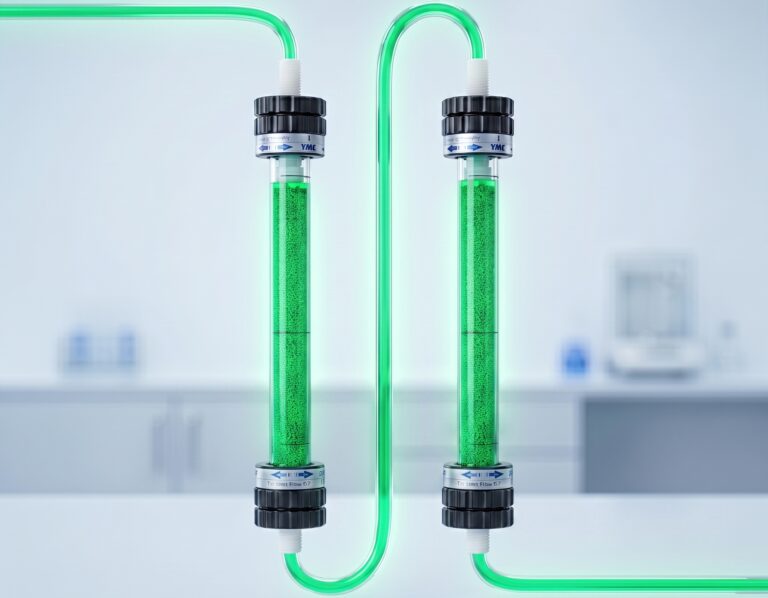
Twin-column cation-exchange MCSGP for biomolecule purification showcases yield and productivity improvements over batch processing.
RESOURCE LIBRARY
The evidence behind every Contichrom® process. Download the open-access PPQ paper, browse application notes by molecule, watch on-demand webinars, and access the peer-reviewed publications underpinning MCSGP, CaptureSMB®, and N-Rich® at GMP commercial scale.
The first peer-reviewed PC/PPQ framework for MCSGP. 95% IPC reduction, 73% PMI reduction, 96% gross-to-gross yield — validated at GMP commercial scale on Bachem Bivalirudin.
Eisenhuth, R. & Müller-Späth, T. — Processes, 2025 (Open-Access)
First peer-reviewed AIEX MCSGP for therapeutic siRNA. Yield improved from 80% to 93% on a sugar-conjugated siRNA sense strand — software-aided method development enabled fast batch-to-MCSGP transfer. Throughput increased 87%.
Weldon et al. Org. Process Res. Dev. 2025, (Open-Access)
Proof-of-concept MCSGP for AAV2 polishing. Full capsid content increased from 30% to 68% (ddPCR) after six cycles — with +20.6% yield, +23% productivity, and 27% reduced buffer consumption vs batch AEX. AutoPeak® PAT validated against cryo-TEM and ddPCR.
Müller et al.
Biotechnol. Bioeng. (Open-Access)
Application notes, peer-reviewed papers, process guides, datasheets, and recorded webinars — searchable by application, technology, product, or service.
Twin-column cation-exchange MCSGP for biomolecule purification showcases yield and productivity improvements over batch processing.
Introduction of CaptureSMB twin-column continuous capture demonstrates superior productivity, capacity utilization, and 10-30% resin cost reduction versus batch chromatography.
Twin-column continuous chromatography applied for F(ab’)2 fragment capture demonstrates the technology’s applicability to non-mAb biotherapeutics.
Twin-column continuous capture technology increases Protein A resin capacity utilization from 50-60% to near-maximum levels.
Twin-column continuous chromatography presented as a productivity-enhancing technology for biopharmaceutical purification processes.
MCSGP applied for purification of common light-chain bispecific antibodies addresses the unique separation challenges posed by this antibody format.
Purification is where oligonucleotide yield is lost, and the synthesis has to be sized to cover it. Converting a reversed-phase batch method for a GalNAc-conjugated gapmer to twin-column MCSGP lifted recovery from 52.7% to 91.6% at the same purity — enough to shrink the synthesis step by 42.5% for the same daily output.
An established anion exchange batch method for a conjugated siRNA sense strand, converted to continuous twin-column MCSGP: 13 cycles, 27 product elutions, and yield up from 80% to 93% at unchanged purity — plus a software-aided route from batch chromatogram to running method.
Continuous chromatography is already in production use, but there was no published account of how to validate it for a regulatory filing. This study provides one, working through Process Characterization and Performance Qualification for MCSGP on commercial-scale Bivalirudin purification: 34 parameters assessed, four tested, one critical.
Green solvents have always cost the peptide industry recovery. This study shows the loss is a property of batch chromatography, not of the solvent: run the same green eluent counter-currently and the yield comes back.
YMC ChromaCon Chromatography Newsletter.
Subscribe for New Resources Unsubscribe anytime.