Research Highlight
Green Solvents Without the Yield Penalty
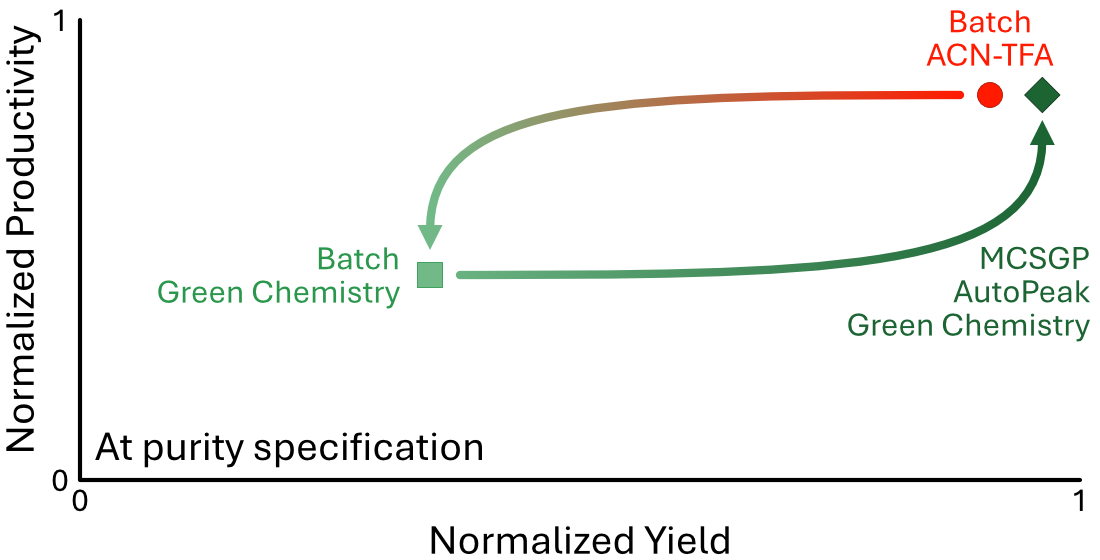
Green solvents such as ethanol and dimethyl carbonate have long been proposed in place of acetonitrile, with acetic acid in place of TFA, but their industrial adoption has been limited by lower yield and productivity in batch operation. A new open-access study shows that the yield gap closes when the same eluents are run in a counter-current twin-column process (MCSGP).
Counter-Current Chromatography Enables Use of Green Solvents for Productive Peptide Purification Processes
Competing interests, as disclosed by the authors: D.H., S.V., T.M.-S. and — for the duration of the work — R.P. are employees of YMC ChromaCon, which commercializes the technology described in the paper. The research received no external funding.
Citation (BibTeX)
@article{prestia2026countercurrent,
  title   = {Counter-Current Chromatography Enables Use of Green Solvents
             for Productive Peptide Purification Processes},
  author  = {Prestia, Rosella and Hauri, Damian and Sponchioni, Mattia
             and Vogg, Sebastian and M{\"u}ller-Sp{\"a}th, Thomas},
  journal = {Separations},
  volume  = {13},
  number  = {7},
  pages   = {195},
  year    = {2026},
  doi     = {10.3390/separations13070195}
}
Preparative reversed-phase liquid chromatography is one of the most resource-intensive stages of synthetic peptide manufacturing, and production processes commonly rely on acetonitrile (ACN) with trifluoroacetic acid (TFA). That eluent system is chosen mainly for its high chromatographic resolution — and it is exactly the combination that environmental and safety pressure is now working to remove.
Greener alternatives are well characterized. Ethanol is low-toxicity and bio-derived; dimethyl carbonate (DMC) is an emerging bio-based substitute for acetonitrile; acetic acid is a typical candidate for a green counterion in place of TFA. What has blocked their adoption is not chemistry but process economics: in conventional batch chromatography, they lead to decreased resolution and product loss.
The finding: green eluents do not fail on purity, they fail on collection window. Every green batch run in this study met its purity specification. What collapsed was recovery — and the study attributes that to the inability of a batch process to use partially resolved fractions, rather than to insufficient purity.
This highlight summarizes the study, its data, and its limitations, and links to the full open-access article.
1. Why This Study Matters: The Solvent Problem in Peptide Purification
Peptide therapeutics are in a demand surge. More than 80 peptide drugs have received regulatory approval since 2023, with over 200 candidates in clinical development. GLP-1 receptor agonists have become the dominant class in the pharmaceutical market, and the global anti-obesity segment is projected to exceed $100 billion by 2030. That demand has exposed manufacturing bottlenecks in synthesis, purification, and fill-finish.
Purification carries a disproportionate share of the burden. Solid-phase peptide synthesis already runs at a process mass intensity of roughly 3,000–15,000 kg of material per kg of active ingredient for peptides in the 1,000–5,000 Da range. Downstream chromatography then adds several hundred to several thousand liters of eluent per kilogram of purified peptide, of which 10–40% is organic modifier.
Three problems with the standard eluent system
- TFA is a PFAS Trifluoroacetic acid belongs to the per- and polyfluoroalkyl substances and is highly persistent in the environment — it is a “forever chemical” with potential toxicity risks. Regulatory and environmental pressure on PFAS in pharmaceutical manufacturing is increasing.
- Acetonitrile is flammable and toxic Replacing the organic modifier is therefore one half of the problem, alongside replacing the acid. Ethanol and dimethyl carbonate are the substitutes tested here.
- The dilution prevents recycling Because the organic modifier is so heavily diluted, the eluent cannot practically be recycled. The paper links that volume directly to waste generation, environmental impact, and limits on process throughput.
The obstacle to switching has been consistent and well documented: replacing ACN/TFA with green alternatives reduces chromatographic resolution, and reduced resolution in a batch process means lower yield and lower productivity. Until now, no industrially scalable process had combined high purity, high yield, and a low environmental footprint.
2. The Study at a Glance
Researchers at YMC ChromaCon and Politecnico di Milano purified two therapeutic peptides using eluent systems containing no acetonitrile and no TFA, first as conventional batch processes and then as continuous multi-column counter-current solvent gradient purification (MCSGP) processes. Method development held the column, the 10 CV gradient volume and the 10 g/Lresin loading fixed, so that the batch comparisons isolate the eluent system; the MCSGP processes were then built from those batch methods.
Tirzepatide yield at 89.0% purity, using ethanol/acetic acid
g/Lresin/h productivity, against 5.3 for the ACN/TFA batch benchmark
Liters of solvent per gram of product — 21% below the conventional batch
Tetracosactide yield at 94.0% purity, using dimethyl carbonate/acetic acid
The two model peptides
Tirzepatide
A 39-amino-acid dual GIP/GLP-1 receptor agonist incorporating non-natural residues and a C20 fatty diacid — representative of the structural complexity of next-generation peptide drugs. Purified from 67.5% crude purity using ethanol/acetic acid, against a purity specification of ≥89.0%.
Tetracosactide
A 24-amino-acid analogue of adrenocorticotropic hormone (ACTH), structurally simpler and without lipid conjugation, used clinically to assess adrenal function. Purified from 55.1% crude purity using dimethyl carbonate/acetic acid, against a specification of ≥92.0%.
Both molecules are conventionally purified with ACN and TFA, and both were run against an optimized ACN/TFA batch process as the reference. Together they bracket the range of therapeutic peptides — a heavily engineered modern construct and a long-established sequence — while sharing the same downstream challenges.
3. Where the Yield Goes
The clearest way to understand the result is to look at how the product pool is defined in each of the three processes. The schematic below redraws the Tirzepatide elution profiles reported in the study; the shaded area is the material actually collected.
- Weak recycling
- Product collection / batch pool
- Strong recycling
- Discarded
Acetonitrile with TFA resolves Tirzepatide from its closely related impurities well enough that a wide slice of the peak clears the 89% purity specification, so a single-pass batch run recovers 81.9% of the loaded material. This is the benchmark every green alternative is measured against.
- Purity
- 89.9%
- Yield
- 81.9%
- Productivity
- 5.3 g/Lresin/h
- Solvent
- 4.3 L/g
Schematic representation of the profiles reported in the study, drawn to show how the product pool is defined in each mode. Values are the measured process results; MCSGP figures are averages of cycles 4 and 5 at cyclic steady state. Colors follow the convention used in the article’s figures: blue for weak-side recycling, pink for the collected product pool, green for strong-side recycling. See Figures 1–3 of the original article for the recorded chromatograms.
A Simple Analogy
Picture a sorting line with a single pass. Items that are clearly good go in the keep bin, items that are clearly bad go in the reject bin, and anything ambiguous — good product mixed with something else — has to go somewhere. In a batch process, ambiguous material goes in the reject or reprocess bin — either written off, or set aside for a separate re-sorting job later.
MCSGP adds a return conveyor. The ambiguous fractions go back to the start of the line instead of into the bin, and get sorted again on the next pass. Sharper sorting still helps, but blunter sorting no longer costs product — it costs another trip around the loop.
4. The Green Solvent Penalty, Quantified
Both peptides were first optimized as conventional batch processes using a common gradient-narrowing procedure, so the green and conventional batches are directly comparable. The results reproduce, with numbers, the trade-off that has kept green eluents out of production.
Tirzepatide with ethanol/acetic acid
Under ACN/TFA, the highest purity appeared along the tail of the main peak and a wide collection window satisfied the 89.0% specification, recovering 81.9% at 5.3 g/Lresin/h. Under ethanol/acetic acid the peak took on a double-peak shape, with high purity only at the front and progressive co-elution with closely related impurities after it. The usable window narrowed sharply and yield fell to 43.2%, with productivity down to 2.9 g/Lresin/h.
Tetracosactide with dimethyl carbonate/acetic acid
The ACN/TFA batch produced a sharp product peak with fractions above 95.0% purity and a maximum in-specification yield of 82.8%. The DMC/AcOH batch produced a very narrow collection window followed by a long tail that was high in purity but low in product concentration. The pool consisted of two fractions, giving 92.3% pool purity at 35.3% yield — a 2.3-fold reduction against the conventional batch — and productivity of 1.6 g/Lresin/h.
The study’s own summary of the batch results: batch processing does not allow for high-yielding, productive purification using green eluent systems for the peptides and conditions investigated.
The penalties compound rather than trade off. Lower recovery — and, for Tetracosactide, a longer process time from the added counterion exchange — reduced productivity by a factor of two and three respectively, and solvent consumption moved the wrong way at the same time — roughly doubling for Tirzepatide and rising more than three-fold for Tetracosactide. Reducing the loading density would recover some yield, but at the cost of still lower productivity and still more solvent. In batch operation there is no setting that delivers all three.
5. How MCSGP Closes the Gap
MCSGP — multi-column counter-current solvent gradient purification — is a continuous, twin-column form of gradient chromatography. It does not improve the resolution of the separation. It changes what happens to the fractions that resolution fails to resolve.
The operating principle
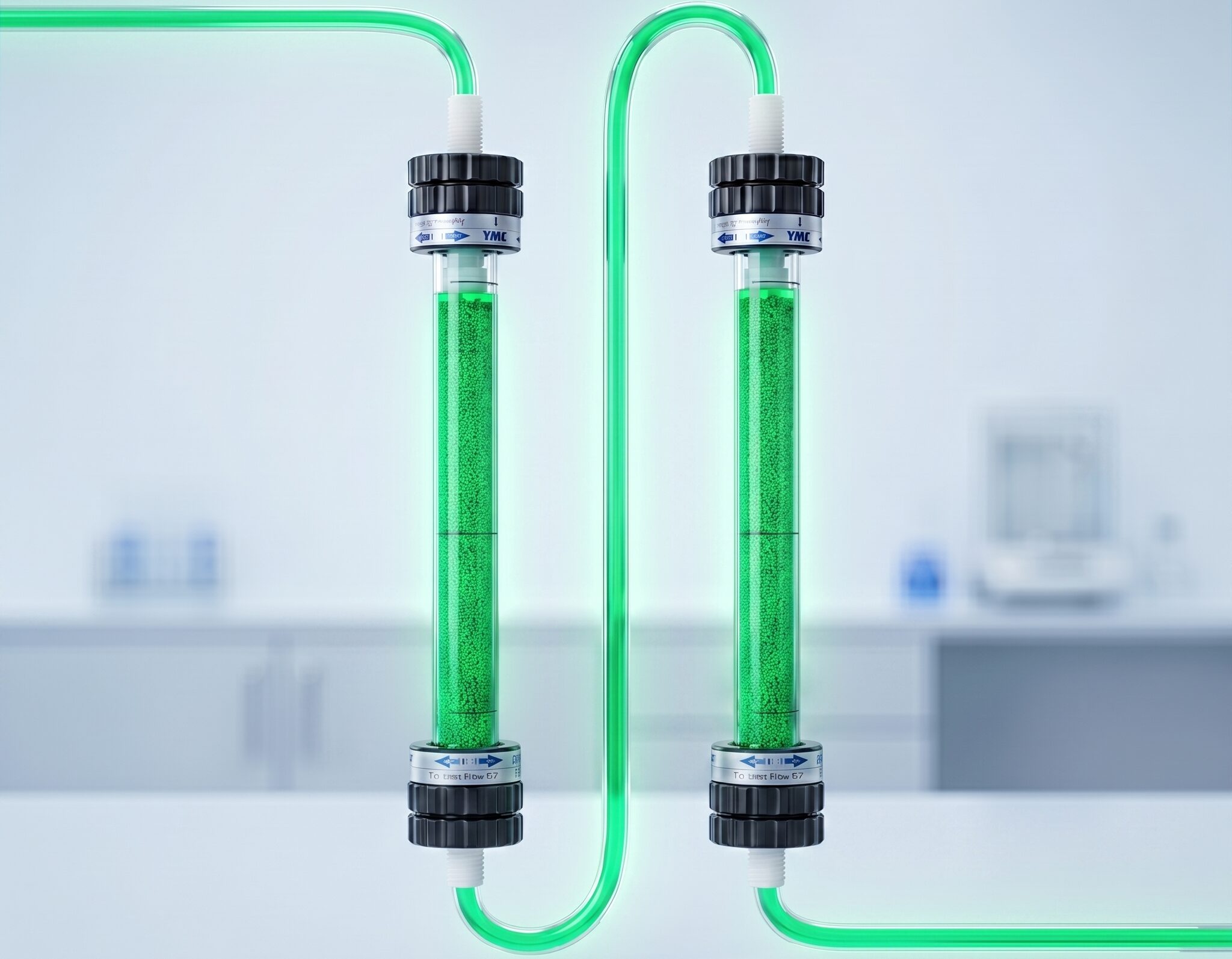
- Two columns, one repeating switch While one column is eluting, the other is being loaded. The roles reverse at each switch, so neither column sits idle and the process runs continuously.
- The overlap regions are recycled, not discarded The elution is separated into weakly adsorbing impurities, the product fraction, and strongly adsorbing species. The two overlap regions between them — product co-eluting with weak impurities, and product co-eluting with strong impurities — are returned to the loading column instead of being discarded.
- Inline dilution keeps recycled material on the column For Tetracosactide, a 4.5-fold inline dilution was used to ensure the recycled material re-adsorbed completely on the downstream column. For Tirzepatide, a 4-fold dilution served a second purpose: preventing precipitation or gelation during the collection and recycling phases.
- The process converges to a cyclic steady state Recycled material accumulates until the internal concentration profile stabilizes. Here that took three cycles; from cycle four onward the chromatograms overlaid almost exactly, and cycles 4 and 5 were used for the performance calculations.
Holding the cut points: UV-based dynamic control
The switch points were set from the live UV signal rather than from elapsed time, using AutoPeak process control. For the Tirzepatide process, a first threshold at 15 mAU opened weak-side recycling, a second at 200 mAU started product collection, and a fall to 75% of the peak maximum — plus a 20-second delay — began strong-side recycling. Because the cut points track the actual peak, the process maintained reproducible cyclic steady-state operation despite variations in the elution profiles.
- Columns One, operated in sequential steps
- Side fractions Discarded, or re-chromatographed in a separate campaign
- Yield vs purity A direct trade-off — a wider pool means lower purity
- Effect of low resolution Directly reduces yield and productivity
- Control Fraction collection, typically with offline analysis
- Columns Two, interconnected and switching continuously
- Side fractions Recycled internally onto the loading column
- Yield vs purity Largely decoupled — both can be held high
- Effect of low resolution Absorbed as additional cycle time, not lost product
- Control Automated UV-triggered switching (AutoPeak)
Applied to the green eluent systems, that mechanism recovered what the batch processes had been discarding. The ethanol/acetic acid MCSGP process reached 88.1% yield at the 89.0% purity specification and 6.3 g/Lresin/h — higher yield and higher productivity than the conventional ACN/TFA batch, using 3.4 L/g of solvent instead of 4.3 L/g. The DMC/AcOH MCSGP process for Tetracosactide, which used weak-side recycling only, reached 93.8% yield at 94.0% purity, exceeding the conventional batch on both.
6. Full Results: Process Comparison
The table below reproduces the study’s process comparison. For the batch processes, the pool with the maximum achievable yield within specification is reported; for MCSGP, the values are averages of steady-state cycles 4 and 5.
Swipe the table sideways to see purity, yield, productivity and solvent use.
| Process / eluent system | Purity (%) | Yield (%) | Productivity (g/Lresin/h) | Solvent (L/g) |
|---|---|---|---|---|
| Tirzepatide 39 aa · 67.5% crude · specification ≥89.0% | ||||
| Batch — ACN/TFA (benchmark) | 89.9 | 81.9 | 5.3 | 4.3 |
| Batch — ethanol/acetic acid | 90.7 | 43.2 | 2.9 | 7.8 |
| MCSGP — ethanol/acetic acid | 89.0 | 88.1 | 6.3 | 3.4 |
| Tetracosactide 24 aa · 55.1% crude · specification ≥92.0% | ||||
| Batch — ACN/TFA (benchmark) | 93.3 | 82.8 | 4.8 | 5.0 |
| Batch — dimethyl carbonate/acetic acid | 92.3 | 35.3 | 1.6 | 17.7 |
| MCSGP — dimethyl carbonate/acetic acid | 94.0 | 93.8 | 2.9 | 7.9 |
Source: Table 3, Prestia et al., Separations 2026, 13, 195 (CC BY). Green values improve on the conventional ACN/TFA batch benchmark; red values fall short of it.
Experimental conditions
YMC-Triart C18-S, 150 × 4.6 mm ID, 10 µm particle size, 12 nm pore size.
Contichrom CUBE 30, controlled by ChromIQ v9.0 with AutoPeak dynamic process control.
10 g/Lresin loading, 10 CV linear gradient, 300 cm/h elution velocity, room temperature.
20 mM acetic acid with 1% ethanol (A) to 90% ethanol (B); ACN/TFA reference at 0.1% TFA.
20 mM acetic acid with 0.1% DMC (A) to 5% DMC (B), pH 3.2, preceded by counterion exchange.
Batch chromatograms and fraction analytics imported into MCSGP Wizard v9.0.4.11 to set the operating parameters.
7. What This Means for Peptide Manufacturing
Sustainability and process performance have generally been treated as a trade-off in peptide downstream processing. The practical contribution of this study is to separate them into two independent levers — the eluent chemistry and the operating mode — and to show that the second can pay for the first.
For Tirzepatide, the green continuous process was simply the better process on every measured axis: higher yield, higher productivity, and lower solvent consumption than the conventional batch, while eliminating both TFA and acetonitrile. For that molecule at least, removing a PFAS from the purification step did not have to be traded against process performance. Because eluent consumption is directly associated with the overall waste of the step, and the dilution of the organic solvent prevents recycling, lower consumption means less waste.
The authors also argue that the scalability and operational robustness of MCSGP with AutoPeak support implementation at manufacturing scale, as previously demonstrated for complex biopharmaceutical products such as oligonucleotides, and that the technique has been characterized for process qualification. In that context they identify solvent viscosity and the associated pressure drop as the main additional consideration when using green eluents.
For the wider picture — where MCSGP sits in a peptide purification workflow and what it has delivered at commercial scale — see peptide purification with MCSGP. The regulatory side of the same question is taken up by another study in this series, which works through Process Characterization and Process Performance Qualification on a commercial peptide.
What the study does not claim
- These are intermediate purity targets, not release specifications. The paper states that the 89.0% and 92.0% values represent intermediate purity targets, and that intermediate chromatographic steps are typically run under less stringent purity requirements. Final therapeutic peptide standards range from 99.0% to 99.9% and are reached across consecutive purification stages.
- The work is at laboratory scale. Two molecules, 150 × 4.6 mm columns, 10 g/Lresin loading. Scale-up is argued from prior MCSGP experience rather than demonstrated here.
- Green MCSGP did not win on every metric. For Tetracosactide, productivity remained below the conventional batch and solvent consumption above it, because the acetate-form process includes an 8 CV on-column counterion exchange from TFA to acetate — a step the ACN/TFA route would require downstream in any case, since the drug substance is administered as the acetate salt.
- The authors have a commercial interest. Four of the five are employees of YMC ChromaCon, which commercializes MCSGP; the paper discloses this, and reports the full batch comparisons so that readers can assess the baseline independently.
8. Key Terms in This Study (Glossary)
| Term | Definition |
|---|---|
| AutoPeak | UV-based dynamic process control that sets chromatographic cut points from the live detector signal rather than from elapsed time, so switching tracks the actual peak. |
| Collection window | The portion of the elution profile that can be pooled while still meeting the purity specification. A narrower window means lower yield at the same purity. |
| Counterion exchange | Replacing the counterion associated with a peptide — here TFA with acetate — so the ion form is consistent with the eluent system and with the final drug product. |
| Cyclic steady state | The condition in a continuous process where each cycle reproduces the previous one. In this study it was reached after three MCSGP cycles. |
| Dimethyl carbonate (DMC) | A bio-based, low-toxicity organic solvent investigated as a green replacement for acetonitrile in reversed-phase liquid chromatography. |
| Eluent consumption | Liters of mobile phase used per gram of purified product. The paper describes it as directly associated with the overall waste of the purification process. |
| Green solvent | A solvent with reduced hazard to health and environment, preferably renewably sourced and readily biodegradable, as assessed by frameworks such as the CHEM21 guide or the GSK solvent sustainability tool. |
| Loading density | The mass of crude material loaded per liter of resin (g/Lresin). The paper notes that lower loading density would enhance yield, but at the cost of reduced productivity and greater solvent consumption. |
| MCSGP | Multi-column counter-current solvent gradient purification: a continuous twin-column gradient process that recycles partially resolved side fractions between columns instead of discarding them. |
| Pareto front | The set of best achievable combinations of two competing objectives — here yield and purity. A green eluent shifts the whole curve downward relative to ACN/TFA. |
| PFAS | Per- and polyfluoroalkyl substances, a class of highly persistent synthetic chemicals subject to increasing regulatory restriction. TFA belongs to this class. |
| Process mass intensity (PMI) | Total mass of material input per unit mass of product. For peptide solid-phase synthesis it typically ranges from 3,000 to 15,000 kg per kg of active ingredient. |
| Productivity | Mass of product produced per liter of resin per hour (g/Lresin/h). It combines yield, loading, and cycle time into a single throughput measure. |
| Strong-side recycling | Return of the trailing overlap region — product co-eluting with strongly adsorbing impurities — onto the loading column. |
| Weak-side recycling | Return of the leading overlap region — product co-eluting with weakly adsorbing impurities — onto the loading column. |
| Yield (recovery) | The fraction of loaded target material that ends up in the collected product pool, at the stated purity specification. |
9. Frequently Asked Questions
Yes. In this study Tirzepatide was purified with ethanol/acetic acid and Tetracosactide with dimethyl carbonate/acetic acid — neither containing acetonitrile or trifluoroacetic acid. Run as conventional batch chromatography, both green systems met their purity specification but lost roughly half the product. Run as continuous MCSGP processes, they reached 88.1% and 93.8% yield respectively, matching or exceeding the ACN/TFA batch benchmark at the same purity specification.
MCSGP — multi-column counter-current solvent gradient purification — is a continuous, twin-column form of gradient chromatography. Instead of discarding the side fractions in which product overlaps with impurities, it returns them to the second column while that column is being loaded. The pure center of the peak goes to the product pool; the impure shoulders receive another pass. This decouples yield from purity, which are inherently in tension in single-column batch operation.
Trifluoroacetic acid is a per- and polyfluoroalkyl substance (PFAS) and is highly persistent in the environment, which places it in the path of tightening regulation. Acetonitrile, its usual partner in reversed-phase peptide purification, is flammable and toxic. Both are used in large volumes: preparative peptide chromatography can consume hundreds to thousands of liters of eluent per kilogram of purified peptide, of which 10–40% is organic modifier.
Approximately half, in this study. At a fixed purity specification, Tirzepatide yield fell from 81.9% with ACN/TFA to 43.2% with ethanol/acetic acid, and Tetracosactide yield fell from 82.8% to 35.3% with dimethyl carbonate/acetic acid. Productivity dropped by factors of two and three respectively. Importantly, the purity target was met in every case — the limitation was the width of the collection window, not the achievable purity.
It depends on the molecule. For Tirzepatide, MCSGP with ethanol/acetic acid used 3.4 L/g against 4.3 L/g for the ACN/TFA batch — roughly 21% less, with neither acetonitrile nor TFA. For Tetracosactide it used 7.9 L/g against 5.0 L/g, because that process integrates an on-column counterion exchange from TFA to acetate. That exchange would be required downstream of the conventional route in any case, since the drug substance is administered as the acetate salt.
The study treats it as a design consideration rather than a barrier. Its conclusions state that using green eluents mainly requires consideration of solvent viscosity and the associated pressure drop, and identifies this as the principal additional factor when scaling green MCSGP. Ethanol is more viscous than acetonitrile.
Two, selected for contrasting structural complexity:
- Tirzepatide — a 39-amino-acid dual GIP/GLP-1 receptor agonist with non-natural residues and a C20 fatty diacid, purified from 67.5% crude purity.
- Tetracosactide — a 24-amino-acid ACTH analogue without unusual modifications, purified from 55.1% crude purity.
Both were run on 150 × 4.6 mm YMC-Triart C18-S columns at 10 g/Lresin loading, on Contichrom CUBE 30 systems. The MCSGP runs used UV-triggered AutoPeak process control.
Yes. It is published open access under a CC BY license in Separations (MDPI), so it can be read, downloaded, and reused with citation. Complete method tables for all four processes, the MCSGP scheduling charts, and the cycle-by-cycle steady-state data are provided in the supplementary material.