





TWIN-COLUMN CAPTURE

Continuous Capture Chromatography with CaptureSMB®

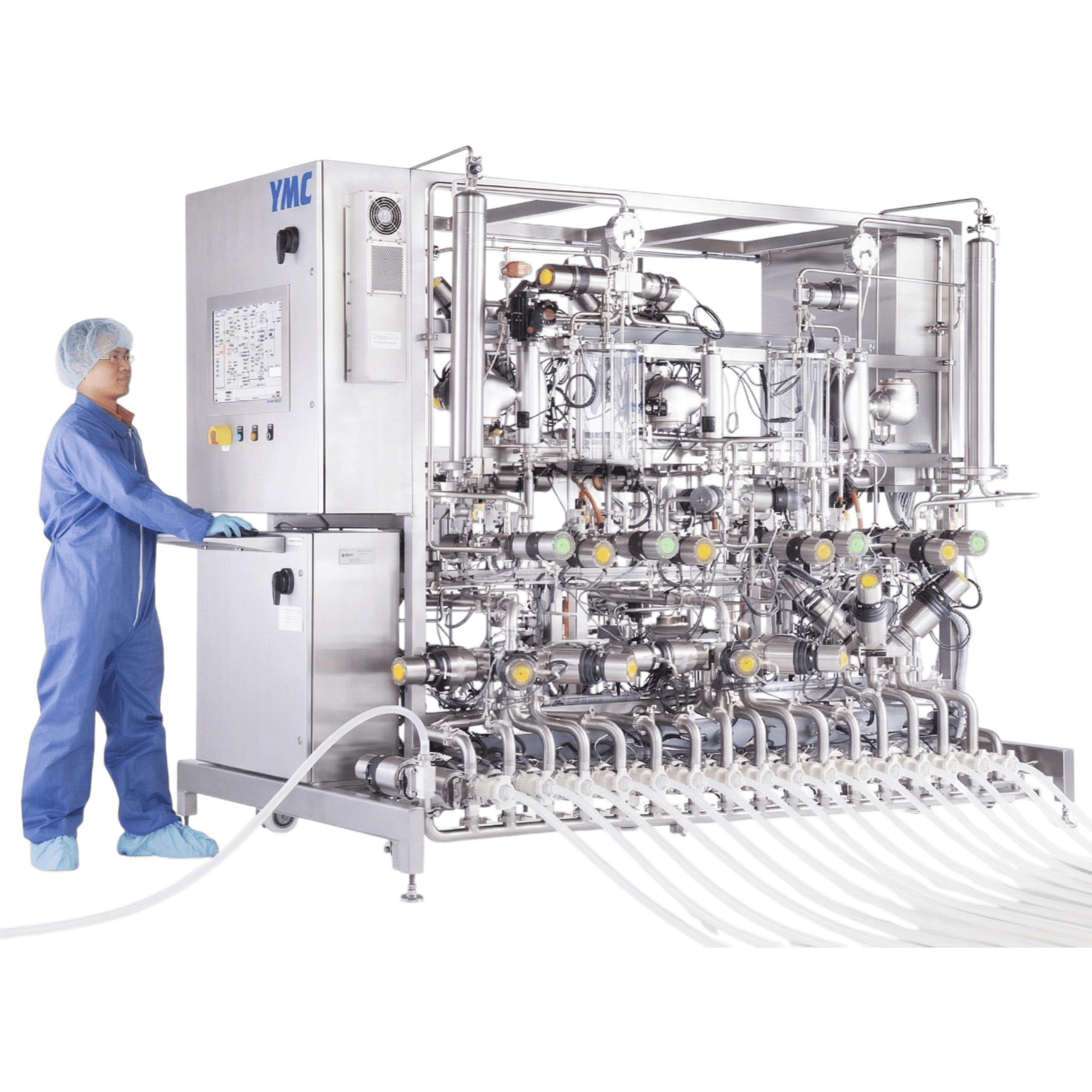
Load to Full Capacity. Continuous capture with twin-column periodic countercurrent chromatography. The simplest PCC configuration on the market. Validated by Bristol Myers Squibb from lab to 100× scale: 2.5× Productivity | 92% Resin utilisation (vs. 67% batch) | 50% less buffer | ≥94% Yield maintained


Source: Angelo et al., BioProcess International 2018; Müller-Späth et al., Biotechnol. Bioeng. 2019 (Bristol Myers Squibb)

The Capture Bottleneck

In batch affinity capture, every loading decision is governed by the same constraint: avoid product break through. The result is a conservative safety margin — columns loaded to 50–70% of their dynamic binding capacity to avoid the risk of any product loss at the column outlet.

That conservative margin is expensive. Protein A resin costs thousands of dollars per liter — up to $16,000/L for premium resins … and other affinity resins are even more expensive. Loading to 60% of capacity means 40% of your resin is idle every cycle. At the same time, the fastest loading flow rates that maximize productivity produce shallow breakthrough curves — which force even more conservative loading margins. The harder you push for throughput, the lower your resin utilization becomes.

For large molecules like monoclonal antibodies and AAV capsids, this tradeoff is especially pronounced. Their low diffusivity means breakthrough curves are inherently shallow at practical flow rates, making high resin utilization and high productivity genuinely incompatible on a single column.

CaptureSMB® Changes the Equation

CaptureSMB® removes the constraint that makes the tradeoff unavoidable. Instead of stopping loading when product starts to break through the upstream column, it lets loading continue — and places a second column immediately downstream to capture whatever breaks through.

The upstream column is loaded beyond its dynamic binding capacity. Product that would be lost in batch is captured on the downstream column. When the upstream column is fully saturated, it is washed and the product is collected. Then columns switch positions: the former downstream column — now preloaded with captured product — becomes the new upstream column, while the former upstream column gets ready to capture the breakthrough from the new upstream column.

2.5×

Productivity increase vs. batch Protein A

92%

Resin utilization vs. 67% batch

50% ↓

Buffer reduction vs. batch process

≥94%

Yield equivalent to batch

BMS-validated at 100× scale — Contichrom® CUBE to TWIN. Angelo et al., BioProcess International, 2018.

Two columns are all it takes. Other periodic counter-current (PCC) systems use three, four, or more columns to achieve high resin utilisation — adding valve complexity, scheduling constraints, and additional method development effort. CaptureSMB demonstrates that a two-column counter-current design delivers the full performance benefit with the simplest possible hardware and the shortest path from batch method to running process.

How CaptureSMB® Works

Each CaptureSMB® cycle consists of two switches, one elution from each column per cycle. Within each switch, three phases run in sequence:

Phase Upstream column Downstream column
Interconnected Loading Feed loaded at high flow rate beyond DBC — breakthrough flows through to downstream column Receives breakthrough from upstream column; product captured (preload)
Interconnected Wash Equilibration buffer flushes the liquid phase from upstream column through to downstream column — remaining product captured Captures product flushed from upstream column void volume
Batch Phase Former downstream column loaded at lower batch flow rate — regenerated column not yet ready Former upstream column: washed, eluted (product collected), CIP, re-equilibrated in parallel

At the end of the batch phase, the columns switch positions by valve — the former downstream column (now preloaded and freshly loaded in batch) becomes the upstream column for the next switch. The cycle repeats indefinitely until the feed is consumed or the process is stopped.

A short Startup phase precedes the cyclic stage: both columns are loaded together to the DBC with columns interconnected, ensuring the downstream column carries a preload equivalent to a steady-state cycle before the first switch. This means cyclic steady state is reached immediately — typically by cycle 2.

The Shutdown stage elutes the former downstream column that was not fully processed in the last batch phase, recovering the remaining product.

The CaptureSMB Process Principle (.pptx)

Method Design with the CaptureSMB® Wizard

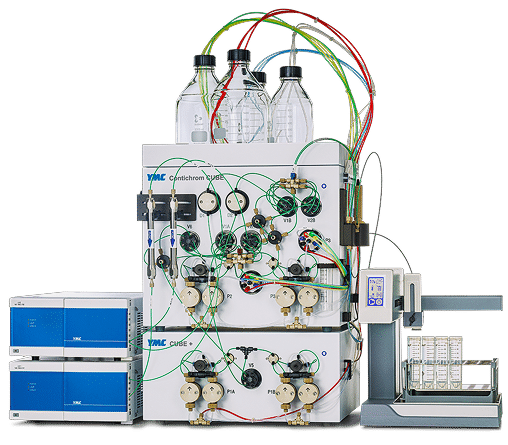
CaptureSMB methods are designed in the CaptureSMB® Wizard in ChromIQ® 9 — a tab-based interface that takes breakthrough curve data from the Contichrom® CUBE and generates a complete, ready-to-run method. The CaptureSMB Wizard starts from breakthrough curve (BTC) data — the measured column outlet concentration as the column is loaded to saturation.

Step 1 — Run a breakthrough curve experiment on the CUBE

Before opening the wizard, run a single-column breakthrough curve experiment on the Contichrom® CUBE at the target residence time. Load the column to at least 70% breakthrough, collecting 10–15 fractions for offline concentration analysis.

The single run data is the main input required – no additional experimental batch runs are needed. The Tutorial tab in the wizard summarises the BTC requirements and recommended residence times for your resin particle size.

Step 2 — Enter column and BTC data in the Loading tab

In the Loading tab, enter feed titer, column dimensions, and loading velocity. Enter the BTC data points (loaded volume in mL vs. breakthrough concentration in g/L) from your offline fraction analysis. Select the appropriate BTC correlation function (e.g., Monoclonal Antibody for Protein A processes) — the wizard fits the curve and displays the estimated static binding capacity and projected capacity utilisation. All subsequent calculations to determine loading parameters and simulate process performance are derived from this fitted curve.

Step 3 — Configure washing, elution, and regeneration

In the Recovery & Regeneration tab, enter the steps for your post-load wash, elution, CIP, and re-equilibration protocol — the same sequence used in your existing batch process. Volume, flow rate, and buffer assignment per pump inlet are set here. The wizard uses these durations to calculate the batch loading flow rate, ensuring the downstream column completes loading within the available regeneration window.

Step 4 — Review performance prediction, activate AutomAb®, and generate

The Method Settings & Performance tab shows predicted process performance before a single CaptureSMB® run: productivity (g/L/h), buffer consumption (L/g), capacity utilisation (%), pool concentration (g/L), cycle time, and switch time. Activate AutomAb® dynamic process control here (see below). Set the number of cycles, then hit Save — the wizard generates Startup, Main, Shutdown, and procedure files, ready to run from the ChromIQ® Procedure tab.

Want to learn CaptureSMB?
Join our Continuous Chromatography Workshop.

AutomAb® — Titer-Adaptive Loading Control for CaptureSMB®

Fixed-time loading works during early process development when conditions are stable and the process is supervised. For manufacturing campaigns — where feed titer varies batch-to-batch and resin capacity declines over hundreds of cycles — AutomAb® is essential.

AutomAb® replaces the fixed-time interconnected loading endpoint with a UV-integrated control decision. During the interconnected loading phase, the sensor between the two columns monitors the UV signal continuously. AutomAb® subtracts the impurity baseline (measured in the previous switch) and integrates the remaining signal over time — building a running preload area value. When the accumulated preload area reaches the target preload area setpoint, ChromIQ® ends the interconnected loading phase and proceeds to the interconnected wash, regardless of how long it took.

High titer this cycle? Breakthrough occurs faster, the setpoint is reached sooner, the switch triggers earlier. Low titer? The switch triggers later. The result is always the same amount of product captured on the downstream column — consistent resin utilization cycle after cycle, regardless of feed variability or column age.

The target preload area is derived directly from a previous CaptureSMB® run using the Evalution center.

See Dynamic Process Control → for the full mechanism and configuration guidance.

Verifying CaptureSMB® Results: The Evaluation Center

Evaluate your CaptureSMB® runs in the Evaluation Center — ChromIQ®’s integrated data analysis module.

  • Cycle Overlay — Superimpose all cycles of a run in one view. Consecutive UV traces converging to identical profiles confirm cyclic steady state — typically reached by cycle 2. Visual confirmation of process consistency before committing to a full campaign
  • Auto Integration — Quantitatively tracks product recovery for each fraction across every switch and cycle. With AutomAb® active, the varying loading duration per cycle is recorded and documentable — quantitative proof the controller is compensating correctly
  • Superimpose — Overlay runs from separate files to compare setpoints, resin lots, or scale-up experiments
  • PDF and Excel export — Per-cycle UV data, integration results, and process parameters compiled into a structured report

The ChromIQ® logbook records every AutomAb® phase switch with the accumulated preload area value that triggered it — an unalterable record of every autonomous loading decision the system made.

CaptureSMB® Advantages at a Glance

Advantage What it means in practice
2.5× productivity increase More product per liter of resin per hour — validated within a 100× scale-up by Bristol Myers Squibb on Protein A capture
92% resin utilisation Near-static binding capacity loading vs. 67% batch — directly reduces resin volume and column size required
50% buffer reduction Smaller columns and higher loading efficiency cut buffer volumes proportionally
≥94% yield maintained No product loss from the additional loading — equivalent to batch yield at dramatically better efficiency
Same resin and buffers All major Protein A resins and your existing wash/elution/regeneration conditions are the starting point
Simplest PCC configuration — two columns CaptureSMB® achieves equivalent or superior performance to more complex 3- or 4-column PCC systems with just two columns. Less hardware means means lower breakdown risk, simpler method development, fewer parameters to optimize, and a faster path from first BTC experiment to running a process
Perfusion-ready Continuous feed input matches perfusion bioreactor output directly — no batch cadence mismatch, however a surge bag is recommended to maintain flexibility.
Direct scale-up path Methods transfer from Contichrom® CUBE directly to the Contichrom® TWIN LPLC Capture production system for biologics — same ChromIQ® method logic

CaptureSMB® Applications

CaptureSMB® is applicable to any affinity capture step where resin cost, productivity, or continuous feed compatibility are factors. It also extends to non-affinity capture and polishing applications with bind-and-elute chemistry.

Molecule class Stationary phase Typical application
Monoclonal antibodies (mAbs) Protein A Continuous capture — BMS-validated at 100× scale
Bispecific antibodies Protein A Continuous capture with titer variability compensation via AutomAb®
Antibody fragments (Fab, scFv) Protein L, Protein G, IMAC Continuous affinity capture with resin utilisation optimisation
Fc-fusion proteins Protein A Continuous capture from high-titre cell culture
Recombinant proteins IMAC, custom affinity resins Continuous affinity capture
AAV gene therapy vectors Non-Protein A affinity resins Continuous capsid capture — particularly valuable for high-cost specialty resins
Non-affinity capture IEX, HIC Bind-and-elute capture and polishing with capacity utilisation improvement

Load More. Waste Less. Run Continuously.

Frequently Asked Questions

Unlock This Resource

Fill in your details to receive the full content straight to your inbox.