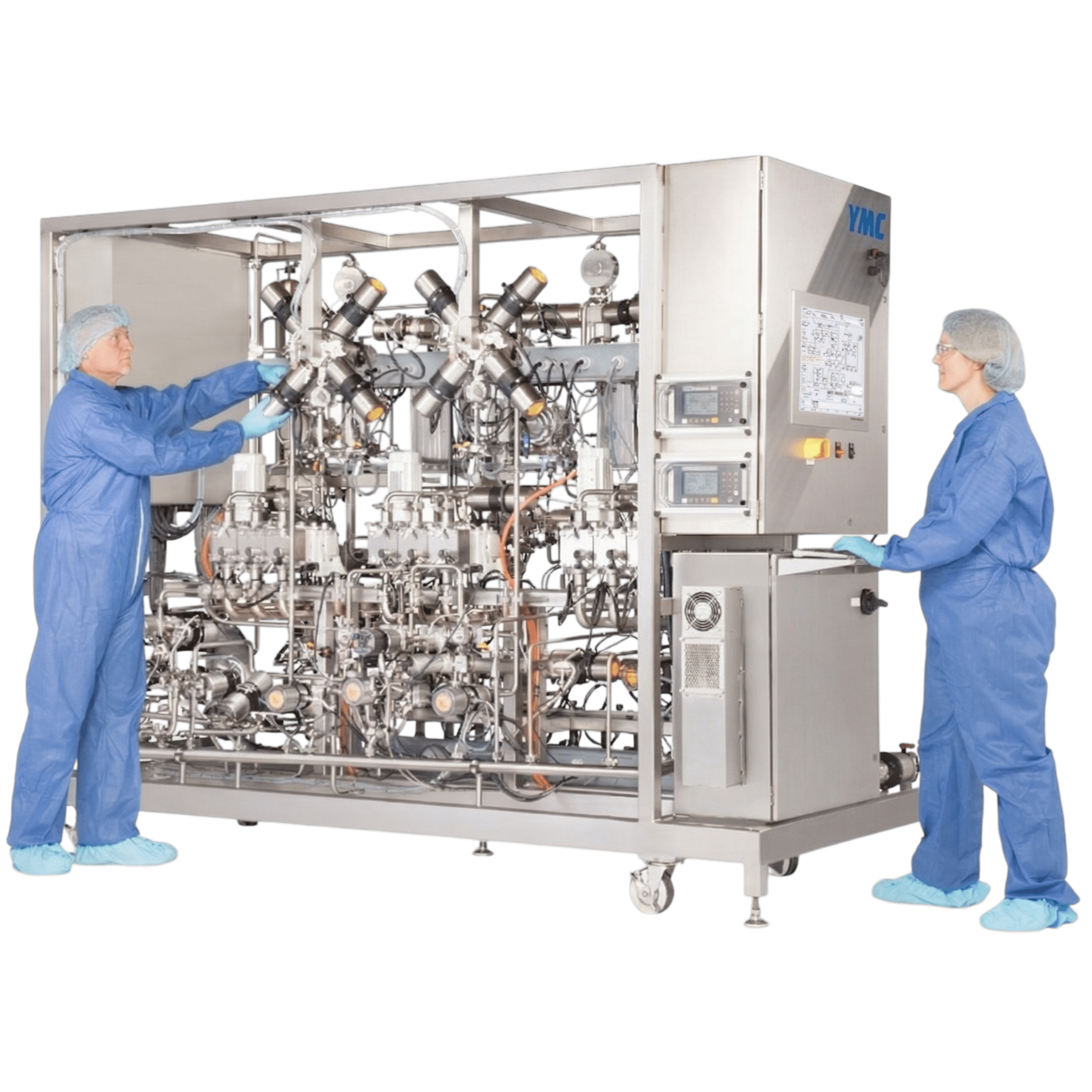


Model based adaptive control of a continuous capture process for monoclonal antibodies production, J. Chromatogr. A
Model-based adaptive control for CaptureSMB automatically adjusts operating conditions in response to feed titer variations.
MONOCLONAL ANTIBODIES
Twin-column Protein A capture for mAb manufacturing. Load Protein A to its true capacity — and keep it there, cycle after cycle. Validated from lab to GMP production scale by Bristol Myers Squibb at 100× scale-up: 2.5× Productivity | 92% Resin utilisation (vs. 67% batch) | 50% less buffer | ≥94% Yield (equivalent to batch)
Source: Angelo et al., BioProcess International 2018; Müller-Späth et al., Biotechnol. Bioeng. 2019 (Bristol Myers Squibb)
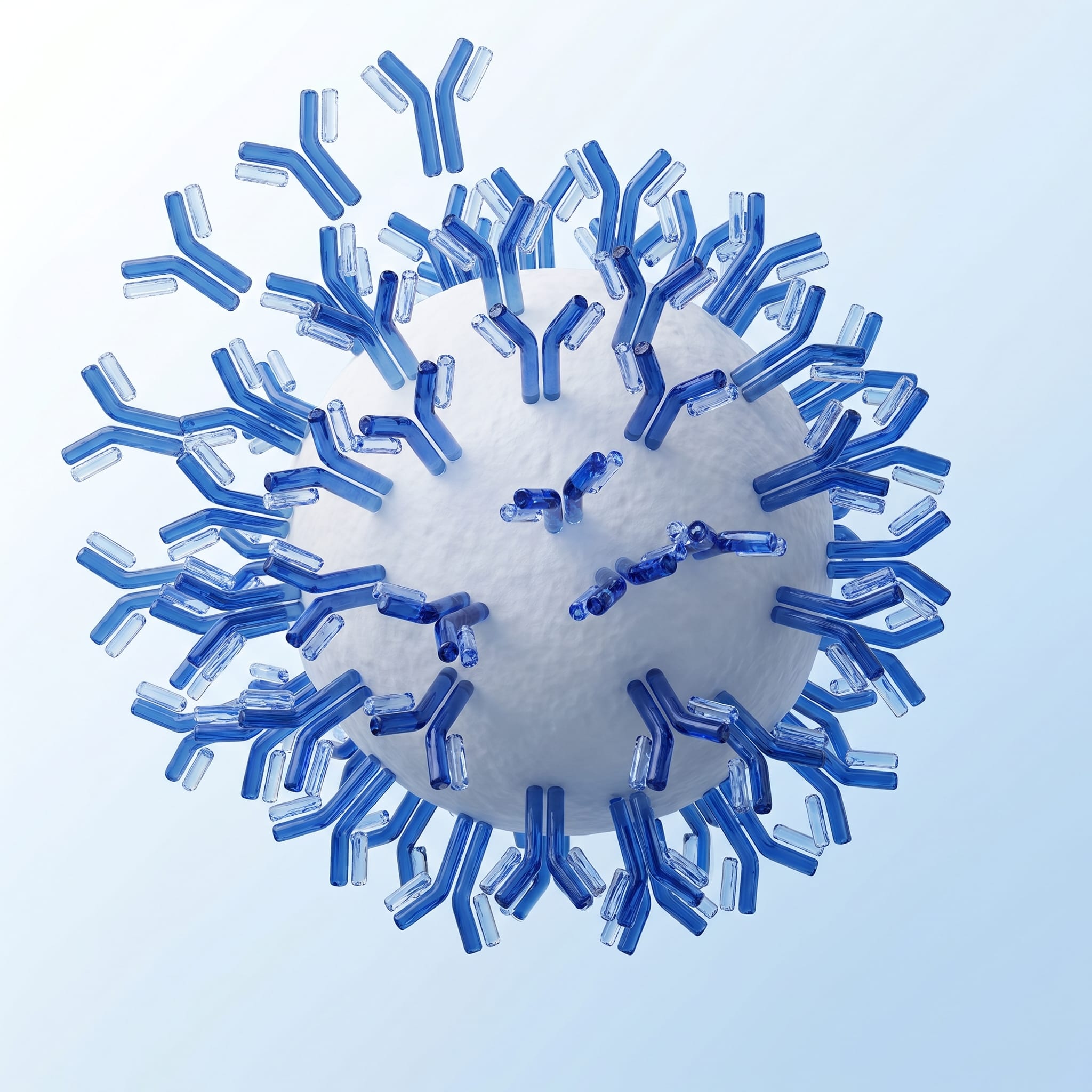
Monoclonal antibodies dominate the biopharmaceutical market — with 100+ approved products, a rapidly growing biosimilar wave, and expanding next-generation formats (bispecifics, ADCs, Fc-fusion proteins). Downstream purification must keep pace.
The Protein A affinity capture step is the cornerstone of mAb downstream processing — but conventional batch chromatography is inherently inefficient. Columns are loaded conservatively to only 50–70% of the resin’s dynamic binding capacity, leaving expensive Protein A resin underutilized. Long sequential cycle times (load → wash → elute → regenerate → re-equilibrate) create idle column time, limiting throughput and inflating facility footprint.
With cell culture titers now routinely exceeding 5–15 g/L and perfusion bioreactors demanding continuous feed processing, the batch capture step is the rate-limiting bottleneck in modern mAb manufacturing.
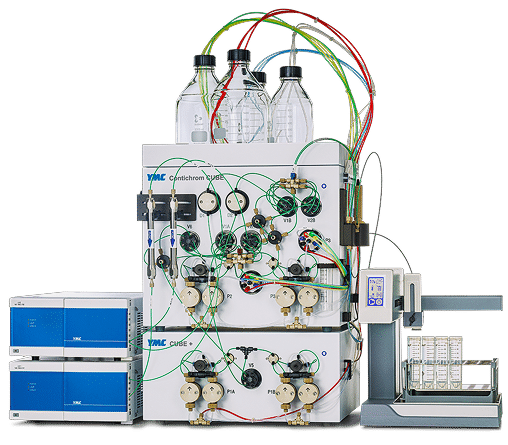
CaptureSMB® is an optimized twin-column periodic countercurrent (PCC) process for continuous Protein A capture of monoclonal antibodies and antibody variants. Two identical columns operate in coordinated interconnected and parallel phases — maximizing resin utilization by safely loading well beyond the breakthrough point, while the second column captures any product that breaks through. The result: 2.5× higher productivity (BMS-demonstrated), 92% resin utilization (vs. 67% batch), and 50% buffer savings compared to batch.
AutomAb® dynamic process control uses in-line UV sensors at each column outlet to monitor the breakthrough curve in real-time, automatically adjusting the interconnected loading duration to compensate for feed titer variability, column aging, and batch-to-batch variation — ensuring robust, unattended 24/7 continuous capture.
Same resin. Same buffers. Superior performance. CaptureSMB works with all major Protein A resins — MabSelect SuRe, MabSelect PrismA, Amsphere, and others — and uses your existing wash, elution, regeneration, and CIP buffers unchanged. Your current batch conditions are the starting point; CaptureSMB® is developed from there. Only two columns required — the simplest PCC configuration available.
Productivity Increase
8.4 → 26.5 g/L/h
Resin Utilization
vs. 67% batch
Buffer Reduction
0.73 → 0.34 L/g
Yield Maintained
Consistent at both scales
Continuous Operation
Perfusion-ready
Scale-Up Validated
CUBE → TWIN (BMS)
| Parameter | Batch Protein A Capture | CaptureSMB® with AutomAb® |
|---|---|---|
| Resin Utilization (DBC) | 67% — conservative loading to avoid breakthrough | 92% — safe overloading with second column capture |
| Productivity | 8.4 g/L/h — limited by sequential cycle times and idle time | 26.5 g/L/h — 2.5× higher, continuous loading eliminates idle time |
| Buffer Consumption | 0.73 L/g — large column volumes drive buffer needs | 0.34 L/g — 50% reduction from smaller columns |
| Product Yield | ≥94% typical | ≥94% — equivalent to batch |
| Product Quality (HCP, Agg, DNA) | HCP 447 ppm, HMW 3.0% | Comparable — HCP 500 ppm, HMW 2.9% |
| Feed Titer Sensitivity | Conservative timing — requires fixed load volumes | AutomAb® dynamically adjusts to titer variability |
| Column Aging | Fixed load parameters, performance degrades over lifetime | AutomAb® compensates for capacity loss in real-time |
| Perfusion Compatibility | Batch cadence mismatched with continuous feed | Ideal — continuous loading matches perfusion output directly |
| Hardware Complexity | Single column, simple | Two columns — simplest PCC configuration |
| Process Control | Manual monitoring or timer-based | Automated UV-based PAT (AutomAb®) |
| Stationary Phase / Buffers | Standard Protein A | Same — no change required |
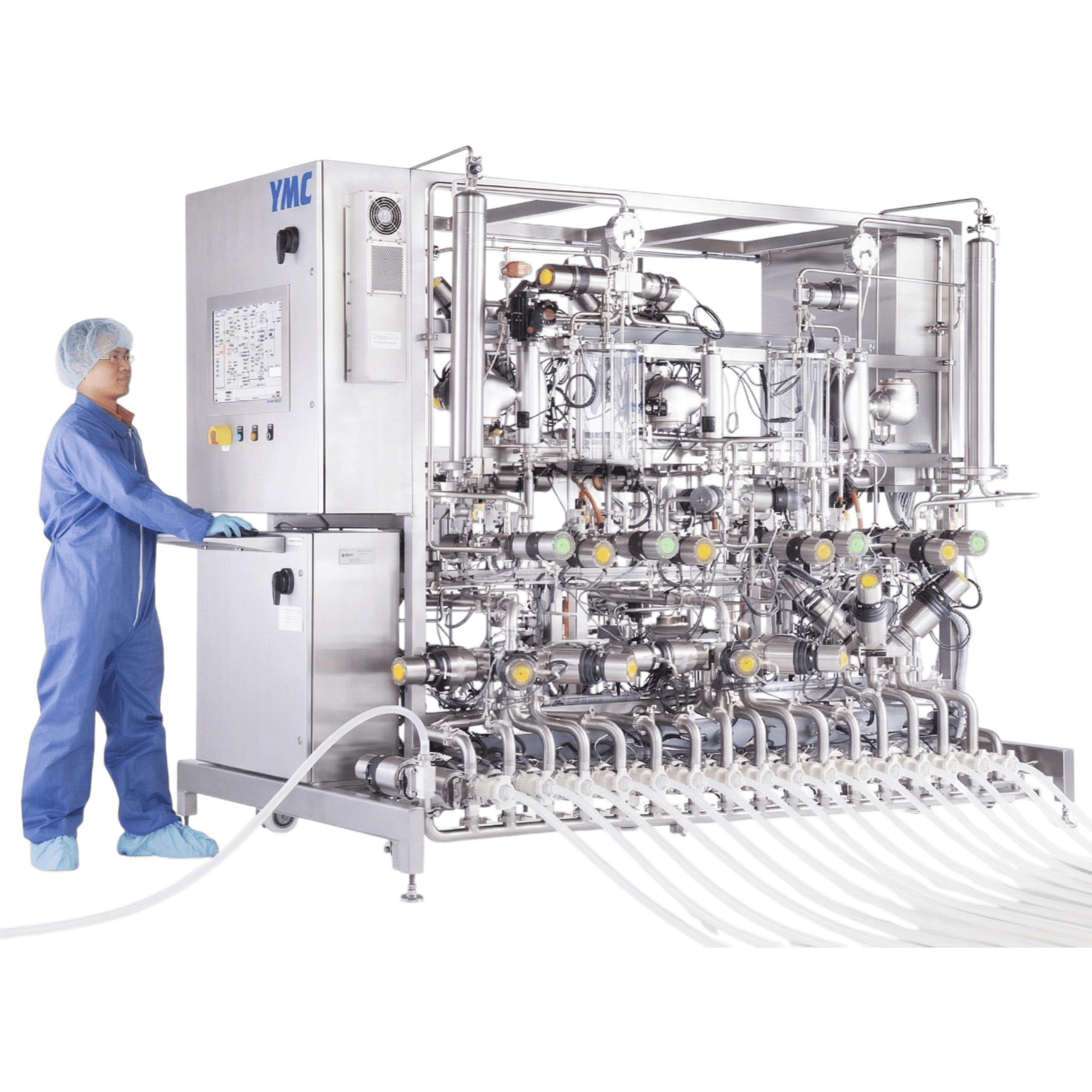
CaptureSMB® delivers 2.5× higher Protein A capture productivity for all IgG subtypes while maintaining ≥94% yield and comparable product quality (HCP, aggregates, DNA). Validated at 100× scale by Bristol Myers Squibb across multiple molecules.
Biosimilar manufacturers face intense cost pressure. CaptureSMB’s 2.5× higher productivity and 50% buffer savings directly lower Cost of Goods — a critical competitive advantage in the biosimilar market where product differentiation occurs through manufacturing efficiency.
Bispecific formats present unique downstream challenges (homodimer removal, charge variants). CaptureSMB® maximizes capture step efficiency, freeing capacity for the more complex polishing steps required. MCSGP continuous polishing on the same Contichrom platform can further resolve closely related bispecific variants.
Antibody fragments can be captured using Protein L, Protein A (for Fc-containing fragments), or custom affinity resins. CaptureSMB® has been demonstrated for F(ab’)₂ fragment capture using Protein L (KappaSelect) in twin-column countercurrent mode (Ulmer et al. 2015), delivering the same productivity and resin utilization gains as for full-length mAbs.
Fc-fusion proteins (e.g., etanercept, abatacept) are captured via Protein A affinity. CaptureSMB® continuous capture applies directly — maximizing resin utilization and throughput for this growing therapeutic class.
CaptureSMB’s continuous loading mode is ideally matched to perfusion bioreactor output. By coupling CaptureSMB® directly to the bioreactor harvest, manufacturers achieve true end-to-end continuous biomanufacturing — reducing facility footprint, eliminating large harvest hold tanks, and shortening manufacturing cadence.
For charge variant, aggregate, or fragment separations that require gradient polishing (CEX, HIC), MCSGP continuous polishing on the same Contichrom platform eliminates the purity-yield trade-off — increasing polishing yield while maintaining target CQA specifications (Müller-Späth et al. 2008, 2010).
Ready to Intensify Your mAb Purification Process?