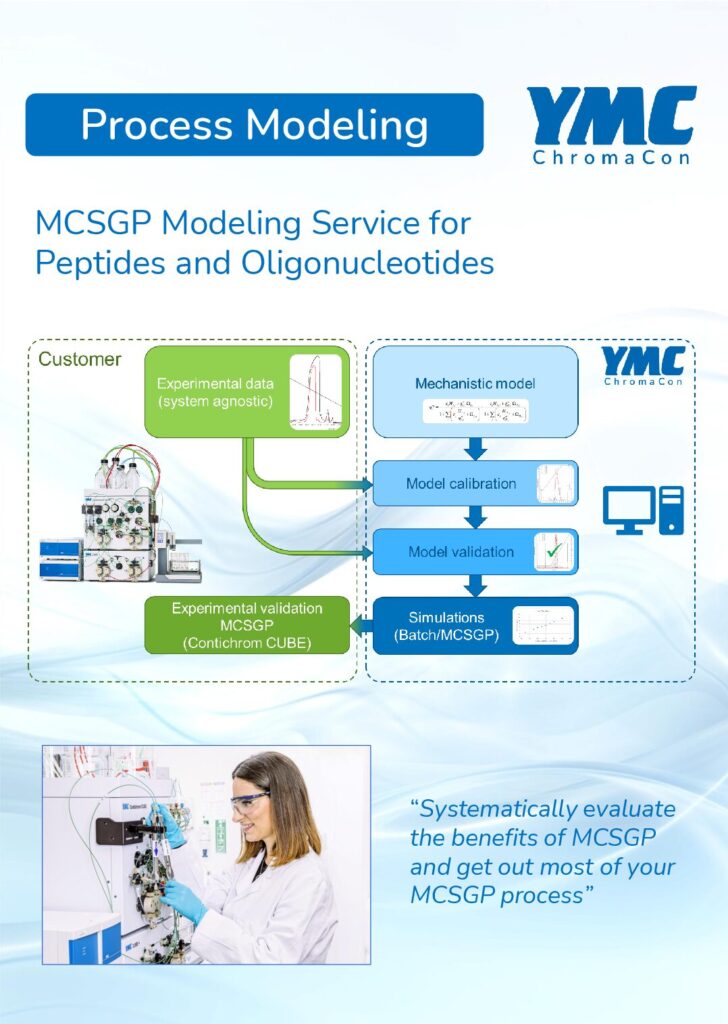
MCSGP Modeling Service for Peptides and Oligonucleotides
ChromaCon’s modeling services support and accelerate MCSGP process design and scale-up of oligo and peptide purifications
PROCESS MODELING
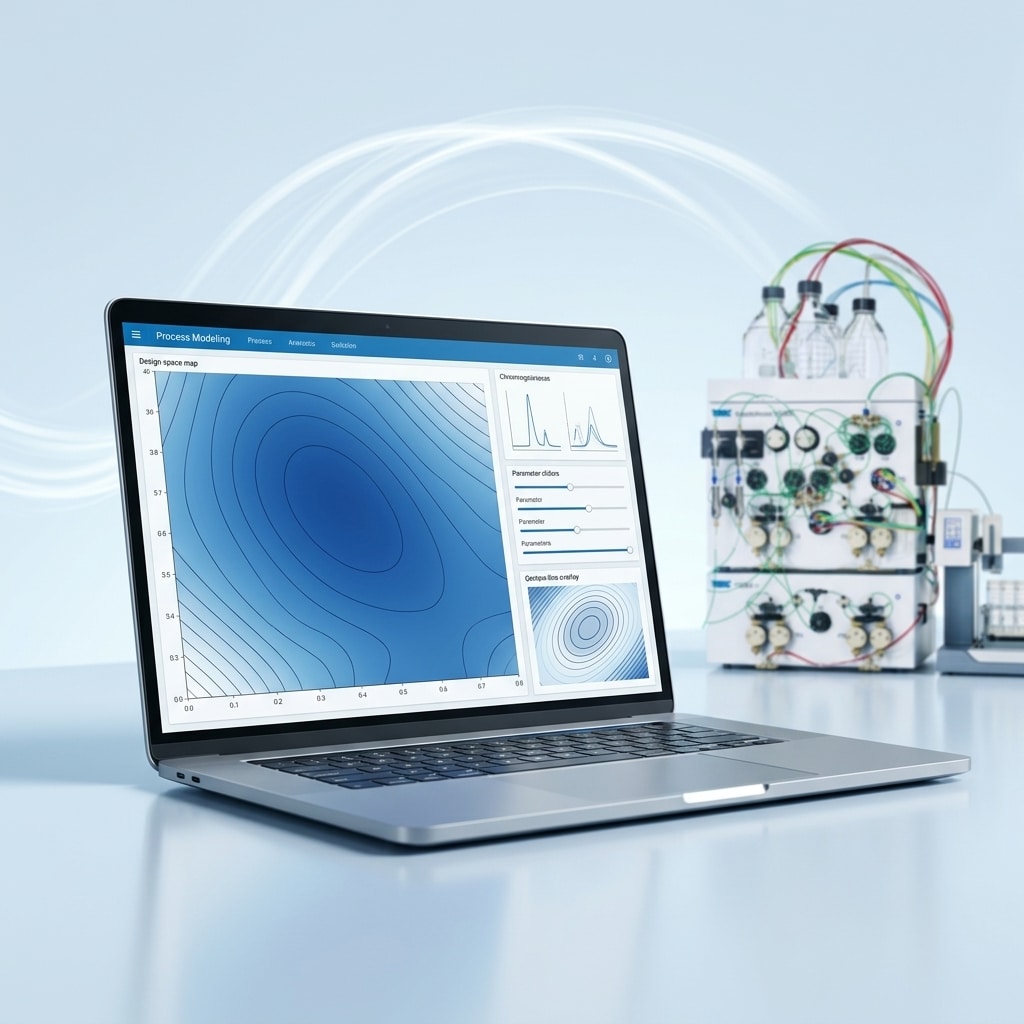
Mechanistic modeling for batch, MCSGP, and CaptureSMB®. Calibrated mechanistic models built from your existing batch chromatography data — used to simulate, optimize, and de-risk processes computationally. Faster development, more robust design space.
Every chromatography development campaign faces the same tradeoff: thoroughness vs. time. Experimentally screening operating conditions, testing robustness, or generating data for regulatory submissions takes column time, material, and analytical effort.
YMC ChromaCon’s process modeling services change the equation. We build calibrated mechanistic models from batch chromatography data you already have — from any HPLC or FPLC system — and use them to simulate process performance across a wide range of conditions. The result is faster process development, better-informed decisions, and stronger regulatory documentation, whether your goal is to optimize a batch process, evaluate MCSGP continuous polishing, or design a CaptureSMB® continuous capture step.
Our process modeling services are available to pharmaceutical and biotechnology companies worldwide.
Save time in process development The model explores parameter space computationally — in hours rather than weeks — reducing the number of experimental runs needed to reach an optimal operating point.
Optimize performance and robustness Identify operating parameters that maximize yield and productivity at your target purity. Then test robustness by simulating realistic parameter variations — so you know how your process behaves before you run it.
Define the design space Map the region of operating parameters where your process meets specification. For continuous processes, evaluate the impact of AutoPeak® or AutomAb® dynamic control on the operating envelope. Directly relevant for regulatory submissions and process characterization.
Support scale-up Use modeling results to generate scale-up parameters and scenarios for transfer from the Contichrom® CUBE to PILOT or TWIN production systems — or between any column dimensions.
A calibrated mechanistic model of your separation, built from gradient batch runs with fraction analysis. The model lets you simulate the effect of operating parameters — gradient slope, load, column dimensions, mobile phase composition — on separation performance without running additional experiments. Use it to optimize your batch process, screen conditions computationally, support scale-up decisions, or build process understanding for regulatory documentation.
Building on a calibrated batch model, we simulate MCSGP performance and compare it to your existing batch polishing process. The service is structured in two stages: a feasibility study (Stage 1) that predicts MCSGP performance and generates scale-up parameters, and an optimization study (Stage 2) that systematically optimizes operating parameters, evaluates robustness, and maps the design space with and without AutoPeak® dynamic control.
Analogous to the MCSGP service, we model your CaptureSMB® capture step using breakthrough curve data and mechanistic modeling. The service predicts continuous capture performance, evaluates the impact of AutomAb® dynamic loading control, and provides optimized operating parameters and scale-up scenarios. Available for affinity and bind-elute capture processes.
Your input is system-agnostic. The experimental data can come from any HPLC or FPLC system — it does not need to be from a Contichrom®.
What we need from you: Batch chromatography data with fraction collection and analytical characterization. For CaptureSMB® modeling, breakthrough curve data is also required. In most cases a small number of well-designed experiments is sufficient — we specify the exact requirements during project scoping.
| Batch Modeling | MCSGP Modeling | CaptureSMB® Modeling | |
|---|---|---|---|
| Purpose | Optimize and understand your batch separation | Evaluate and optimize MCSGP continuous polishing | Evaluate and optimize CaptureSMB® continuous capture |
| Prerequisite | None — standalone | None (batch model is built as part of the service) | None (batch/breakthrough model is built as part of the service) |
| Your input | Gradient batch runs with fraction analysis | Gradient batch runs with fraction analysis | Breakthrough curve data + batch binding data |
| What we model | Effect of gradient, load, column dimensions, mobile phase on separation performance | MCSGP feasibility vs. batch, operating point optimization, robustness, design space (with/without AutoPeak®) | CaptureSMB® feasibility vs. batch capture, loading optimization, robustness, design space (with/without AutomAb®) |
| Key deliverables | Calibrated model, optimized batch parameters, scale-up scenarios | Predicted MCSGP performance, optimized setpoint, AutoPeak® parameters, design space evaluation | Predicted CaptureSMB® performance, optimized setpoint, AutomAb® parameters, scale-up scenarios |
| Typical applications | Any gradient separation — process understanding, scale-up, regulatory support | Peptide polishing (RP), oligonucleotide purification (AEX) | mAb capture (Protein A), recombinant protein capture, bind-elute affinity |
All services can be combined with experimental feasibility studies, training, or consulting.
Each modeling engagement is quoted based on the complexity of the separation and scope of the work. Contact us with your project details and we’ll provide a tailored proposal.
Included in the quoted price: Model building, calibration, validation, all simulations, and a comprehensive results report. For continuous process modeling, this includes support for transferring the simulated operating point to a Contichrom® system.
Not included: Experimental work on your end (batch runs, fraction analysis, breakthrough curves) and any experimental validation runs on YMC ChromaCon systems. If you’d like YMC ChromaCon to perform experimental validation, this can be scoped as a combined modeling + feasibility study engagement.
Ready to Model Your Process?