Optimizing model predictive control of the chromatographic MCSGP process, J. Process Control
Model predictive control strategies for MCSGP optimization enable advanced process control and real-time optimization.
RESOURCE LIBRARY
The evidence behind every Contichrom® process. Download the open-access PPQ paper, browse application notes by molecule, watch on-demand webinars, and access the peer-reviewed publications underpinning MCSGP, CaptureSMB®, and N-Rich® at GMP commercial scale.
The first peer-reviewed PC/PPQ framework for MCSGP. 95% IPC reduction, 73% PMI reduction, 96% gross-to-gross yield — validated at GMP commercial scale on Bachem Bivalirudin.
Eisenhuth, R. & Müller-Späth, T. — Processes, 2025 (Open-Access)
First peer-reviewed AIEX MCSGP for therapeutic siRNA. Yield improved from 80% to 93% on a sugar-conjugated siRNA sense strand — software-aided method development enabled fast batch-to-MCSGP transfer. Throughput increased 87%.
Weldon et al. Org. Process Res. Dev. 2025, (Open-Access)
Proof-of-concept MCSGP for AAV2 polishing. Full capsid content increased from 30% to 68% (ddPCR) after six cycles — with +20.6% yield, +23% productivity, and 27% reduced buffer consumption vs batch AEX. AutoPeak® PAT validated against cryo-TEM and ddPCR.
Müller et al.
Biotechnol. Bioeng. (Open-Access)
Application notes, peer-reviewed papers, process guides, datasheets, and recorded webinars — searchable by application, technology, product, or service.
Model predictive control strategies for MCSGP optimization enable advanced process control and real-time optimization.
MCSGP applications for protein and peptide purification demonstrate the technology’s broad applicability across biomolecule classes.
Investigation of CIP strategies for continuous cation exchange chromatography establishes cleaning protocols for extended MCSGP operations.
MCSGP applied for separation of three mAb charge variants achieves 93% yield at 90% purity compared to 0% yield at equivalent purity in batch mode.
The semicontinuous three-column MCSGP process configuration establishes foundational principles for twin-column continuous chromatography.
Systematic parametric analysis of six-column MCSGP establishes design principles for multi-column continuous chromatography configurations.
A practical primer on chromatography: what it is, how it works, and why it matters. Learn about key separation mechanisms including reversed-phase, ion exchange, size exclusion and affinity chromatography, plus how to read chromatograms and the difference between analytical and preparative methods.
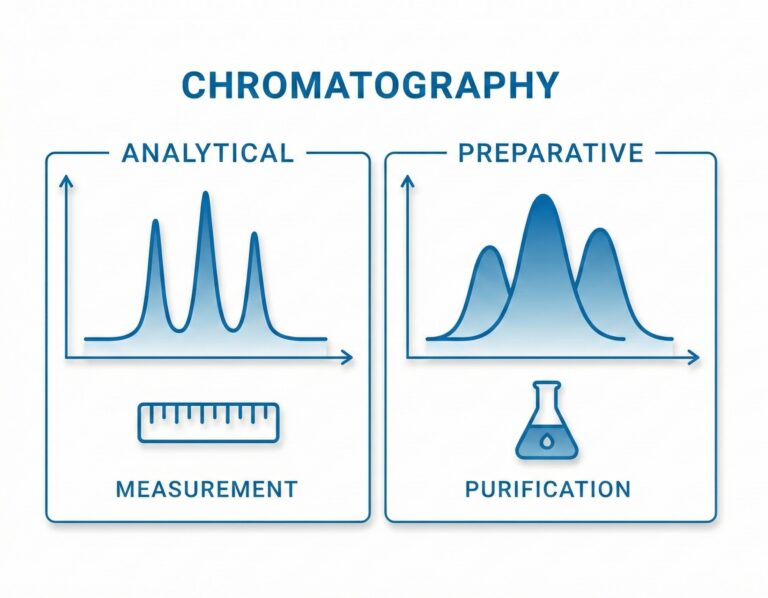
Analytical chromatography produces data; preparative chromatography produces purified material. This guide explains the key differences in goals, scale, column design and optimization strategies, and why every preparative step is a balance of competing goals—purity, yield and throughput.
YMC ChromaCon Chromatography Newsletter.
Subscribe for New Resources Unsubscribe anytime.