A semicontinuous 3-column countercurrent solvent gradient purification (MCSGP) process, Biotechnol. Bioeng.
The semicontinuous three-column MCSGP process configuration establishes foundational principles for twin-column continuous chromatography.
PEPTIDES
Higher yield, less solvent, no re-chromatography — no purity–yield trade-off. MCSGP is the twin-column preparative HPLC process proven at commercial scale by Bachem on Bivalirudin.
Across 4 PPQ runs: 99.2% Purity | −96% In-process controls | Multi-day GMP campaigns | +9% Yield gain
Source: Eisenhuth & Müller-Späth, Processes 2025 (Bachem Bivalirudin PPQ campaign, Open Access)
Peptide demand is surging — driven by GLP-1 agonists, oncology peptides, and a pipeline of 150+ candidates in clinical trials. Purification by reversed-phase HPLC is the critical bottleneck.
Conventional batch chromatography forces a painful trade-off: high purity or high yield — not both. Achieving target purity requires a narrow center-cut, discarding valuable product in side-fractions. Recovering that product means costly re-chromatography — with all the associated solvent consumption, QC testing, and campaign delays.
For high-volume APIs like semaglutide and tirzepatide, this inefficiency is unsustainable.
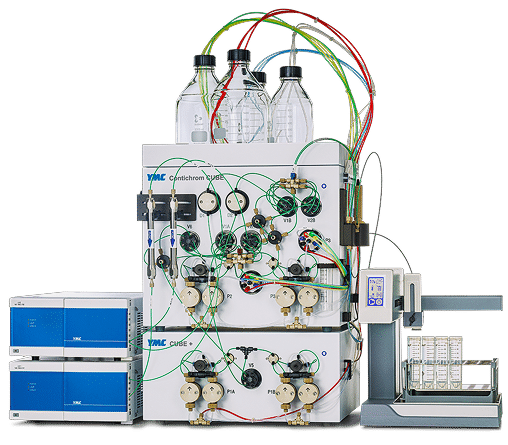
MCSGP (Multi-column Countercurrent Solvent Gradient Purification) eliminates the purity-yield trade-off in peptide chromatography. Two identical columns continuously recycle impure side-fractions — recovering peptide product that batch processes discard. It uses the same RP and IEX resins and solvents as your existing batch peptide method.
AutoPeak® dynamic process control monitors peptide elution profiles in real-time via UV and conductivity, automatically adjusting collection windows to maintain consistent output quality — enabling robust, unattended 24/7 peptide purification.
Same chemistry. Better results. MCSGP works with the RP-C18, C8, C4, IEX, and mixed-mode stationary phases and mobile phases already used in your peptide batch process — your existing resin and solvent conditions are the starting point for MCSGP development. No change to your chromatographic chemistry is needed.
Yield Increase
Solvent Reduction
Campaign Time
Re-chromatography Runs
Fewer IPC Analyses
Lyophilization Volume
| Parameter | Batch Peptide Chromatography | MCSGP with AutoPeak® |
|---|---|---|
| Purity-Yield Trade-off | Inherent — narrow cuts sacrifice yield | Eliminated — high purity AND yield simultaneously |
| Product Yield | 50–80% | 80–99% (+10–50% absolute) |
| Re-chromatography | Required for side-fractions | Eliminated — internal recycling |
| Solvent Consumption | High | Up to 75% reduction |
| IPC/QC Burden | Testing every side-fraction, every batch | 75–95% fewer analyses |
| Campaign Duration | Days per batch | Up to 80% shorter (continuous 24/7) |
| Process Control | Manual monitoring | Automated (AutoPeak® UV-based PAT) |
| Robustness | Sensitive to drift and feed variability | AutoPeak® dynamically compensates |
| Operator Requirement | Requires supervision | Designed for unsupervised operation |
| Sustainability (PMI) | High waste and solvent intensity | Significantly improved PMI |
| Stationary Phase / Eluents | Standard RP / IEX | Same — no change required |
Long-chain peptides (30–39 aa) with complex impurity profiles. MCSGP enables high-yield RP-HPLC purification at the multi-hundred-kg scale demanded by the GLP-1 market — with up to 75% less solvent and proportional upstream synthesis savings.
MCSGP consistently outperforms optimized batch processes for peptides in the 10–30 aa range. Published data on glucagon showed +23% yield at identical purity, with a straightforward one-day method transfer from batch.
Combine orthogonal peptide purification steps in a single automated 2D integrated batch workflow — or run MCSGP on the throughput-limiting step. One Contichrom system replaces multiple standalone batch HPLC units.
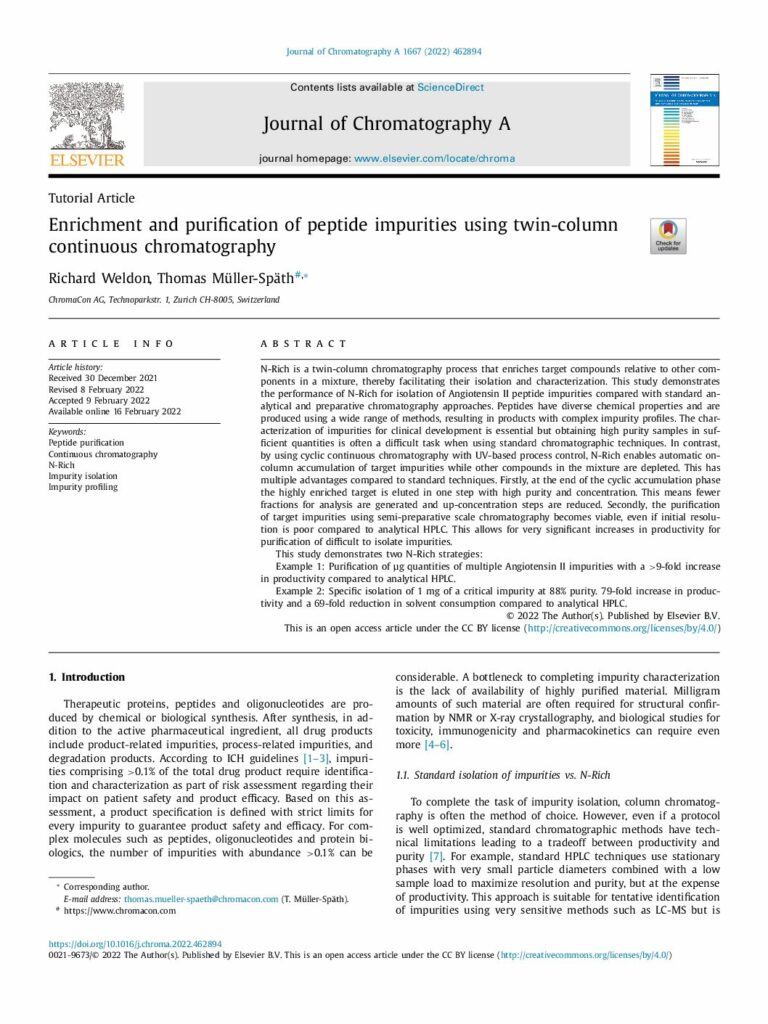
ICH-required peptide impurity characterization typically takes weeks of repetitive analytical runs. N-Rich automated on-column enrichment isolates milligram quantities of target peptide impurities up to 80× faster.
Ready to Upgrade Your Peptide Purification Process?