IOPC 2026 — YMC ChromaCon at the International Oligonucleotides & Peptides Conference, Athens
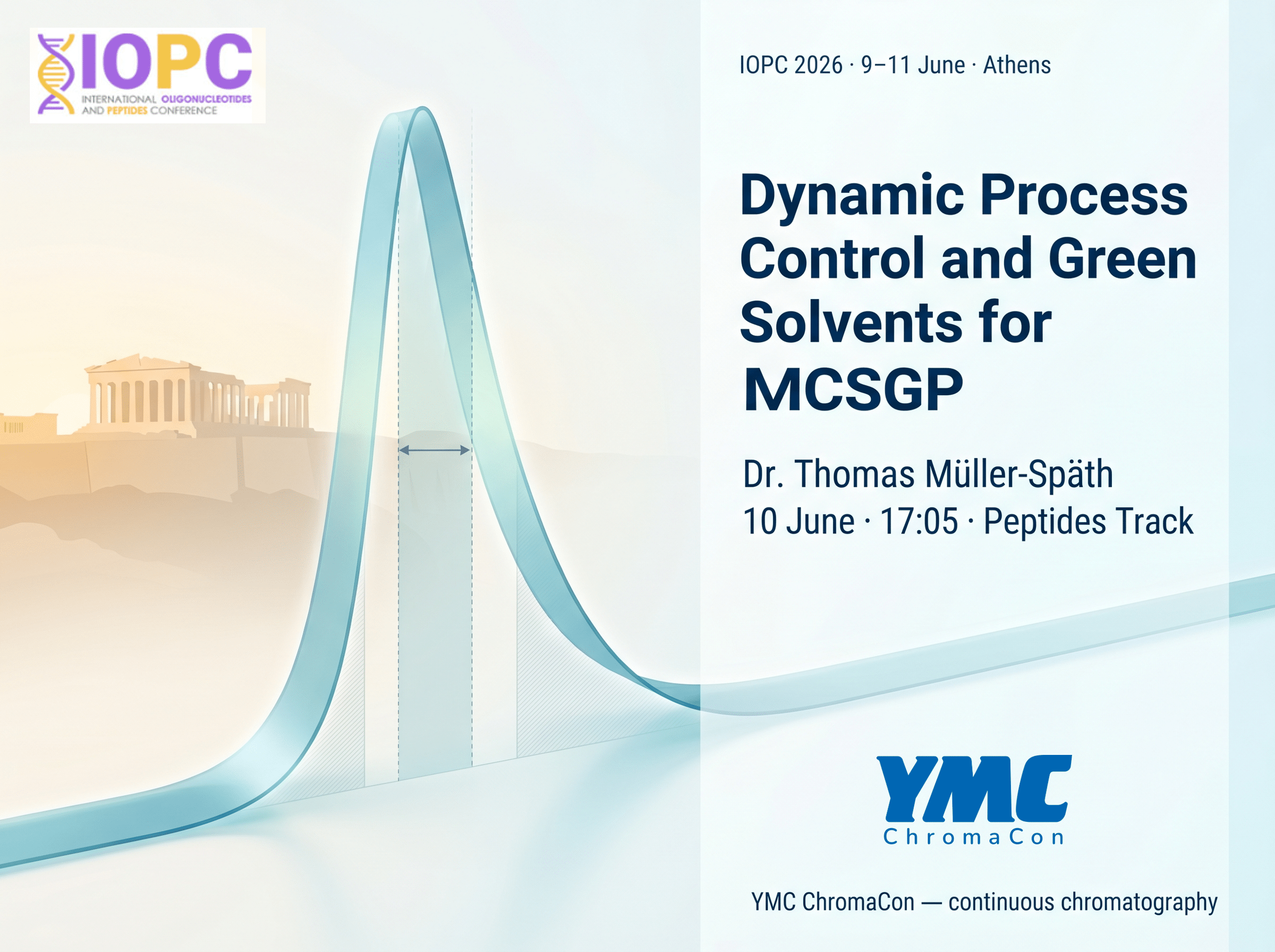
Meet YMC ChromaCon at IOPC 2026 in Athens, 9–11 June. CEO Dr. Thomas Müller-Späth presents new data on AutoPeak® dynamic process control and green solvents for MCSGP — for robust, sustainable, PFAS-free peptide and oligonucleotide manufacturing.
Events
IOPC Conference
09 Jun 2026
The 7th International Oligonucleotides and Peptides Conference. New data on AutoPeak® dynamic process control and green-solvent MCSGP for sustainable peptide and oligonucleotide manufacturing.
Event at a Glance
Event
IOPC 2026 — 7th International Oligonucleotides and Peptides Conference
Dates
9–11 June 2026
Venue
Titania Hotel, Athens, Greece
YMC ChromaCon focus
MCSGP continuous polishing with AutoPeak® dynamic control — for peptides, GLP-1s, and oligonucleotides
Our Talk
Dynamic Process Control and Use of Green Solvents in Continuous Chromatography (MCSGP)
Wednesday, 10 June 2026 — 17:05–17:35 · Peptides track
Dr. Thomas Müller-Späth — CEO and co-founder, ChromaCon AG, a YMC company
MCSGP is increasingly adopted across the pharmaceutical industry for the purification of synthetic peptides and oligonucleotides. In the context of GLP-1 peptide manufacturing in particular, MCSGP addresses the core challenges of scalability, automation, and sustainability — through its process principle of automatic, in-line side-cut recycling.
This presentation covers two developments that decide whether an MCSGP process is genuinely production-ready:
AutoPeak® — UV-based dynamic process control. AutoPeak® is the proprietary closed-loop control technology required to run MCSGP reliably at manufacturing scale. It monitors the elution profile in real time at the column outlet and adjusts product collection windows cycle-by-cycle to compensate for retention time drift, column aging, and starting-material variability. Without AutoPeak®, fixed-time MCSGP cannot deliver consistent purity and yield across hundreds of cycles. The talk covers practical implementation guidance for designing robust, drift-tolerant AutoPeak®-controlled MCSGP processes.
Green solvents for MCSGP. A case study demonstrating MCSGP with green solvents — maintaining the yield and purity that batch chromatography typically forfeits when fluorinated solvents are removed. The findings are directly relevant to the reduction of hazardous waste and the elimination of PFAS (forever chemicals) from peptide and oligonucleotide manufacturing.
Why It Matters
Without AutoPeak®
MCSGP with AutoPeak®
Manufacturing operation
Fixed-time windows; manual intervention as retention times drift
Closed-loop UV-triggered windows; consistent across hundreds of cycles
Response to feed variability
Yield loss or purity excursion
Automatic compensation, cycle-by-cycle
Solvent footprint
High; often PFAS-containing
Up to 75% reduction; PFAS-free solvent systems demonstrated
Regulatory positioning
Manual control burdens validation
AutoPeak® validated as Process Analytical Technology (PAT)
Meet Us in Athens
Dr. Thomas Müller-Späth and the YMC ChromaCon team will be available throughout IOPC 2026 to discuss:
MCSGP for GLP-1 and complex peptide manufacturing — process design and scale-up
AEX MCSGP for synthetic oligonucleotides — ASOs, siRNA, GalNAc conjugates
Green-solvent MCSGP workflows and PFAS-elimination strategies
The Contichrom® CUBE for process development, scale-up to Contichrom® PILOT 300X and Contichrom® TWIN HPLC for GMP manufacturing
Feasibility studies, rental options, and on-site demos at our Zurich facility
About the Speaker
Dr. Thomas Müller-Späth is CEO and co-founder of ChromaCon AG, a YMC company. He has led the development of MCSGP, AutoPeak®, and N-Rich® from research concept to GMP-validated commercial technology, including the first published Process Characterization and Performance Qualification framework for MCSGP (Eisenhuth & Müller-Späth, Processes 2025, with Bachem on the bivalirudin programme).
Frequently Asked Questions
Dr. Thomas Müller-Späth, CEO and co-founder of ChromaCon AG (a YMC company), will present “Dynamic Process Control and Use of Green Solvents in Continuous Chromatography (MCSGP)” on Wednesday 10 June at 17:05 in the peptides track. The talk covers AutoPeak® — our proprietary closed-loop control technology for MCSGP manufacturing — and a case study on green-solvent MCSGP that eliminates PFAS without sacrificing yield or purity.
MCSGP is a cyclic process that runs for hundreds or thousands of switches across a campaign. Retention times drift as columns age, feed varies, and buffer batches change. Fixed-time collection windows cannot accommodate this. AutoPeak® monitors the UV elution profile at the column outlet in real time and adjusts the product collection window cycle-by-cycle, keeping every cycle on target. It is validated as a Process Analytical Technology (PAT) and is what takes MCSGP from development-ready to production-ready.
Many established peptide and oligonucleotide RP-HPLC methods rely on fluorinated additives, including PFAS-class “forever chemicals”. Removing them in a batch process typically costs yield or purity. The case study presented at IOPC shows that with MCSGP and AutoPeak® control, the same separation can be performed with green solvents — without the yield and purity loss that batch chromatography typically forfeits when fluorinated solvents are eliminated. This directly addresses hazardous-waste reduction and PFAS-elimination targets in pharmaceutical manufacturing.
GLP-1 agonists like semaglutide and tirzepatide are long-chain peptides with complex impurity profiles and very high commercial volumes. Batch RP-HPLC forces a purity–yield trade-off and consumes large solvent volumes. MCSGP recycles impure side-fractions internally, recovering peptide product that batch processes discard, with up to 75% less solvent. AutoPeak® keeps the process consistent across long manufacturing campaigns. For GLP-1 manufacturing this addresses scalability, automation, and sustainability simultaneously.
Yes. Bachem has run GMP MCSGP peptide manufacturing since 2022. The first published Process Characterization and Performance Qualification framework for MCSGP — Eisenhuth and Müller-Späth, _Processes_ 13(12):3950 (2025) — was demonstrated on the 20-mer peptide Bivalirudin and showed 62% gross-to-gross yield, greater than 99.0% purity across all PPQ batches, a 95% reduction in in-process controls versus batch, and PMI reduced from approximately 5,200 to 1,400 kg/kg. AutoPeak® was validated as a PAT in the same programme.
Yes. MCSGP runs on the same hardware for both peptides (RP-HPLC mode) and oligonucleotides (AEX or IP-RP mode). It has been applied to antisense oligonucleotides, siRNA, and GalNAc conjugates. Recent published data on a siRNA conjugate (Weldon et al., _Organic Process Research & Development_ 29:1400, 2025) showed a yield increase from 80% to 93% by AEX MCSGP.
Dr. Thomas Müller-Späth and the YMC ChromaCon team will be available throughout the three days in Athens. Use the contact form on this page to request a meeting slot. We can discuss MCSGP for your specific peptide or oligonucleotide programme, green-solvent workflows, feasibility studies at our Zurich facility, Contichrom® CUBE rental, or scale-up to the Contichrom® PILOT 300X and Contichrom® TWIN HPLC.
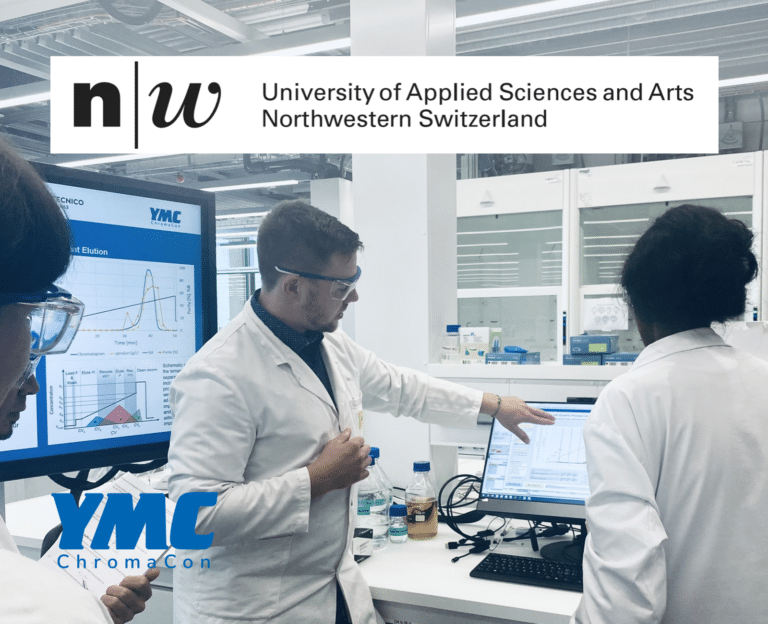
From 7-9 September 2027, the Institute for Pharma Technology at FHNW hosts a 3-day seminar at the Muttenz (Basel) campus in Switzerland. Combining lectures, case studies and hands-on twin-column training, participants gain practical skills in continuous chromatography for mAbs, oligonucleotides, peptides and viral vectors.
YMC ChromaCon's Dr. Thomas Müller-Späth presents "Continuous Chromatography for Biologics" at the IChemE BESIG conference at UCL on 23 June 2026 — capture and polishing case studies across monoclonal antibodies, bispecifics, and ADCs, plus process control and scale-up.
Manage Consent
To provide the best experiences, we use technologies like cookies to store and/or access device information. Consenting to these technologies will allow us to process data such as browsing behavior or unique IDs on this site. Not consenting or withdrawing consent, may adversely affect certain features and functions.
Functional
Always active
The technical storage or access is strictly necessary for the legitimate purpose of enabling the use of a specific service explicitly requested by the subscriber or user, or for the sole purpose of carrying out the transmission of a communication over an electronic communications network.
Preferences
The technical storage or access is necessary for the legitimate purpose of storing preferences that are not requested by the subscriber or user.
Statistics
The technical storage or access that is used exclusively for statistical purposes.The technical storage or access that is used exclusively for anonymous statistical purposes. Without a subpoena, voluntary compliance on the part of your Internet Service Provider, or additional records from a third party, information stored or retrieved for this purpose alone cannot usually be used to identify you.
Marketing
The technical storage or access is required to create user profiles to send advertising, or to track the user on a website or across several websites for similar marketing purposes.