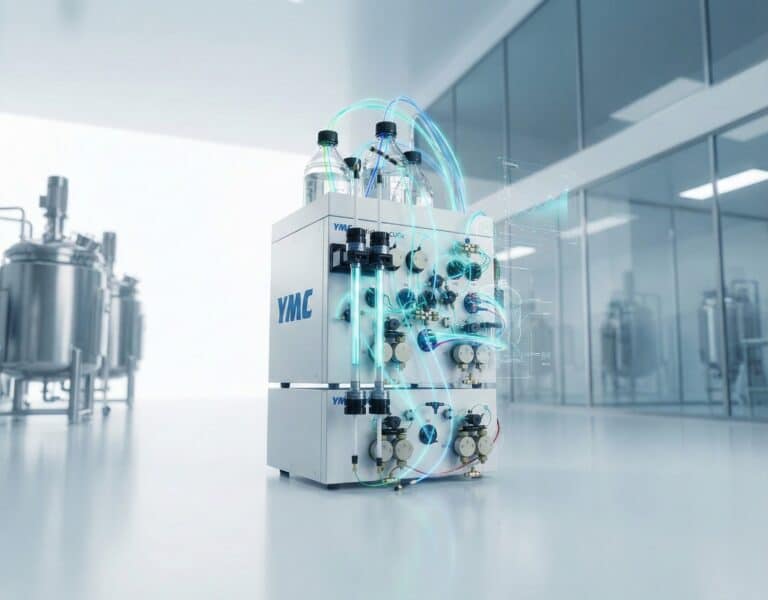
Zürich —February 1st 2024 — YMC ChromaCon celebrates a major industry milestone: Bachem AG has successfully transitioned to large-scale, GMP-compliant purification of peptides and oligonucleotides using Multicolumn Countercurrent Solvent Gradient Purification (MCSGP). This achievement confirms that MCSGP-based continuous chromatography is now a proven production technology for the global TIDES (therapeutic peptides and oligonucleotides) market.
Bachem’s new manufacturing capability enables purification of up to two tons of crude peptides and 500 grams of oligonucleotides per line under GMP conditions, demonstrating that continuous multicolumn chromatography can meet demanding commercial-scale requirements for quality, productivity, and sustainability.
A New Era for Large-Scale Peptide & Oligonucleotide Purification
Purification has long been a bottleneck in TIDES manufacturing. Traditional single-column batch chromatography is often constrained by high solvent consumption, long cycle times, and limited throughput. By implementing MCSGP at industrial scale, Bachem demonstrates that these limitations can be overcome with continuous, digitally controlled processes that deliver high yield and high purity at significantly improved productivity.
This milestone validates MCSGP as a scalable solution for complex synthetic biomolecules, including peptides, oligonucleotides, and other emerging modalities where downstream processing is historically challenging and expensive.
How MCSGP Continuous Chromatography Works
MCSGP (Multicolumn Countercurrent Solvent Gradient Purification) is a continuous multicolumn chromatography process. Instead of running one overloaded column in batch mode and discarding valuable side fractions, MCSGP operates with two or more columns in a countercurrent arrangement and automatically recycles impurity-containing fractions.
In a typical MCSGP configuration:
- The feed is loaded onto one column and separated under a solvent gradient.
- The pure center of the product peak is collected continuously as high-purity product.
- Impurity-containing “side cuts” (shoulders) are not discarded. Instead, they are internally recycled to another column for further separation.
- This internal recycling step recovers additional purified product that would otherwise be lost in batch chromatography.
By eliminating the classic purity–yield–throughput trade-offs of single-column batch chromatography, MCSGP enables manufacturers to meet stringent quality targets while achieving higher productivity and better resource efficiency.
Key Benefits of MCSGP for TIDES Manufacturing
Large-scale implementation of MCSGP delivers a combination of performance, sustainability, and economic benefits that are highly attractive for peptide and oligonucleotide production.
- Higher recovery at target purity – Automated internal recycling of side fractions significantly increases yield compared to conventional batch purification, even at stringent purity specifications.
- Reduced solvent consumption – Continuous multicolumn operation uses solvent more efficiently, directly lowering environmental footprint and operating costs.
- 24/7 continuous operation – MCSGP is designed for steady-state, around-the-clock production, increasing overall throughput and facility utilization.
- Fewer re-chromatography steps – Valuable material is recovered in-line through recycling, minimizing repetitive batch processing and shortening overall cycle times.
- Simplified analytical burden – Only the combined product pool typically requires release testing, reducing analytical workload compared to multi-step batch campaigns.
Why the Bachem Milestone Matters
The successful deployment of GMP-compliant industrial MCSGP capacity at Bachem is a pivotal moment for the broader TIDES ecosystem.
- Meeting surging TIDES demand – As peptide and oligonucleotide therapeutics move from pipelines to commercial products, scalable downstream processing becomes critical. MCSGP offers a robust answer to this demand.
- Transforming production economics – By increasing yield and productivity and decreasing solvent usage and cycle times, MCSGP can substantially reduce cost of goods for complex molecules.
- Supporting sustainability goals – Lower solvent consumption and reduced waste streams align with environmental objectives increasingly prioritized by regulators, manufacturers, and patients.
- Demonstrating GMP readiness – Large-scale, GMP-compliant operation confirms that MCSGP is no longer a laboratory concept, but a mature technology for routine commercial manufacturing.
YMC ChromaCon’s Role in Pioneering MCSGP Technology
YMC ChromaCon is one of the originators of modern MCSGP technology. Building on our founding roots with ChromaCon AG and our long-standing focus on continuous chromatography, we have helped shape MCSGP from early development through to industrial implementation.
Today, YMC Chromacon continues to support biopharmaceutical companies, CDMOs, and manufacturers worldwide in adopting and optimizing continuous chromatography. The success at Bachem validates not only the technical maturity of MCSGP, but also the strategic value of continuous purification as a core platform for future TIDES manufacturing.
Looking Ahead: Scaling Continuous Purification Across Modalities
The industrial roll-out of MCSGP for peptides and oligonucleotides is an important step, but it is only the beginning. Continuous multicolumn chromatography offers significant potential for a wide range of complex synthetic biomolecules and emerging modalities.
- Scaling capacity to support increasing volumes of commercial TIDES products.
- Adapting MCSGP and related continuous capture technologies for new molecule classes.
- Integrating MCSGP with upstream and downstream continuous processing steps to enable end-to-end continuous manufacturing.
- Further optimizing process design, automation, and digital control for smart, data-driven purification.
YMC Chromacon remains committed to collaborating with partners across the value chain to accelerate adoption of MCSGP and continuous chromatography, helping bring important therapeutics to patients more efficiently and sustainably.
About YMC ChromaCon
YMC ChromaCon is a life science tools company located in Zurich, Switzerland, providing best-in-class chromatography process solutions to the pharmaceutical and biopharmaceutical industry. The company has developed and patented novel process principles, process control and simulation software, equipment designs and operating software for batch, cyclic and continuous chromatography.
These process solutions deliver significant CAPEX and OPEX savings while enabling scalable chromatographic solutions for large-scale purification applications. YMC ChromaCon’s Contichrom® laboratory-scale equipment is co-marketed worldwide by YMC ChromaCon and its partners. YMC ChromaCon has provided global licenses for its process technologies to YMC America for implementation into scale-up systems.
YMC ChromaCon Contact
Dr. Thomas Müller-Späth, CEO
www.chromacon.com