FEASIBILITY STUDIES
See the Improvement Before You Commit — Chromatography Feasibility Studies
CaptureSMB® and MCSGP feasibility studies.
A 4–6 week, molecule-specific benchmark against your existing batch process — on your resin, with your feed, under your conditions. You receive quantified productivity, yield, buffer consumption, and IPC reduction data — not assumptions.


Hard Data on Your Molecule
You know your batch chromatography process works. The question is whether continuous chromatography can make it work significantly better — higher productivity, better resin utilization, lower buffer consumption — without compromising yield or product quality.
A YMC ChromaCon feasibility study answers that question with hard data. We take your existing method, reproduce it on our Contichrom® platform to establish a fair benchmark, and then run the equivalent process in continuous mode. You receive a side-by-side comparison with real performance metrics from your molecule, on your resin, under your conditions.
Feasibility studies are available for two continuous chromatography technologies, each addressing a different part of the downstream process:
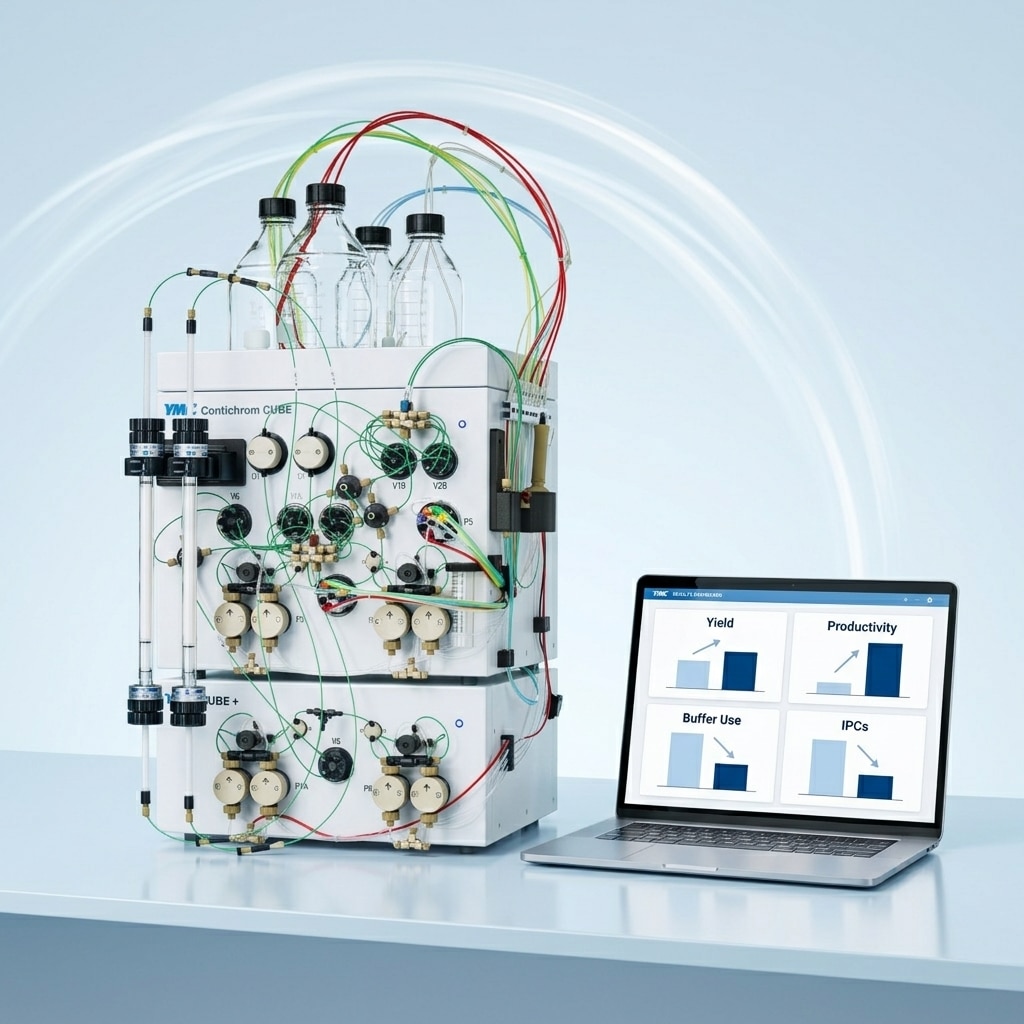
CaptureSMB® — Continuous Capture
Twin-column periodic counter-current (PCC) chromatography for affinity and bind-elute capture steps. CaptureSMB® maximises resin utilisation by loading one column while the other is being washed, eluted, and regenerated — with product breakthrough from the first column captured on the second.
Best suited for:
Protein A capture of monoclonal antibodies, affinity chromatography for hormones and recombinant proteins, and other bind-elute steps where resin cost or throughput is a bottleneck.
MCSGP — Continuous Polishing
Multicolumn counter-current solvent gradient purification for difficult separations where batch chromatography faces a tradeoff between yield and purity. MCSGP recycles impure side fractions automatically, achieving high purity and high yield simultaneously.
Best suited for:
Charge variant and isoform fractionation (IEX), oligonucleotide purification (AEX), small-molecule and peptide polishing (RP), and any gradient-based separation where the product peak overlaps with closely eluting impurities.
A Structured, Low-Risk Evaluation
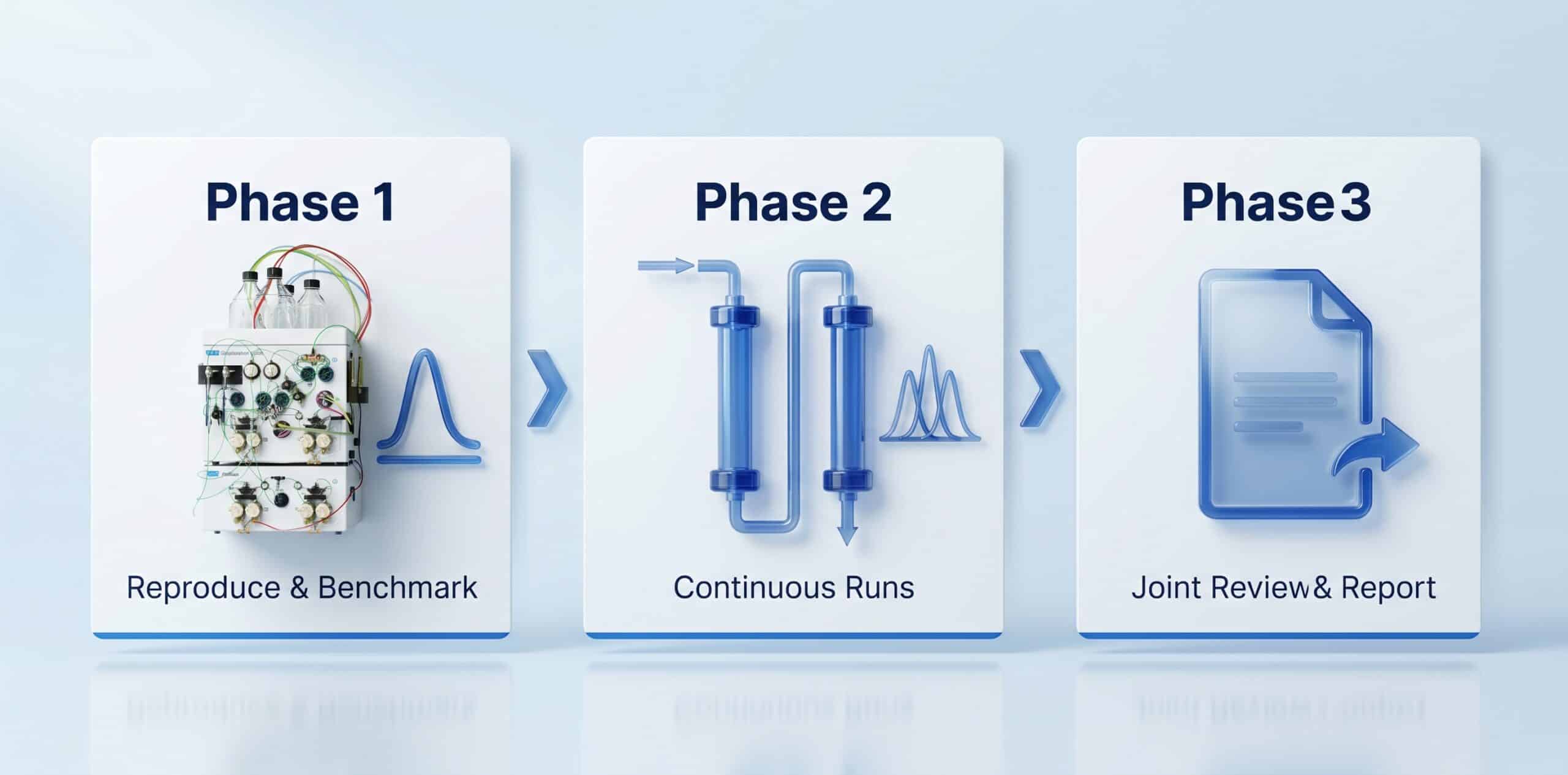
Phase 1 — Reproduce & Benchmark
We reproduce your analytical HPLC method and your preparative batch chromatography process on our equipment, using your starting material and resin. This establishes a like-for-like benchmark so that any comparison with continuous mode is scientifically fair.
Phase 2 — Continuous Chromatography Runs
We design and execute at least 3 continuous chromatography runs (CaptureSMB® or MCSGP) targeting improved performance versus the batch benchmark. All fractions are analysed and, where required, shipped to you for independent characterisation.
Phase 3 — Joint Review & Report
You receive a comprehensive report comparing batch and continuous performance across all key metrics. We review the data together and discuss recommendations — including scale-up scenarios if the results support it.
Typical timeline:
4–6 weeks after receipt of starting material and purchase order, depending on the complexity of the separation and the number of work packages.
Project Deliverables
| Deliverable | Description |
|---|---|
| Batch benchmark data | Your existing method reproduced at YMC ChromaCon — chromatograms, yield, purity, productivity |
| Continuous process data | ≥ 3 CaptureSMB® or MCSGP runs with optimised operating parameters |
| Side-by-side comparison | Productivity (g/L/day), yield (%), resin utilisation (%), buffer consumption (L/g), product concentration |
| Purified samples | Fractions from continuous runs shipped to you for independent quality assessment |
| Scale-up assessment | Estimation of process performance at production scale based on study parameters |
| Final report | Comprehensive PowerPoint with all experimental data, methods, chromatograms, and recommendations |

CaptureSMB® — Typical Results
CaptureSMB® delivers its biggest gains through dramatically higher resin utilization and throughput. Because the twin-column design loads one column past the point where a batch process must stop, far more of the resin’s binding capacity is used in every cycle.
| Metric | Batch (reference) | CaptureSMB | Typical improvement |
|---|---|---|---|
| Productivity | 15–21 g/L resin/day | 37–62 g/L resin/day | 2–3× higher |
| Resin utilization | 55–65% | 90–96% | +30–35 percentage points |
| Buffer consumption | 15–19 L/g product | 6–7 L/g product | 55–60% reduction |
| Yield | > 95% | > 95% | Maintained |
| Product concentration | 1.5–2.0 g/L | 2.5–3.0 g/L | Higher elution pool concentration |
CaptureSMB® is particularly impactful when resin cost is high (e.g. custom affinity ligands) or when column throughput limits overall plant output.

MCSGP — Typical Results
MCSGP delivers its biggest gains by breaking the yield-purity tradeoff inherent in batch gradient chromatography. Where a batch process must choose a narrow collection window (sacrificing yield for purity, or vice versa), MCSGP recycles the impure edges of the product peak and reprocesses them automatically.
| Metric | Batch (reference) | MCSGP | Typical improvement |
|---|---|---|---|
| Yield at target purity | 50–70% (purity-limited) | 90–99% | +25–40 percentage points |
| Purity at target yield | 70–85% (yield-limited) | > 90–95% | +10–20 percentage points |
| Productivity | Baseline | 1.5–3× higher | Depends on batch collection strategy |
| Eluent consumption | Baseline | 30–50% reduction | Less reprocessing of side fractions |
| Pooling complexity | Multiple runs pooled manually | Continuous steady-state output | Simplified downstream handling |
MCSGP is most impactful when your batch process suffers from a significant yield loss to meet purity specifications, or when you are reprocessing side fractions through additional batch runs.

Transparent, Fixed-Price Studies
Each feasibility study is quoted as a fixed price covering all experimental labour, equipment time, analytical HPLC, reporting, and project management.
Typical study pricing: This is negotiated based upon on the number of work packages, the complexity of the separation, and the analytical scope. Multi-phase studies with an initial benchmarking work package followed by continuous process optimization are priced higher than short, simple packages.
Contichrom® system discount: If, based on the study results, you decide to purchase a Contichrom® system within a pre-agreed time period, a discount on the system price applies. This is offered as a separate agreement and carries no obligation — the feasibility study stands on its own.
YMC ChromaCon uses best efforts to achieve agreed performance targets. Due to the inherent uncertainty of process development, specific outcomes cannot be guaranteed. We are fully transparent about what is achievable at every stage.

Study Requirements & Next Steps
Ready to Evaluate Continuous Chromatography?