Continuous Chromatography Workshop 2027 for mAbs, Peptides and Oligonucleotides

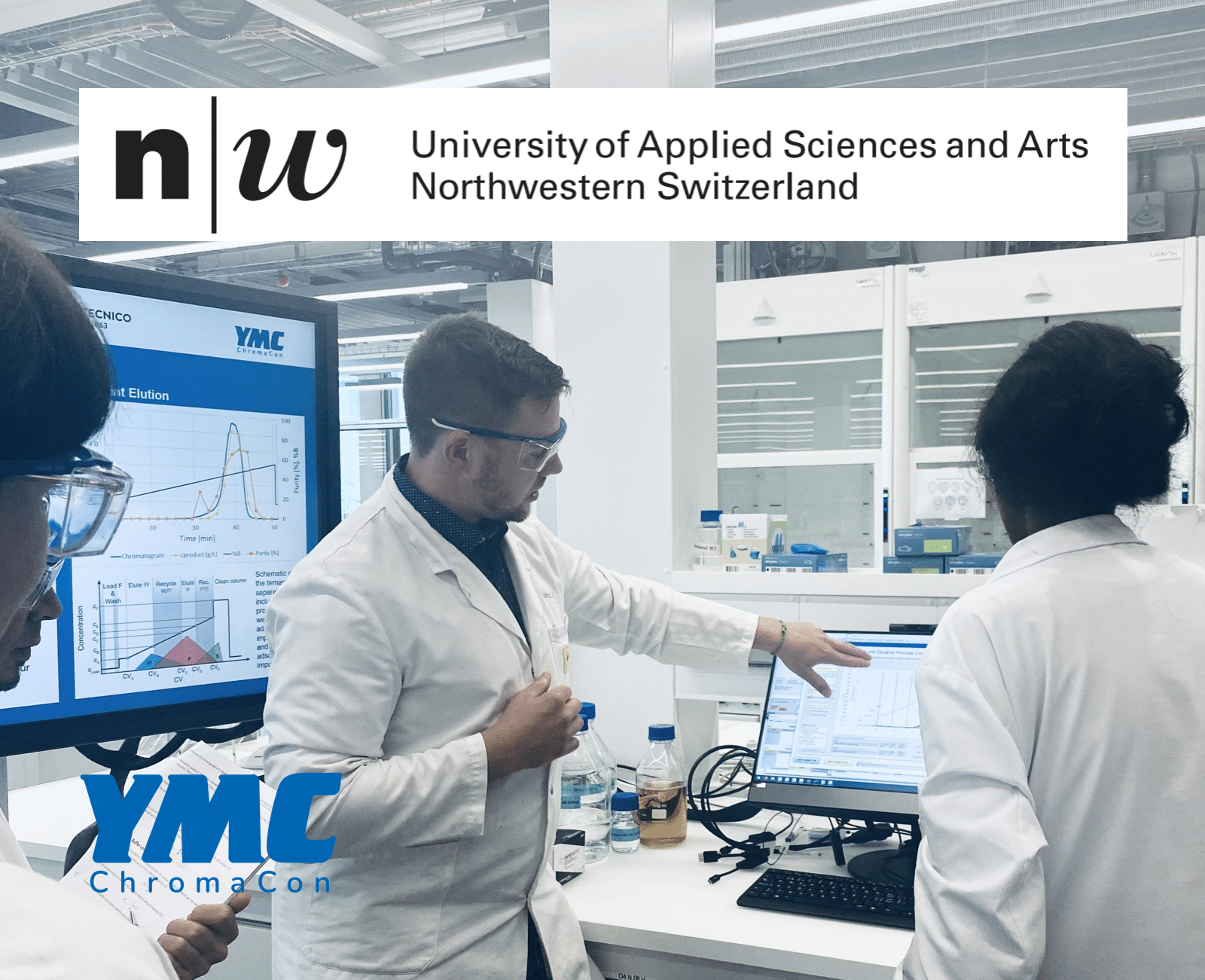
From 7 to 9 September 2027, the FHNW School of Life Sciences hosts a three-day, hands-on seminar on continuous chromatography at its Muttenz campus near Basel, Switzerland. You learn the principles from leading experts in the field and apply them straight away on Contichrom® CUBE twin-column systems, for capture and polishing of mAbs, peptides, oligonucleotides and viral vectors.

Key facts

DatesTuesday 7 – Thursday 9 September 2027 (3 days)
LocationFHNW Campus Muttenz, Hofackerstrasse 30, 4132 Muttenz (near Basel), Switzerland
OrganizerFHNW School of Life Sciences
FormatOn site: lectures, lab sessions and group work
LanguageEnglish
Course feeCHF 3,000
Application deadline31 July 2027
CertificateConfirmation of participation
Course directorProf. Dr. Thomas Villiger, FHNW

What you will learn

Continuous twin-column processes such as CaptureSMB® and MCSGP raise productivity and resin utilisation and cut buffer and solvent use compared with single-column batch chromatography. This seminar shows you how, and when, to use them. By the end of the three days you will be able to:

  • explain the fundamentals of large-molecule chromatography
  • design, run and optimise multi-column chromatography processes
  • evaluate process performance and plan the scale-up
  • apply what you learned straight away, through practical lab training

Hands-on training on Contichrom® CUBE

Every day pairs lectures with lab sessions. Working in small groups on Contichrom® CUBE twin-column systems, you will:

  • run batch and CaptureSMB® affinity capture side by side
  • develop a linear-gradient polishing method and run it as MCSGP with AutoPeak® dynamic process control
  • compare batch and continuous runs on productivity, yield, resin use and buffer consumption
  • present your group’s capture and polishing results and discuss them with the lecturers

Programme

Each day combines theory, lab work and expert-guided analysis. The topics below follow the 2026 programme; the detailed 2027 timetable will be published on the FHNW course page.

DayThemeTopics
Tue 7 SepProduction of BiotherapeuticsProduction of biotherapeutics; fundamentals of large-molecule chromatography; continuous countercurrent chromatography for affinity capture; performance evaluation. Lab: batch capture and CaptureSMB®. Evening: welcome reception.
Wed 8 SepHands-on ChromatographyBind-and-elute (polishing) chromatography. Lab: linear gradient chromatography and MCSGP with AutoPeak®. Evaluation of batch vs CaptureSMB®; group presentations. Evening: social programme and dinner.
Thu 9 SepWorkshop and Wrap-upModelling and simulation; MCSGP evaluation and group presentations; scale-up of continuous chromatography; N-Rich® for isolation of impurities; course review. Optional guided lab tour.

Course leaders

Learn from experts with academic and industrial backgrounds, supported in the lab by experienced supervisors and tutors.

  • Massimo Morbidelli, Ph.D. – Professor of Chemical Reaction and Separation Technologies, Department of Chemistry, Politecnico di Milano
  • Thomas Müller-Späth, Ph.D. – CEO, YMC ChromaCon, Zurich

What past participants say

“The continuous chromatography seminar had an excellent balance of theoretical content and laboratory based exercises. It was great to explore the significant gains observed in productivity, buffer consumption and resin utilization over batch chromatography.” – Theresa Ahern, PhD, Eli Lilly (Ireland)

“Great to learn all the potential and applications of the different ways of using continuous chromatography and learn that this is not just a smart way of working in research, but that it can be implemented in large scale production.” – Mercedes Ferreras, PhD, Novo Nordisk (Denmark)

Who should attend

The seminar is designed for separation scientists and process development engineers from industry and academia who already have some experience with single-column chromatography. It suits you if you work in:

  • downstream process development for biologics, peptides or oligonucleotides
  • chromatography method development and purification
  • scale-up and manufacturing
  • academic research moving from batch to continuous processing

How to register

Apply by 31 July 2027 on the FHNW website. Places are limited to keep the lab groups small.

Questions about the course or registration: Prof. Dr. Thomas Villiger, FHNW – , +41 61 228 52 46

Questions about the technology or Contichrom® systems: YMC ChromaCon –

Read up before the course

Questions about the course?

Frequently Asked Questions About the Continuous Chromatography Course

YMC ChromaCon at the BESIG Novel Technologies in Bioprocessing Conference — UCL, London, 23 June

A one-day IChemE BESIG conference on the newest developments in bioprocessing tools and strategies. Our CEO presents continuous chromatography for biologics — capture and polishing for monoclonal antibodies, bispecifics, and ADCs.

Event at a Glance

EventBESIG Novel Technologies in Bioprocessing Conference (IChemE Biochemical Engineering Special Interest Group)
DateTuesday, 23 June 2026 (one-day conference)
VenueUniversity College London (UCL), London, United Kingdom
YMC ChromaCon focusContinuous chromatography for biologics — CaptureSMB® capture and MCSGP polishing for mAbs, bispecifics, and ADCs

Our Talk

Continuous Chromatography for Biologics

Tuesday, 23 June 2026 · UCL, London

Dr. Thomas Müller-Späth — CEO and co-founder, ChromaCon AG, a YMC company

Continuous chromatography offers tremendous improvements in throughput and cost for the downstream processing of biologics. This presentation introduces the core principles of continuous chromatography, then works through case studies across monoclonal antibodies, bispecific antibodies, and antibody-drug conjugates (ADCs). It also covers the two factors that determine whether a continuous process is genuinely production-ready: dynamic process control and scale-up.

The talk addresses, in turn:

  • Continuous capture for monoclonal antibodies. CaptureSMB® twin-column periodic countercurrent capture loads Protein A resin safely beyond breakthrough, delivering 2.5× higher productivity, 92% resin utilisation, and 50% buffer savings versus batch — validated from lab to GMP scale by Bristol Myers Squibb. AutomAb® dynamic control adjusts loading duration in real time to compensate for feed titer variability and column aging.
  • Polishing for bispecifics and ADCs. MCSGP continuous polishing eliminates the purity-yield trade-off of batch chromatography by internally recycling impure side-fractions. For bispecific charge-variant profiles and high-value ADC payloads, AutoPeak® dynamic control keeps the product collection window precisely on target across long campaigns.
  • Process control and scale-up. AutomAb® and AutoPeak® — our proprietary UV-based dynamic control technologies — are what take a continuous process from development-ready to production-ready, and are validated as Process Analytical Technology (PAT). Methods transfer directly from the Contichrom® CUBE to GMP manufacturing on the Contichrom® TWIN.

Case Studies at a Glance

Antibody formatContinuous chromatography approachWhat it delivers
Monoclonal antibodiesContinuous Protein A capture with CaptureSMB® and AutomAb® dynamic control2.5× higher productivity, 92% resin utilisation, 50% less buffer — validated lab-to-GMP by Bristol Myers Squibb
Bispecific antibodiesMCSGP continuous polishing with AutoPeak® dynamic controlResolves complex charge-variant profiles with tight, UV-tracked collection windows
ADCsMCSGP continuous polishing of payloads and conjugatesRecovers high-value product that batch polishing discards; reduces in-process controls and PMI

Meet Us at UCL

Dr. Thomas Müller-Späth and the YMC ChromaCon team will be available during the conference to discuss:

  • Continuous Protein A capture (CaptureSMB®) for mAbs, bispecifics, Fc-fusion proteins, and antibody fragments
  • Continuous polishing (MCSGP) for charge variants, aggregates, and ADC payloads
  • Dynamic process control with AutomAb® and AutoPeak® — validated as PAT
  • Process development on the Contichrom® CUBE and scale-up to GMP manufacturing on the Contichrom® TWIN
  • Integration of continuous capture with perfusion bioreactors for end-to-end continuous biomanufacturing
  • Feasibility studies, rental options, and on-site demos at our Zurich facility

About the Speaker

Dr. Thomas Müller-Späth is CEO and co-founder of ChromaCon AG, a YMC company, and an expert in downstream processing and continuous bioprocessing technologies, with extensive experience in chromatography process development, scale-up, and manufacturing for biologics. He has led the development of CaptureSMB®, MCSGP, AutomAb®, AutoPeak®, and N-Rich® from research concept to GMP-validated commercial technology.

Frequently Asked Questions

IOPC 2026 — YMC ChromaCon at the International Oligonucleotides & Peptides Conference, Athens

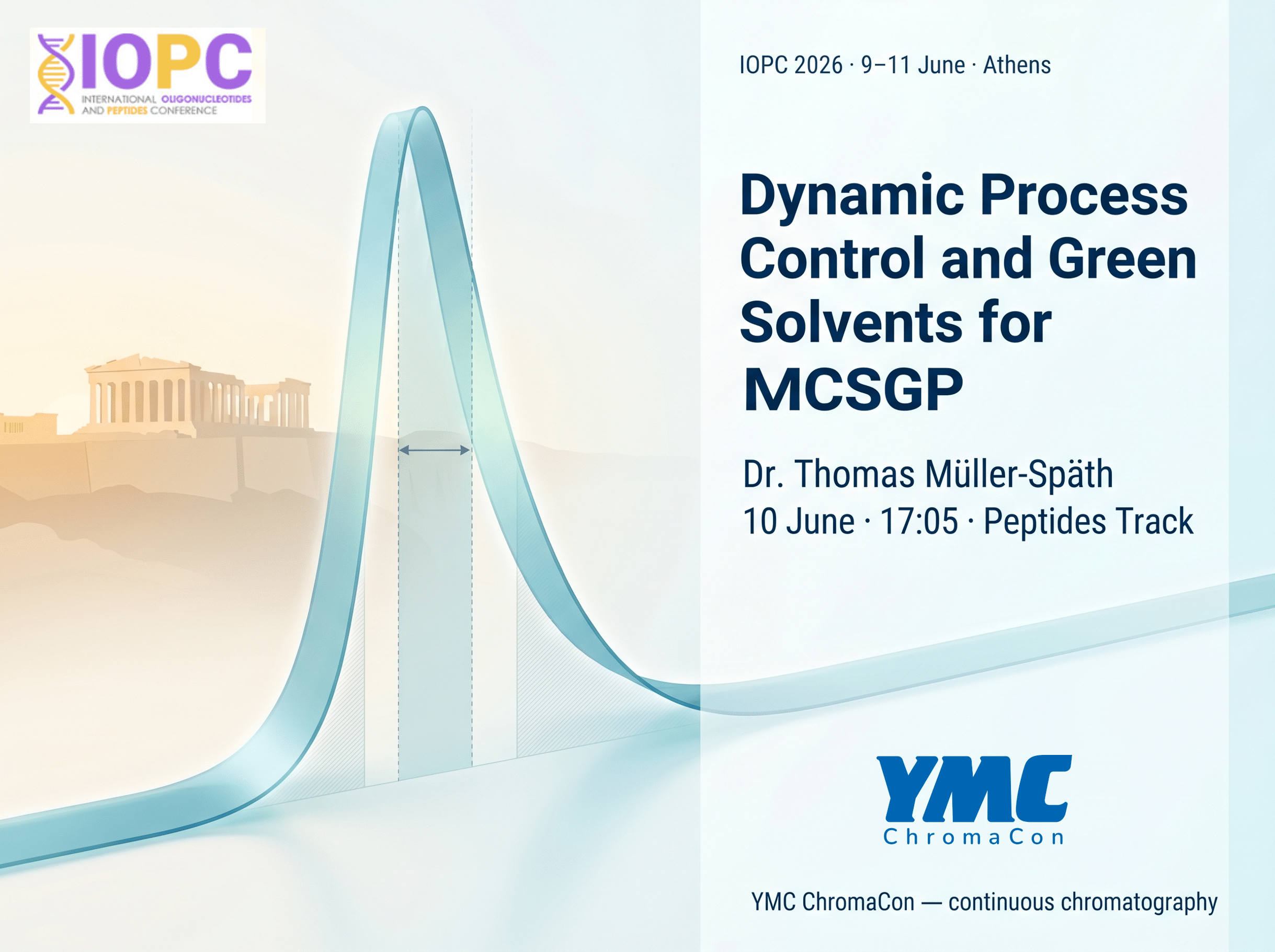
YMC ChromaCon at IOPC 2026 Athens — Dynamic Process Control and Green Solvents for MCSGP

The 7th International Oligonucleotides and Peptides Conference. New data on AutoPeak® dynamic process control and green-solvent MCSGP for sustainable peptide and oligonucleotide manufacturing.

Event at a Glance

EventIOPC 2026 — 7th International Oligonucleotides and Peptides Conference
Dates9–11 June 2026
VenueTitania Hotel, Athens, Greece
YMC ChromaCon focusMCSGP continuous polishing with AutoPeak® dynamic control — for peptides, GLP-1s, and oligonucleotides

Our Talk

Dynamic Process Control and Use of Green Solvents in Continuous Chromatography (MCSGP)

Wednesday, 10 June 2026 — 17:05–17:35 · Peptides track

Dr. Thomas Müller-Späth — CEO and co-founder, ChromaCon AG, a YMC company

MCSGP is increasingly adopted across the pharmaceutical industry for the purification of synthetic peptides and oligonucleotides. In the context of GLP-1 peptide manufacturing in particular, MCSGP addresses the core challenges of scalability, automation, and sustainability — through its process principle of automatic, in-line side-cut recycling.

This presentation covers two developments that decide whether an MCSGP process is genuinely production-ready:

  • AutoPeak® — UV-based dynamic process control. AutoPeak® is the proprietary closed-loop control technology required to run MCSGP reliably at manufacturing scale. It monitors the elution profile in real time at the column outlet and adjusts product collection windows cycle-by-cycle to compensate for retention time drift, column aging, and starting-material variability. Without AutoPeak®, fixed-time MCSGP cannot deliver consistent purity and yield across hundreds of cycles. The talk covers practical implementation guidance for designing robust, drift-tolerant AutoPeak®-controlled MCSGP processes.
  • Green solvents for MCSGP. A case study demonstrating MCSGP with green solvents — maintaining the yield and purity that batch chromatography typically forfeits when fluorinated solvents are removed. The findings are directly relevant to the reduction of hazardous waste and the elimination of PFAS (forever chemicals) from peptide and oligonucleotide manufacturing.

Why It Matters

 Without AutoPeak®MCSGP with AutoPeak®
Manufacturing operationFixed-time windows; manual intervention as retention times driftClosed-loop UV-triggered windows; consistent across hundreds of cycles
Response to feed variabilityYield loss or purity excursionAutomatic compensation, cycle-by-cycle
Solvent footprintHigh; often PFAS-containingUp to 75% reduction; PFAS-free solvent systems demonstrated
Regulatory positioningManual control burdens validationAutoPeak® validated as Process Analytical Technology (PAT)

Meet Us in Athens

Dr. Thomas Müller-Späth and the YMC ChromaCon team will be available throughout IOPC 2026 to discuss:

  • MCSGP for GLP-1 and complex peptide manufacturing — process design and scale-up
  • AEX MCSGP for synthetic oligonucleotides — ASOs, siRNA, GalNAc conjugates
  • Green-solvent MCSGP workflows and PFAS-elimination strategies
  • The Contichrom® CUBE for process development, scale-up to Contichrom® PILOT 300X and Contichrom® TWIN HPLC for GMP manufacturing
  • Feasibility studies, rental options, and on-site demos at our Zurich facility

About the Speaker

Dr. Thomas Müller-Späth is CEO and co-founder of ChromaCon AG, a YMC company. He has led the development of MCSGP, AutoPeak®, and N-Rich® from research concept to GMP-validated commercial technology, including the first published Process Characterization and Performance Qualification framework for MCSGP (Eisenhuth & Müller-Späth, Processes 2025, with Bachem on the bivalirudin programme).

Frequently Asked Questions